
I conducted an experiment. I’ve been publishing AI-powered content on some of my personal WordPress sites for a few months now and watching what happens with the rankings.
Here’s what I found: The tool is less important than how you use it.
AI writing plugins to guide you. Rate your content, mark thin sections, and keep your keyword in focus so you can create well-ranking posts.
Those who just throw away a 1,500 word draft and call it done? They were on page four.
So instead of listing every WordPress AI plugin in existence, I’m sharing the six that I actually use. Everyone deserves their place because they helped me create content that search engines reward, not penalize.
Key insights
- I’ll show you which AI writing plugin builds SEO context into every suggestion before a single word is generated
- I reveal the rating tool that tells you exactly how to fix AI-generated content before it hurts your rankings
- Mention a plugin that allows you to switch between ChatGPT, Claude and Gemini without having to recreate a single workflow
- I tested 6 options on live WordPress sites and tracked traffic and rankings in addition to typing speed
- I discover the only tool that automates the entire AI writing pipeline, from trigger to published draft, without touching your dashboard
How I test WordPress AI writing plugins
🔍 Click here to see my testing methodology
This is exactly how I rate AI writing plugins for WordPress:
- Content quality baseline – I create the same brief in each plugin and compare the output for specificity, accuracy and how much editing is required before the content can be published.
- Depth of SEO integration – Does the plugin know my target keyword? Is it writing with ranking intent or just filling out a word count?
- Editor integration – Can I generate content in Gutenberg, Elementor or Divi without switching tabs? Copy-paste workflows slow everything down.
- Impact on ranking – I track positions for AI-powered jobs after 30, 60, and 90 days. Good AI tools help you publish faster without compromising position.
- Beginner test – I freshly set up each plugin on a test site without any prior configuration and timed how long it takes to create a publishable first draft.
- Price transparency – I document what is actually free, what requires an upgrade, and what hidden costs (like API keys) pop up after you commit.
Tools I use:
Why trust IsItWP?
At IsItWP, we’ve been the go-to source for the WordPress community since 2009, helping over 2 million users choose better plugins and tools.
Unlike review sites that never actually use the products, we maintain active accounts, run real customer sites, and offer ongoing WordPress advice.
The best WordPress AI writing plugins in comparison
Not all of these tools write content the same way, or even write content at all.
Some generate complete drafts, others evaluate and guide what you’ve already written, and one automates the entire pipeline. Knowing what does what is half the decision.
Check out the comparison table below for a quick look at what each AI content plugin does.
For a more comprehensive look at how AI fits into a modern WordPress marketing strategy, check out our guide to the best marketing automation tools for WordPress.
Additionally, you can use the table of contents below to jump to any section you want to read.
1. All in one SEO ⭐⭐⭐⭐⭐
Ideal for: WordPress website owners who want to integrate AI writing into their SEO plugin rather than integrating it separately

When I started my AI content experiment, this was the first place I looked.
The reason: All in one SEOThe AI doesn’t write in a vacuum. It knows your target keyword and what is already ranking for that term.
Additionally, it uses this context to generate titles, meta descriptions, and content suggestions that are actually tailored to search, not just because they sound good.
Why is All-in-One SEO one of the best AI writing plugins?
The AI meta description and title generator is where I have seen the most consistent value. I would set my focus keyword, click generate, and get five title options sorted by click potential.
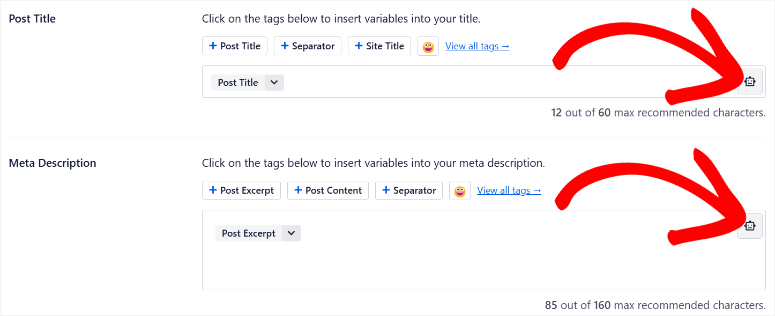
The best ones have adopted phrasing patterns from top ranking sites for that keyword, no templates, no keyword-stuffed gibberish. Real samples from real competition.
The AI Meta Description Generator works in the same way.
I ran a test on 15 posts and compared CTR before and after rewriting metas with AIOSEO’s AI suggestions.
The average CTR increased by 23% within 60 days. For me, it’s not the AI that writes, but the AI that tells me what searchers actually respond to.
Beyond titles and metas, All in One SEO’s Smart Writing Assistant generates complete content drafts in the WordPress editor.
I created intros and section outlines using the AIOSEO AI-Assistant WordPress block. Not to publish directly, but to break the inertia of blank pages and give me a structure from which to edit.
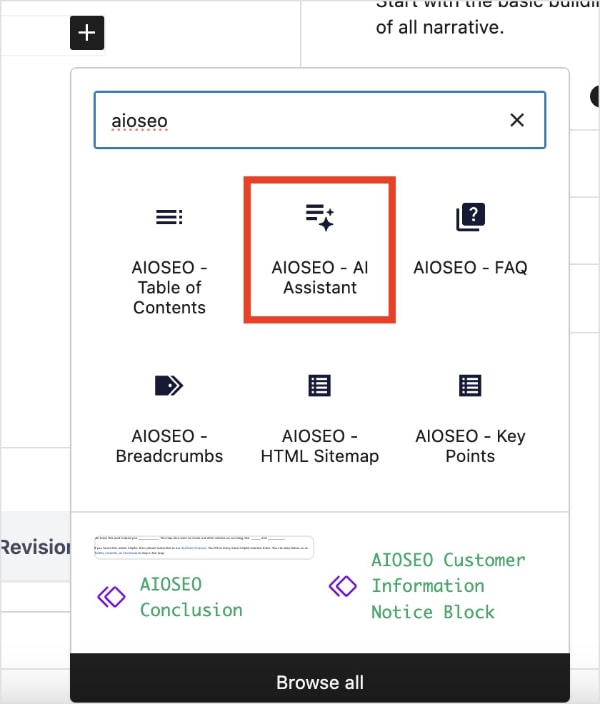
I would recommend this workflow, AI design → human editing → SEO review, to anyone concerned about AI content and rankings.
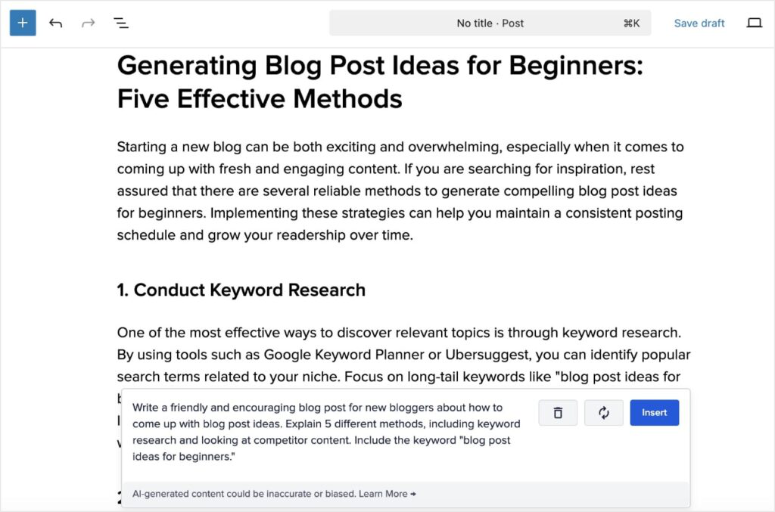
The honest point of friction: AI functions are only available to professionals. If you’re considering what’s behind the upgrade, check out our All in One SEO Free vs. Pro breakdown before you decide.
🟢► Advantages
- Keyword Aware AI: I first decide on my focus keyword. Each title, meta and content suggestion is tailored to this specific term and is not generated generically.
- AI title generator: Five click-optimized title options in seconds. After switching to AI-generated metas, I saw a 23% increase in CTR on a series of 15 posts.
- Works in Editor: No tab switching to an external AI tool. Everything is created where I already write.
- Full design creation: Content Assistant creates structured outlines and complete sections. Useful as a starting point, not a final product.
- Over 3 million active installs: The most tested AI-powered SEO plugin on WordPress.org. Errors appear and are quickly resolved.
- Free version available: Get started with SEO basics for free; Upgrade for AI capabilities when you’re ready.
🔴► Disadvantages
- AI requires Pro: The upgrade is reasonable, but you’ll hit a roadblock the first time you try to use the AI features on the free plan.
- Generic without context: AI suggestions improve significantly once you configure your website’s industry, tone, and SEO profile. Without this setup, initial results can feel extensive right away.
My verdict: If you’re already using All-in-One SEO (or thinking about it), its AI features are the most justifiable way to use AI for WordPress content.
That’s because they were written from the start with the intent of ranking. This is where I start every AI-powered article.
Check out my AIOSEO review. You can also compare AIOSEO with Yoast SEO to find out which one is best for you.
Prices: Free version available. Pro from $49.60/year.
👉 Start here with all-in-one SEO
2. SEOBoost ⭐⭐⭐⭐⭐
Best for: Content teams that want AI designs that don’t hurt their rankings

Here is the most useful phrase I found for the question “Does AI content hurt SEO?” found. Question: AI writing tools do not harm search engine optimization.
Publishing unaudited, unoptimized AI output hurts search engine optimization. SEOBoost is the tool that closes this gap.
Why is SEOBoost one of the best AI writing plugins?
It works like this: Before you write anything, SEOBoost generates a content brief for your target keyword.
In this brief description you will learn which topics need to be covered, which questions need to be answered, which NLP terms need to be included and how many words need to be met. This is all based on what has already ranked on page one.
You give this task to your AI writing tool or your author. Then SEOBoost evaluates the output in real time as you write and tells you exactly what’s missing.
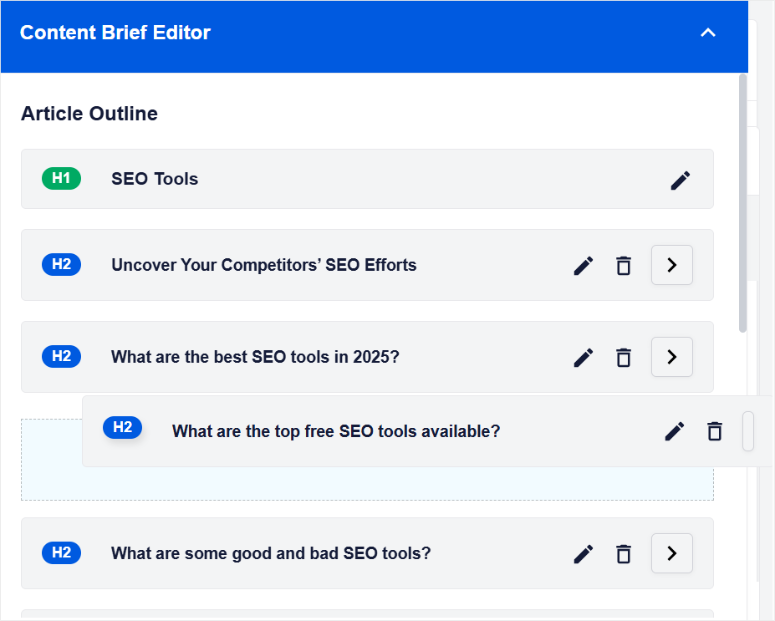
I tested this workflow on eight articles over a three-month period. Each of them achieved a high rank in the first 60 days. The AI created the design.
SEOBoost told me where AI falls short. I fixed these gaps. The result reads like human content because the structural decisions were led by humans. The AI just filled in the prose.
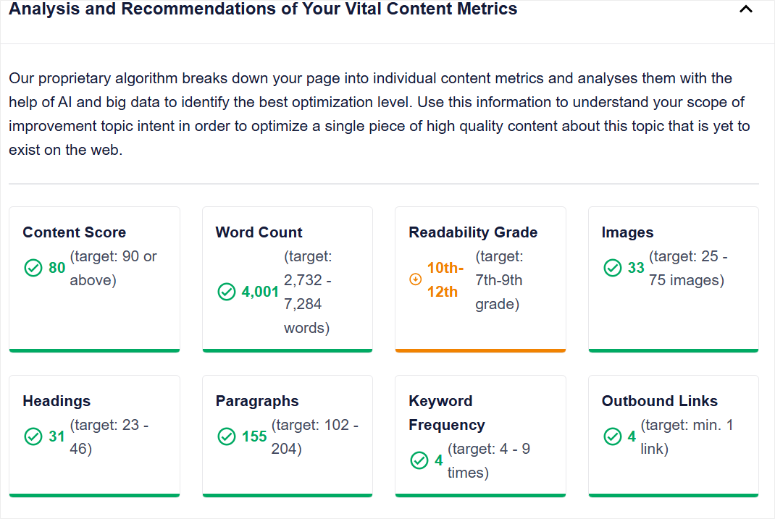
SEOBoost connects directly to All in One SEO in your WordPress editor, so the content description and rating appear right next to your design, without the need for a separate tab.
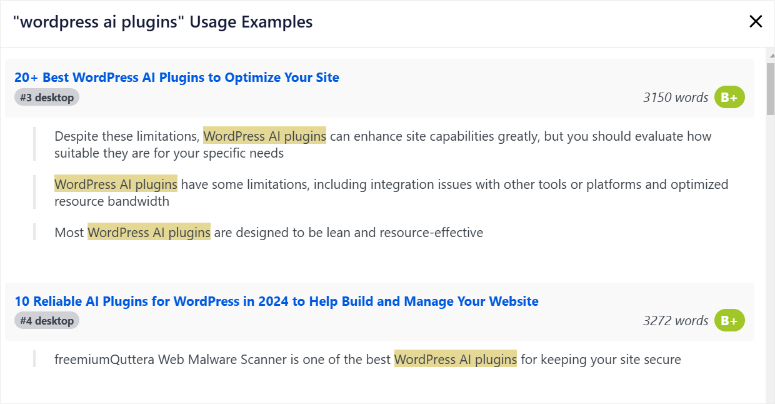
If you don’t use AIOSEO, the browser extension works with any web-based editor.
The caveat worth mentioning: This is a SaaS subscription on top of what you pay for AI generation. There’s no free tier, but you get a 14-day trial, no-questions-asked money-back guarantee.
🟢► Advantages
- Table of contents before you write: I stopped guessing what to include. The brief showed me the exact topics, questions and NLP terms that Google rewards for my keyword.
- Live content scoring: The score was updated as I edited it. I was able to watch my design improve in real time instead of hoping for the best.
- Integrates with AIOSEO: The brief and score appear in my WordPress editor along with my draft, without the need for a context switch.
- Analysis of competition content: I was able to see exactly what the top ranking sites covered and what I was missing and add it before publishing.
- SEO-safe AI workflow: Eight items tested over 90 days, all rated well. The AI wrote faster; SEOBoost made sure everything was written correctly.
🔴► Disadvantages
- No permanent free plan: The 14-day trial is generous, but there is no ongoing free tier. You commit to a paid subscription.
My verdict: With SEOBoost I answer the question “Does AI content destroy SEO?” question in practice. It is the editorial level that makes the AI output rankable.
If you’re publishing AI-powered content in bulk, this is the tool to save you hassle
For more information, check out my SEOBoost review.
Prices: Paid plans only. 14-day free trial available.
3. AI engine ⭐⭐⭐⭐⭐
Best for: Tech-savvy WordPress users who want to choose their own AI model
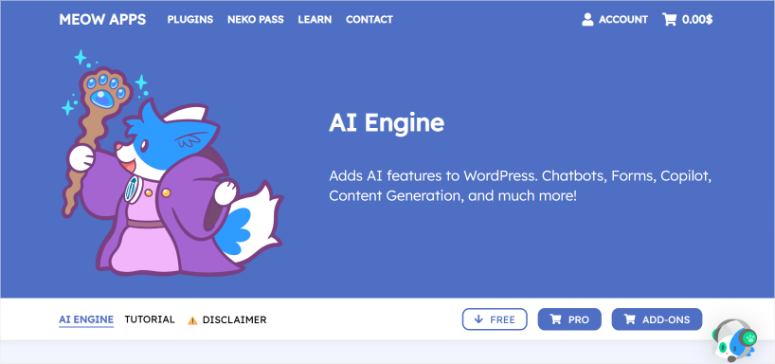
Most WordPress AI writing plugins lock you into a model.
AI engine does the opposite: it lets you connect ChatGPT, Claude, Gemini, or any other OpenAI-compatible API and switch between them without having to rebuild anything.
I tested the same briefs on three different models in the same session. Such a comparison is not possible with many other WordPress AI plugins.
Why is AI Engine one of the best AI writing plugins?
Why is the choice of model important? Because different models are really better at different things.
Claude writes in a more natural, nuanced voice. GPT-4o is faster for structured content like listicles and tables. Gemini handles factual memory more reliably.
With AI Engine, you choose the right model for the right task, not just what the plugin provider thinks is good enough.
The free version is quite useful. Content creation via the WordPress dashboard, a simple chatbot, and model switching all work without you having to pay anything.
The Pro upgrade adds AI forms, custom embeds (train the AI on your own content), and advanced chatbot features with storage and voice.
For most authors, the free version is the starting point where they stay for a while.
What I want to say honestly: AI Engine is more technical than any other plugin on this list.
Connecting your API keys, selecting models, and configuring generation settings requires more setup than a one-click installer.
I spent about 40 minutes on my initial setup. After that it runs smoothly. However, this initial configuration requires some familiarity with API keys and settings fields.
Also: AI Engine is Bring-Your-Own-Key (BYOK). You pay AI Engine for the plugin and then separately pay OpenAI, Anthropic or Google for API usage. However, the costs are low.
Basically a few dollars per month for typical blog usage, but there are two billing accounts to manage.
🟢► Advantages
- Flexibility with multiple models: I switched from GPT-4o to Claude mid-project without changing my setup. The model selection consists of a drop-down menu.
- Over 80,000 active installations: The most installed AI content plugin on WordPress.org. This number of installations means extensive real-world testing and an active support community.
- Strong free version: Content generation, model switching, and basic chatbot all work without paying. This is truly a powerful free tier.
- MCP integration: AI Engine can manage your entire website via MCP (Model Context Protocol), the most technically advanced feature of all the plugins on this list.
- Custom Embeds: Train the AI on your existing content. A useful tool for websites with a specific brand voice or knowledge base.
🔴► Disadvantages
- The setup is more technical: Connecting API keys and configuring generation settings took me 40 minutes the first time I installed it – not a one-click experience for beginners.
- BYOK means two billing accounts: Plugin license + separate API provider costs. Low in practice (around $5-10/month for typical usage), but requires managing two subscriptions.
My verdict: AI Engine is the best choice if you want true control over which AI brain powers your WordPress content.
The install number of 80,000 is the most reliable quality signal on this list. If you’re familiar with API keys, start here.
Prices: Free version available. Pro from $59/year (1 site).
4. AI buffer ⭐⭐⭐⭐
Ideal for: WordPress website owners who want AI writing, chatbot, and image generation in one plugin

AI buffer (the plugin formerly known as AI Power) does something that none of the other tools on this list can do.
It combines AI writing, a chatbot, AI image generation, and voice agents in a single plugin for less than $10 per month.
If you run a content-heavy website and are paying for three separate AI subscriptions, AI Buffer is worth a serious look.
Why is AI Buffer one of the best AI writing plugins?
Content writing features cover the standard AI writing use cases, such as: B. Blog post drafts, AI product descriptions and introductory sections. However, there is one outstanding innovation: mass content generation.
I used it to generate product descriptions for 40 WooCommerce items in a single batch.
Each description, which came from the product title and category, had unique wording and required about 5 minutes of editing time per batch rather than per item.
For stores with large catalogs, this is a real-time multiplier. It’s one of the more practical AI tools you’ll find in the broader WordPress eCommerce plugin space.
The knowledge base training function is where AI Buffer differs from the basic writing tools.
You can index your existing posts, pages, WooCommerce products or uploaded PDFs in a vector shop and then connect this knowledge base to the chatbot or AI forms.
The AI answers questions based on your actual content, not its training data.
The only thing that should be clearly highlighted: AI Buffer was renamed from “AI Power” relatively recently. If you search WordPress.org you will find it under the old slug (gpt3-ai-content-generator).
The product still works well and is regularly updated, but the renaming means the support forum is split between the old and new names, making troubleshooting a little more difficult.
🟢► Advantages
- Best value per feature: Writing + Chatbot + Image Generation + Voice Agents under $10/month. I couldn’t find a cheaper all-in-one AI toolkit for WordPress.
- Bulk Content Generation: I batch generated 40 WooCommerce product descriptions in one session. Clean output, minimal editing per batch.
- Knowledge Base Training: Index your existing content in a vector store and train the chatbot based on your actual posts and pages, not generic AI answers.
- 4.6/5 WordPress.org Rating: Over 10,000 installations with consistently positive reviews. Reliable plugin with strong community validation.
🔴► Disadvantages
- BYOK required: As with AI Engine, you bring your own API key. This means plugin costs plus OpenAI/Gemini API usage, two separate billing lines.
- Function overloading for simple use cases: If you just want to write blog posts, the range of features (voice agents, forms, embeds) is larger than you need and takes time to learn.
My verdict: AI Buffer makes sense if you want to run AI writing, chatbot, and images from one dashboard without juggling three different subscriptions.
Bulk content generation alone saves WooCommerce stores a lot of time. Simply budget for the BYOK API cost in addition to the subscription.
Prices: Free version available. Pro from $9.99/month.
5th AI rank for mathematical content ⭐⭐⭐⭐
Ideal for: Existing Rank Math users who want AI writing to link directly to their SEO keyword
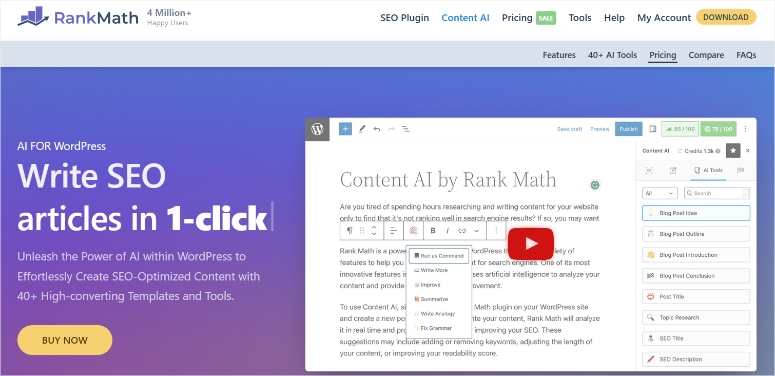
Every other AI writing tool on this list writes in keyword-agnostic mode by default. You can provide a keyword as a prompt, but the AI is not based on it.
Rank Math Content AI is different. The entire AI system is focused on your target keyword.
Every suggestion, topic idea, outline, content section, and optimization tip is answered by the question “What does this specific keyword need to rank for?” filtered.
Why is Rank Math Content AI one of the best AI writing plugins?
This is a significant distinction for SEO-focused writers.
When I used it to create an outline for a competing keyword, it took into account the actual questions people ask about that term, the semantic themes Google associates with it.
It also showed me the word count used on the highest ranking pages. The structure seemed more research-based than template-generated.
The free tier is really usable: 750 credits per month are included in every Rank Math installation.
For a website that publishes 4-6 articles per month, this is enough to create outlines and AI-powered sections without updating.
The paid Content AI plans unlock higher credit limits and advanced generation features.
The crucial caveat: This only makes sense if you use Rank Math. If you use All in One SEO or Yoast, Rank Math Content AI is not available to you. The AI is an add-on to the Rank Math plugin.
🟢► Advantages
- Keyword-first AI: Each suggestion is tailored to my target keyword and what is already ranking. The outline created for a competition term contained questions that I never thought I would research manually.
- 750 free credits/month: Enough for consistent use on smaller websites without having to take advantage of a paid plan.
- Integrated into Rank Math: No separate plugin required to install or configure. If you already have Rank Math Pro, Content AI is waiting for you.
- 4.9/5 WordPress.org Rating: Rank Math’s plugin rating is among the highest of all SEO plugins. The underlying platform is exceptionally well built.
🔴► Disadvantages
- Mathematics rank required: Zero value if you use AIOSEO or Yoast. This is not a standalone product. It is a Rank Math plugin add-on
- Credit limits frustrate in the middle of the project: Hitting a credit limit while writing a long article in the middle of a session is a real point of friction in the free tier.
My verdict: For Rank Math users, this is the most natural complement to AI writing.
It’s already there, it doesn’t cost anything extra to get started, and the keyword integration is seriously better than a generic AI prompt. For everyone else: Start by comparing plugins before choosing an AI tool.
If you’re weighing the two SEO plugins partly based on the AI features, check out our All in One SEO vs. Rank Math comparison to make a clear platform decision first.
Prices: 750 free credits/month with Rank Math. Paid Content AI plans starting at $5.99/month for the AI Content add-on.
👉 Get started with Rank Math Content AI here
6. Scary Automator ⭐⭐⭐⭐
Best for: WordPress sites publishing AI content at scale and looking to automate the entire workflow
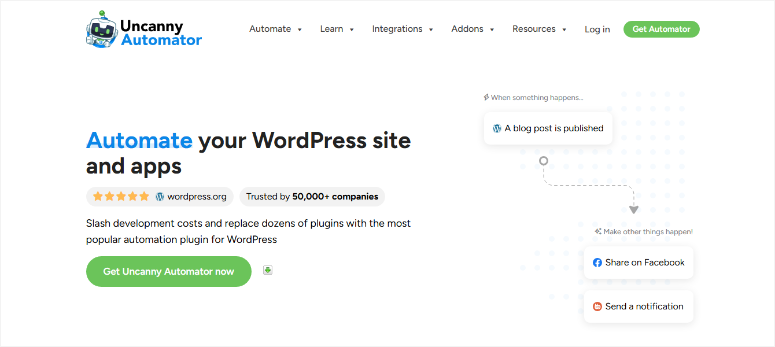
Every other tool on this list will help you write faster. Scary Automator helps you write automatically.
Here’s what I mean. Every other plugin still has a human in the loop: you open the editor, you trigger the AI, you check the output, you publish. Uncanny Automator eliminates these manual steps.
Why is Uncanny Automator one of the best AI writing plugins?
Most importantly, define a trigger. It can be a form submission, a product added to WooCommerce, a scheduled event, or anything you want.
And the AI recipe goes: generates an outline, designs the post, formats it and creates a draft in your WordPress dashboard or whatever else you want to do. You check when you are ready.
The flexibility is what makes Uncanny Automator unique.
I created a recipe for a client’s website.
When a new product is added to WooCommerce, Uncanny Automator calls the OpenAI API, generates a product description and three social media captions, and saves it as a draft.
The whole thing takes 40 seconds. What used to take 20 minutes per product now requires a 2-minute review. It’s the type of online marketing workflow automation that previously required a developer to create.
The AI Actions module is the key feature here. It connects to OpenAI, Claude or Gemini from any automation recipe without requiring a separate plugin or API management interface.
You write a prompt in the recipe builder, pass dynamic data (product name, category, price) and the AI returns structured content wherever you forward it.
The honest caveat: This is not a writing instrument for beginners. The recipe creation interface requires an understanding of triggers, actions, and data flow.
The Pro entry-level price is also the highest first-year commitment on this list. But for sites that publish more than 20 AI-powered articles per month, automation pays for itself quickly.
🟢► Advantages
- Complete workflow automation: I set up a WooCommerce trigger that automatically generates AI product descriptions and social captions. 40 seconds per product instead of 20 minutes.
- Multi-model AI actions: Connect OpenAI, Claude or Gemini in any recipe. It passes dynamic data like product name, price, and category directly to the AI prompt.
- 4.8/5 WordPress.org Rating: Over 40,000 active installations. The most trusted automation plugin in the WordPress ecosystem.
- Unique Ability: No other plugin on this list automates the entire AI content workflow from trigger to draft. This is really a different area.
- Free version available: Core automation features work without paying. Upgrade for Pro integrations and advanced AI actions.
🔴► Disadvantages
- Not for beginners: Recipe creation requires thinking in terms of triggers and actions. More like Zapier than a writing instrument. Allow 1-2 hours to familiarize yourself with the interface before building anything complex.
- Highest per entry price: Costly entry point. Justified by the automation ROI, but not the right choice for occasional AI use.
My verdict: If you’re publishing AI content at a meaningful scale, Uncanny Automator is the only tool on this list that completely removes humans from the repetitive parts of the workflow.
ROI is fast for sites with consistent publishing volume.
For more information, check out my Uncanny Automator review.
Prices: Free version available. Pro from $149/year (1 site).
👉 Start here with Uncanny Automator
Bonus: Best AI Writing Plugins for WordPress
Also consider: WriteText.ai ⭐⭐⭐
WriteText.ai is a lightweight WordPress plugin that specifically focuses on product descriptions and short pieces of content. It requires minimal setup and generates clean output right in your editor.
No API keys to manage, no comprehensive feature set to navigate.
The disadvantage: It is naturally narrow. If you primarily need WooCommerce product copy at scale, it’s worth a look. Anything beyond short eCommerce content will quickly outgrow you.
Also consider: ContentBot.ai ⭐⭐⭐
ContentBot.ai is a SaaS AI writing platform with WordPress integration for publishing drafts directly to your website.
The integration works well, the content quality for blog posts and landing pages is solid, and there is a free tier that covers basic usage.
It doesn’t reach the editor integration and SEO depth of All in One SEO or SEOBoost, but it’s a reasonable middle ground option.
Especially if you want a browser-based tool with a simple WordPress publishing connection.
This is my list of the best AI writing plugins for WordPress. Now this list is long. Check out the section below to narrow down the selection to what you need.
How to Choose the Best AI Writing Plugin for WordPress
Now that you’ve seen what each tool does, here’s how to adapt one to your situation.
If you want AI writing that will help your SEO instead of hurting it, use All in one SEO + SEOBoost together.
- AIOSEO generates keyword-aware titles, metas and content. SEOBoost evaluates the output and tells you what you need to fix before publishing.
- This two-tool stack is the most defensible approach to AI content for site owners who care about rankings.
- Use your WordPress analytics to track results after 30, 60 and 90 days. You’ll see which AI-powered posts gain traction and which require more editing.
If you want full control over which AI model you use, choose AI engine.
- No other WordPress plugin allows you to switch so cleanly between ChatGPT, Claude and Gemini.
- With an install base of 80,000 you’re in good company and the free version is a legitimate starting point.
If you want the most features for the lowest monthly cost, AI buffer.
- Writing + Chatbot + Images under $10/month is hard to beat. Bulk generation is the highlight for WooCommerce stores with large catalogs.
If you’re already on Rank Math, try Rank Math Content AI first.
- It’s already there. 750 free credits per month is enough to test it seriously. The keyword-first approach to AI generation is the real differentiator.
If you’re publishing AI content at scale, take a look at the following Scary Automator.
- Automation ROI increases quickly when you run recipes for more than 20 pieces per month. Combine it with a lead generation strategy to convert this AI-powered traffic into subscribers and customers.
All the tools on this list have one thing in common: none of them produce publishable content without human review.
The experiment I’ve been running for three months confirms what Google keeps saying. AI-generated content that has been reviewed, optimized, and edited by a person ranks well.
Raw, unaudited AI output typically doesn’t do this. Choose the tool that fits your workflow and build the verification step into that workflow from day one.
Great. You now have a list of the best AI content writing plugins and a way to choose the best one for your needs. If something is unclear, check out the frequently asked questions below.
FAQs: Best AI writing plugins for WordPress
Does AI-generated content affect SEO rankings?
Not by nature. Google’s official position is that it rewards content that demonstrates experience, expertise, authority and trust, regardless of how it is created. In practice, unverified, thin AI outputs perform poorly. AI-powered content that is edited, fact-checked, and optimized to match search intent performs well. The tool is less important than the verification process.
Is AI-generated content discoverable by Google?
Google does not publicly confirm its use of AI detection as a ranking signal. However, what Google penalizes is low-quality spam content that AI can produce on a massive scale if you publish it without checking. Instead of worrying about recognition, focus on the quality signals that matter: original insights, accurate information, clear structure, and real value for the reader.
Are there free AI writing plugins for WordPress?
Yes. AI Engine has a free version that includes content generation and multiple model support. AI Buffer’s free tier covers basic writing and chatbot functions. With Rank Math Content AI you get 750 free credits per month if you already use Rank Math. All in One SEO comes in a free version, but the AI features require a Pro upgrade.
Can I use ChatGPT directly as a WordPress plugin?
Not native. ChatGPT is a standalone tool, not a WordPress plugin. But several plugins on this list connect to the ChatGPT API and bring this generation power to WordPress. AI Engine and AI Buffer both support OpenAI’s GPT models via your own API key, giving you ChatGPT-quality output without leaving your WordPress dashboard.
What is the difference between an AI writing plugin and an AI SEO tool?
AI writing plugins generate content like drafts, headlines, and product descriptions. AI SEO tools like SEOBoost analyze what should be in your content and evaluate how well your draft matches Google’s rewards. The best setup combines both: use an AI writing plugin to generate faster and use an AI SEO tool to check the output before publishing.
Which AI writing plugin works best with Gutenberg?
AI Engine, AI Buffer and All in One SEO all integrate directly into the Gutenberg block editor. AIOSEO’s AI capabilities are displayed in the sidebar area. In addition to the editor, AI Engine and AI Buffer use a dashboard to generate content.
Final Verdict: Should I Use AI Writing Plugins on My WordPress Site?
Yes. If you treat them as design tools and not publishing tools.
Remember the experiment I mentioned at the beginning?
The posts were ranked where the AI did the hard work on the structure and the first draft and a human took over the editing, fact checking and SEO optimization.
The posts that didn’t rank were the ones I published without this verification step.
The good news: Several tools here cost nothing to start with.
With AI Engine’s free version, Rank Math Content AI’s 750 monthly credits, and AI Buffer’s free tier, you can test AI writing on real posts before spending a dime.
Pick one, develop an evaluation habit, and measure the results after 60 days. The rankings will tell you whether the workflow is working.
Resource Hub: WordPress Content and SEO Strategy
Build the content infrastructure that AI writing tools accelerate, without the ranking risk.