
Organic search still delivers some of the highest returns in marketing, and the right content optimization tools make it easier to capture.
But in 2026 the stakes are higher than before. AI search engines like Google AI Overviews, Perplexity and ChatGPT are now a standard part of the buyer research process and do not select sources in the same way as traditional search. Marketing teams that only optimize for Google rankings are often invisible in AI-generated responses – and being invisible in AI responses also means they are invisible to buyers.
This guide covers the best content optimization tools available in 2026, organized by use case. Whether the goal is to build a content stack from scratch or to fill gaps in an existing content optimization workflow, this guide will explain what each tool does and who it is best suited for.
Table of contents
Types of Content Optimization Tools
Content optimization tools improve content quality, search visibility, and conversion performance. Lots of content and There are SEO analysis tools on the market, many of which cover a wide range of functions.
Before we dive into specific recommendations for AI content optimization tools, here is a breakdown of the main categories:
- On-page optimization and content evaluation tools Analyze published or drafted content against top ranking pages and flag keyword gaps, structural issues, and readability issues.
- Research, letter writing and content writing accelerators Help marketing teams plan and design faster by using AI to create sketches, briefs, and first drafts based on keyword and intent data.
- Internal linking and site structure tools Identify opportunities to strengthen semantic relationships between pages and improve crawlability.
- Experimentation and content QA tools Enable content teams to test content variations and review existing pages for technical or structural issues before publishing or republishing.
- Performance reports and strategy tools Track content performance in terms of rankings, traffic, engagement and, increasingly, AI visibility – including whether a brand appears in AI-generated responses.
HubSpot Pro Tip: As AI visibility becomes a standard reporting requirement, tools that track it will become increasingly important. HubSpot AEO shows where a brand appears in AI-generated responses in ChatGPT, Perplexity and Gemini – and connects this data to the same CRM where the team already tracks leads and pipelines.
Recommended Resource: 9 SEO friendly CMS options
The best content optimization tools by use case
Combine the most effective content stacks SEO optimization software with dedicated research, AI visibility and reporting tools. The following breakdowns are organized by category and cover what each tool does, who it’s best for, and how it fits into a content stack.
On-page optimization and content scoring
These tools analyze and evaluate content compared to top competitors and provide specific recommendations to close gaps. Most use NLP and semantic analysis instead of simple keyword density.
HubSpot SEO marketing software
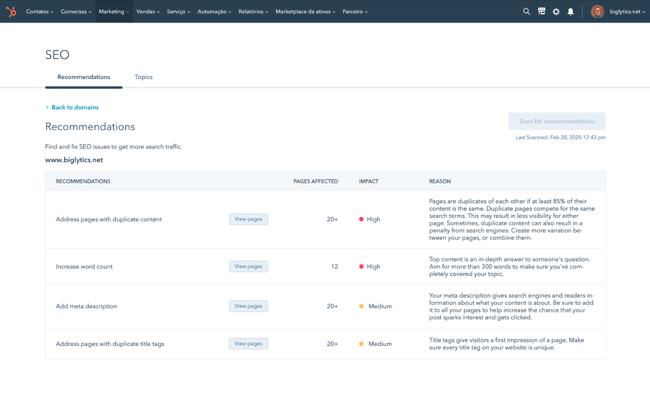
HubSpot’s SEO marketing software integrates with Marketing Hub and provides teams with a centralized view of SEO performance, on-page recommendations, and topic cluster structure. It’s all connected to the same CRM data that powers the rest of the HubSpot platform.
Unlike standalone SEO tools, HubSpot’s SEO recommendations are directly linked to a brand’s actual content and pages. Teams can see which pages need optimization, implement those recommendations within the same platform, and track the downstream impact on traffic and leads without having to switch between tools or manually stitch together data.
What I like: The biggest advantage is not the recommendations themselves (which are solid), but that they are linked to real pipeline data. If a content team can demonstrate that improving a group of pages resulted in a measurable increase in marketing qualified lead (MQL) volume, securing executive buy-in for SEO investments becomes much easier.
Key Features
- On-page SEO recommendations with step-by-step instructions
- Topic cluster visualization and internal linking suggestions
- Page-level performance data connected to CRM and contact records
- SEO analysis related to real traffic, leads and sales attribution
Best for: Marketing teams who already use HubSpot and want built-in SEO visibility without having to manage a separate tool. Ideal for mid-market and enterprise teams that need to report on full-funnel content ROI.
Pro tip: Teams on Marketing Hub Professional or Enterprise can add AEO through the HubSpot for Marketers package, maintaining SEO and AI search visibility on one platform.
What the experts say: Rob FreedmanVice President of Marketing at SureCam, said, “I use HubSpot’s content editor, SEO recommendations, and content calendar to plan, publish, and optimize website and blog content, then link each asset directly to campaigns so I can report on pipeline and revenue impact in our CRM.”
Clearscope
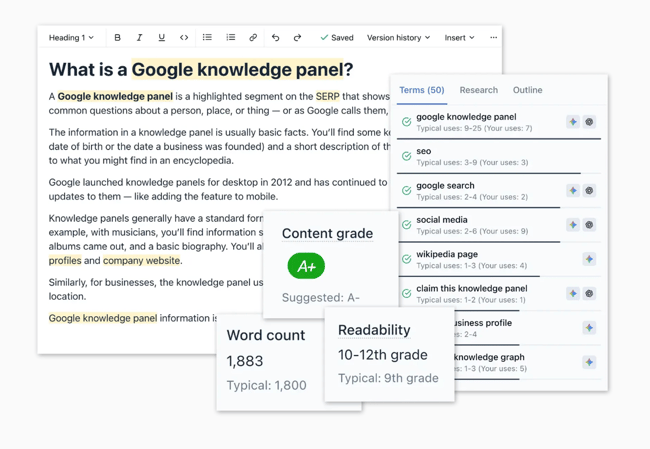
Clearscope is a content discoverability platform that covers the entire content workflow: topic research, AI-powered design, on-page optimization, content monitoring, internal linking, and AI search visibility tracking in ChatGPT and Gemini.
Key Features
- Content scoring with real-time reporting on keyword and topic coverage
- Fast tracking via ChatGPT and Gemini to monitor brand mentions in AI-generated responses
- Query fanout awareness
Prices: Starts at $129/month.
What I like: Clearscope’s interface is clean and fast, making it one of the easier tools for standardization within a writing team. The query fanout feature is useful for an AI search strategy and helps teams understand the downstream searches that AI platforms trigger to create their answers. It also gives content teams a concrete signal about where they should invest.
Best for: Enterprise content teams and agency partners who want a unified platform for on-page optimization and AI search visibility with unlimited user slots and no per-seat pricing.
What the experts say: Cassy AiteCo-founder of Postbeam.ai and Hoppier.com, said: “Clearscope has been a big part of how I scale content with new writers. It helps both me and the writer reduce the amount of on-page SEO research for content, which shortens the editing process and gives me more confidence that the content is actually optimized before it goes live.”
surfer
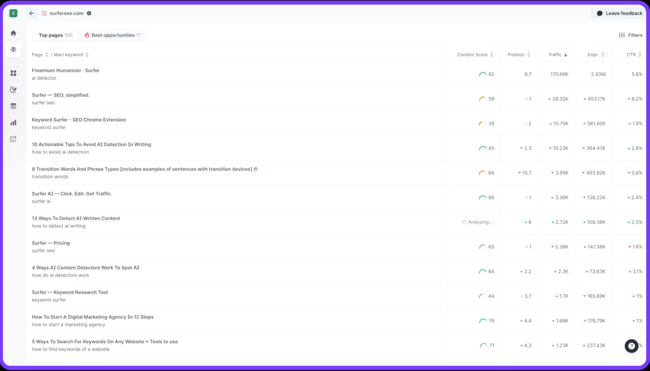
Surfer is an AI visibility platform that combines on-page content optimization with AI search tracking, topic authority planning, and competitive intelligence across Google and major AI engines including ChatGPT, Perplexity, Gemini, and Google AI Overviews.
Key Features
- Real-time content score with NLP-driven keyword and structure recommendations
- Monitors brand visibility in ChatGPT, Perplexity, Gemini, Claude, Google AI Mode and AI Overviews
- Mention gap analysis to identify where competitors appear in AI responses but the brand does not
- Brand sentiment analysis to show how AI models shape the brand in its reactions
Prices: Starts at $119/month billed monthly or $99/month billed annually.
What I like: The Mention Gap feature is a useful addition for teams developing an AI search strategy. Knowing exactly which AI engines are naming competitors for a specific topic gives teams a concrete starting point to close visibility gaps instead of optimizing unconditionally.
Best for: Content teams and SEO specialists who want a unified platform for on-page optimization and AI visibility tracking with strong support for high-volume publishing and multi-brand management.
What the experts say: Chris CoussonsFounder of Visionary Marketing, tests tools before fully committing to adding them to the martech stack. This is what he said about Surfer SEO:
“We ran a test of Surfer SEO at the end of last year and optimized 50% of a client’s outdated blogs using their content optimization, leaving the other 50% unchanged and measuring the impact. The uplift on the optimized blogs was, in my opinion, higher than anyone expected, with an average increase of 4 digits (zero for control) and 43% clicks in the following 3 months. We’ve used it on all of our clients’ blogs since then.”
Research, briefings and content writing accelerators
Optimization begins before writing begins. This category includes tools that help teams plan more strategically, create better briefs, and speed up first draft creation while basing content on real keyword and intent data.
HubSpot Content Hub
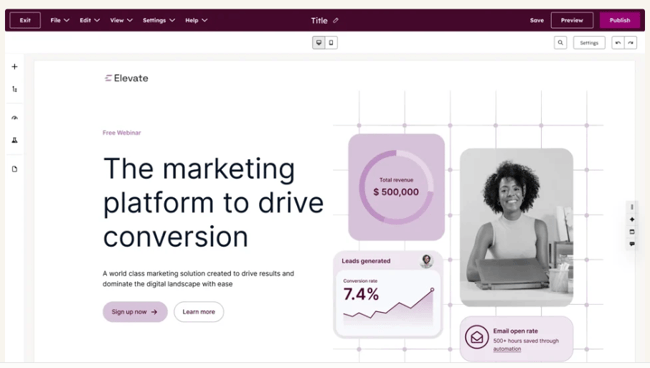
HubSpot’s CMS platform with built-in AI content creation, drag-and-drop editing, and content optimization capabilities for teams looking to create, publish, and optimize content in a single environment.
Content Hub helps content teams publish faster, but its bigger advantage is structural: the AI content writer produces clear, extractable content that both human readers and AI search engines can analyze and cite. This structure is consistent with the way generative engines evaluate and draw from sources.
For teams looking to optimize for Answer Engine Optimization (AEO), this integration between the CMS and the AI writing layer is a significant structural advantage. Teams don’t retrofit AI optimization to an old CMS; The feature is already integrated into the content creation workflow.
Key Features
- AI content writer to design and reuse
- Smart content and personalization for different audience segments
- Integrated SEO recommendations, connected to Marketing Hub
- Content performance analysis
Best for: Teams that want a unified platform to create, publish, optimize and measure content without stitching together separate CMS, SEO and AI tools.
HubSpot Pro Tip: Content Hub and Marketing Hub are separate products, but designed to work together. Teams that want both traditional SEO and AEO on one platform can access this through the HubSpot for Marketers package, which combines both hubs and includes AEO – all connected to the same CRM data.
What the experts say: Kshitij ChaudharyFounder of Dintellects, relies heavily on HubSpot’s content tools. He said, “I love using HubSpot Content Tools. They help me organize my content work and see how my blog posts are performing. I can see how they help me generate leads and improve my search rankings. The tool is extremely helpful because it keeps all my content and marketing work in one place.”
Frase
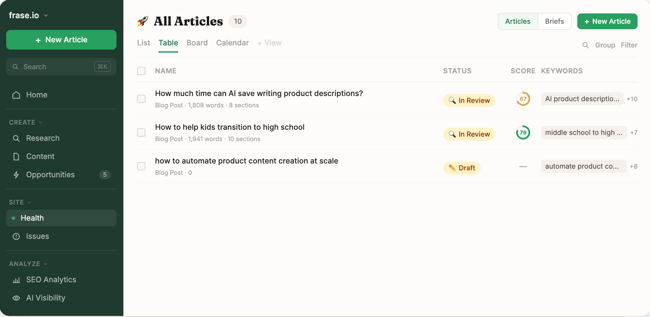
Frase is an agent SEO and GEO platform that combines research, writing, optimization, AI-driven visibility tracking, and content curation into a single platform. Frase covers the entire content strategy, from SERP research and letter writing to AI-powered drafting, combined SEO and GEO scoring, and automatic content decay detection.
Key Features
- AI agent with over 80 specialized skills for natural language research, optimization and content creation
- Combined SEO and GEO optimization factor
- Closed-loop content curation that monitors articles, diagnoses ranking and citation declines, and automatically republishes corrections
- Content atomization for reuse in LinkedIn, email, social and other formats
Prices: Starts at $49/month billed monthly or $39/month billed annually.
What I like: Instead of optimizing for Google in one tool and then checking AI visibility separately, Frase gives marketers a single score that takes both into account. This is helpful for teams that have asked themselves, “Now that AI search matters, are we optimizing for the right things?”
Best for: Content teams looking to consolidate a fragmented tool stack into one platform that covers research, writing, SEO, GEO, and AI visibility tracking.
What the experts say: Chaudhary is also a Frase user. He said: “I use this tool for quick content research. It helps me create outlines for my articles and find out what people are searching for online. I can see what questions people have and what they want to know about something. It helps me write my articles.”
MarketMuse
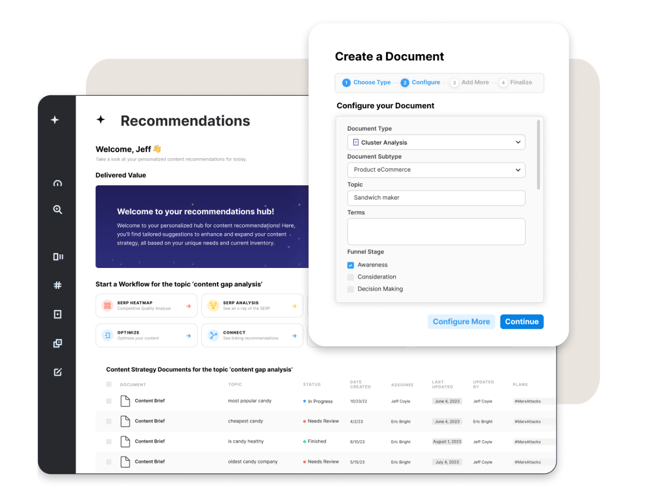
MarketMuse is a content intelligence platform that uses AI to identify content gaps, prioritize topics, and assess content quality across an entire website.
Key Features
- Site-level content inventory and gap analysis
- Topic modeling and competitive benchmarking
- Content descriptions with personalized difficulty levels
- Nine content overview types, including comparison, FAQ, how-to, and product review formats
Prices: Free plan available; Paid plans are based on offers.
What I like: MarketMuse helps marketers quickly create a complete content library that covers top priority target topics and gaps. For content teams, this tool can help eliminate duplication of effort and focus effort where it will have the greatest strategic impact.
Best for: Enterprise and mid-market teams that manage content libraries larger than 100 pages and need a strategic, site-wide view of their content gaps.
Internal linking and site structure support
Strong internal linking helps search engines understand topic authority, improves crawlability, and ensures equality between related pages, all of which increase over time. Here are some tools that can help marketers optimize website structure.
HubSpot SEO topic clusters (via Marketing Hub)
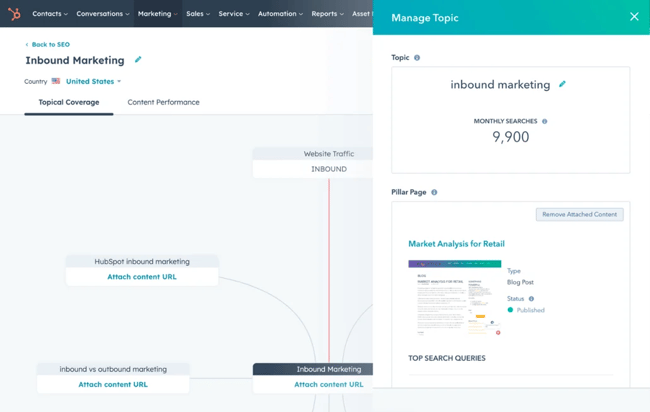
HubSpot’s Topic Clustering tool visualizes how pillar pages and clustered content are connected on a website. It highlights missing links, identifies orphaned content, and makes it easier to build a semantic architecture that search engines – and AI machines – reward.
Unlike standalone site audit tools, the topic cluster map is integrated directly into Marketing Hub, so recommendations are tied to the same pages, contacts, and pipeline data that the rest of the team is already working with. As a cluster improves, the impact is visible in the same dashboard where leads and sales are tracked. Topic clusters are available for Marketing Hub Starter, Pro, and Enterprise.
What I like: The visual map makes it easy to present the website’s structure to stakeholders who don’t have deep knowledge of SEO. The ability to show the connection between strategic topics and actual content in a single view tends to accelerate alignment on content priorities – and makes it much easier to make the case for investing in gap content.
Key Features
- Visual topic cluster map showing the relationships between pillars and cluster pages across the site
- Topic suggestions based on relevance, competition and popularity
- Orphan content detection for pages that are not yet connected to a cluster
- Performance data connected to CRM and contact records via Marketing Hub
Best for: Marketing teams already use HubSpot and want a strategic overview of their content architecture without having to manage a separate site audit tool. Particularly useful for teams building or expanding topic clusters as part of an AI search visibility strategy.
Link Whisper
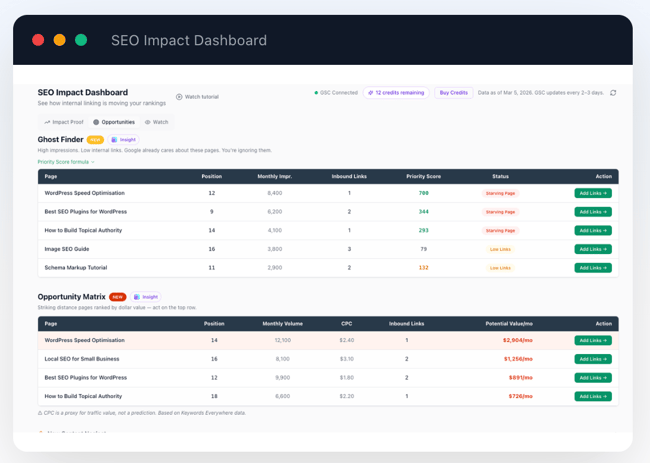
Link Whisper is a WordPress plugin that uses AI to suggest and insert internal links as you write content, with site-level reporting for orphan pages, broken links, and link structure.
Key Features
- AI-powered internal link suggestions in the WordPress editor
- Automatic linking of keywords in existing and future posts
- Orphan content detection with site-wide reporting on internal links
- Google Search Console integration to display ranking keywords as link targets
Prices: Starts at $97/year.
What I like: Link Whisper eliminates the manual work of internal linking without the need for a strategic overhaul. The GSC integration is also a useful addition, as it makes the terms that Google already associates with a brand’s pages visible as link targets.
Best for: WordPress-based content teams with large archives looking to improve internal linking without a manual review process. Not suitable for non-WordPress sites.
What the experts say: Keran SmithCo-founder and Chief Marketing Officer at LYFE Marketing, said: “Link Whisper saves me hours by allowing me to implement anchor text for multiple keywords with a single click. We have thousands of pages on our site, so it helps us improve our anchor text efforts at scale.”
Screaming frog
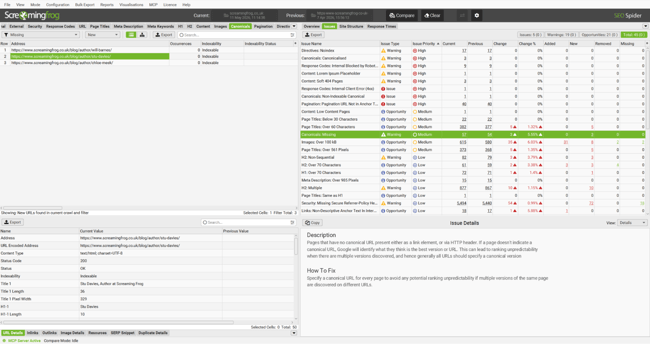
Screaming Frog is a technical SEO crawler for Windows, macOS and Linux that checks website structure, identifies over 300 SEO issues and uncovers internal linking gaps.
Key Features
- Full site crawling with broken link, redirect chain and duplicate content detection
- Internal link analysis with crawl depth, link score and anchor text reports
- JavaScript rendering via built-in Chromium for crawling React, Angular and Vue.js frameworks
- Integration with Google Analytics, Google Search Console and PageSpeed Insights APIs
Prices: $279/year. Free version available.
What I like: No other tool offers the same depth of crawl data at this price. Screaming Frog’s AI integration allows SEO teams to perform content quality checks or custom extraction prompts at scale during a crawl without building a separate workflow.
Best for: SEO specialists and technical teams who need comprehensive site crawling before or after a major content push, site migration or CMS change.
What the experts say: For Roberta VoroneckisHead of SEO and Growth at Demo Agency, Screaming Frog is non-negotiable. “Screaming Frog is my go-to source for technical SEO audits because it provides a very detailed look at crawling issues, metadata, internal linking, indexing signals and site structure,” he said.
Experiments and content QA
Publishing is just the beginning of content optimization. This category includes tools that help teams test what works and review existing content before republishing.
Hotjar
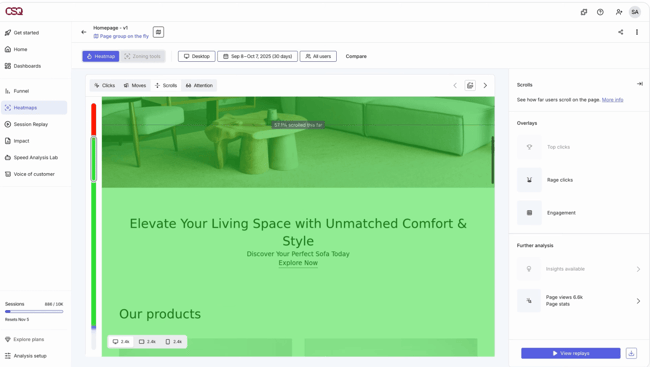
Hotjar, now part of Contentsquare, is a behavioral analytics platform that shows how real users interact with content pages through heatmaps, session recordings, funnels and on-page surveys.
Key Features
- Click, pan, and scroll heatmaps that show where users are engaging and losing interest on a page
- Session replay to observe real user journeys and identify drop-off points or content that causes confusion
- Funnel analysis to visualize where users go beyond key page sequences
- On-page surveys and feedback widgets to collect qualitative responses in context
Prices: Free plan available. Paid plans start at $49/month when billed monthly or $39/month when billed annually.
What I like: Hotjar answers a question that most content optimization tools can’t answer: are the people who land on a page actually reading it, engaging with it, and understanding it? For content teams running optimization sprints, combining heatmap data with post-publish performance metrics closes the loop between content quality and user behavior in a way that pure SEO scoring cannot.
Best for: Content and demand gen teams that need behavioral data to inform content quality assurance and page-level optimization decisions. Particularly useful for high-traffic landing pages, pillar content, and any pages being tested for conversion improvements.
What the experts say: Smith also uses Hotjar in his content optimization toolbox. He said: “Hotjar plays an important role in helping us understand and improve the UI and UX of our website. The ability to view actual records of how our website visitors navigate the website is extremely insightful.”
Google Search Console
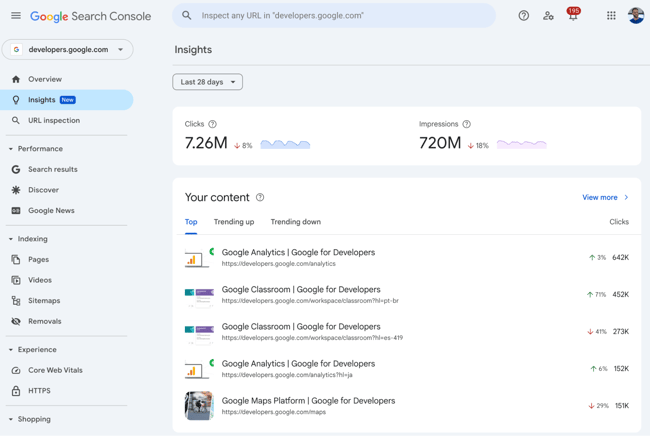
Google Search Console is Google’s free tool for monitoring search performance, including clicks, impressions, CTR, and average position by query and page.
Key Features
- Query and page performance data with clicks, impressions, CTR and average position
- Coverage and indexing status, which shows which pages Google can and cannot crawl
- Core Web Vitals reports for page experience and load performance
- Manual action notifications alerting website owners to Google penalties
Prices: Free.
What I like: Search Console is the basis. The query data is particularly useful for identifying content that is close to ranking but performing poorly.
Best for: All teams. Non-negotiable.
What the experts say: Voroneckis said, “Google Search Console is usually my starting point because it shows how a business is already being found, which pages are getting traction, and where the easiest optimization opportunities are.”
Performance reports and strategy tools
Proving that content drives pipeline is one of the most difficult problems in marketing. Here are some content optimization tools that can help bridge the gap between publishing and performance reporting.
HubSpot AEO (Answer Engine Optimization)
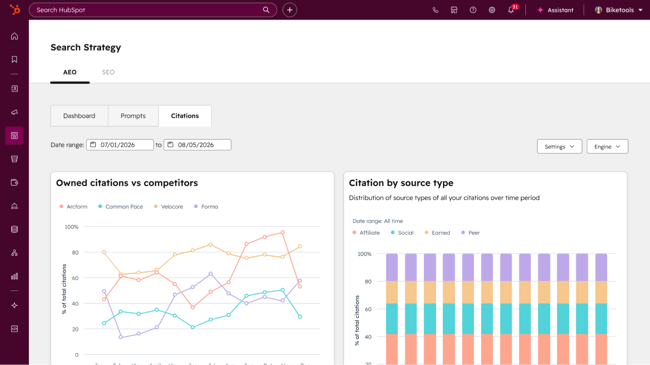
HubSpot’s AEO tool helps marketing teams understand where and how their brand appears in AI-generated responses across ChatGPT, Perplexity, and Gemini – and what drives or limits that visibility.
In 2026, ranking in traditional search and citation in AI answers are two different outcomes that require different signals. A page can rank on page one and still be missing from ChatGPT answers, Perplexity answers, or Gemini results for the same query. HubSpot AEO shows where a brand appears in AI responses, identifies the content and entity signals that influence visibility, and provides teams a structured way to track progress over time.
Demand generation leaders increasingly need to tie content investments to the pipeline, and AEO visibility metrics – citations, share of AI replies, reporting by topic – are now a required reporting layer alongside traditional SEO metrics.
Key Features
- Assessing brand visibility across all AI engines – Tracks how often your brand appears in ChatGPT, Gemini and Perplexity responses, with sentiment analysis (positive, negative or neutral) and share of voice compared to competitors.
- Timely tracking and citation analysis – Monitors the specific questions your buyers ask AI and shows which domains, content types, and pages are cited in the answers – for your brand and your competitors.
- Prioritized recommendations combined with content tools – Turns visibility gaps into clear next actions (publish blog post, refresh page, interact on Reddit) without leaving HubSpot.
Prices: HubSpot AEO starts at $50/month (or $45/month if billed annually) and includes a 28-day free trial, no credit card required. Teams on Marketing Hub Professional or Enterprise receive deeper CRM integration and built-in content tools in addition to AEO.
What I like: HubSpot AEO connects AI visibility data to the same platform where marketing teams track SEO, content, CRM, and pipeline. This integration makes the data useful, not just interesting – it becomes possible to see not only where the brand appears in AI responses, but also what content and unit building activities are driving that visibility.
HubSpot Pro Tip: HubSpot AEO is available with HubSpot Marketing Hub Pro and Enterprise. Marketing teams that combine HubSpot SEO tools with AEO gain a unified view of traditional and AI search performance – the only way they can accurately measure the full impact of a content investment in 2026.
Semrush
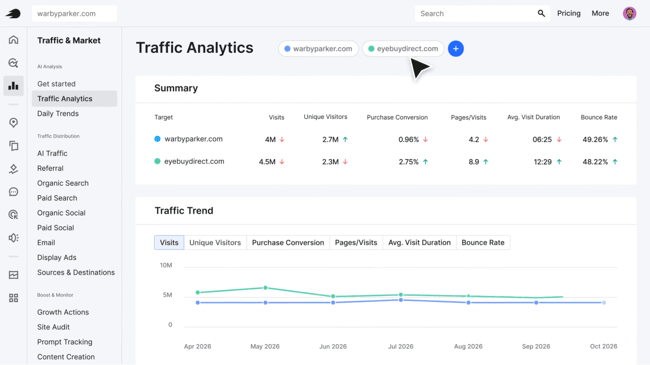
SEMrush is an all-in-one digital marketing platform that includes SEO, AI-driven visibility tracking, competitive intelligence, content optimization, advertising and PR.
Key Features
- Keyword research via the Keyword Magic Tool with a database of over 28 billion keywords in 142 geodatabases
- Content marketing toolkit with content briefs, topic research and an SEO writing assistant
- AI Visibility Toolkit to track brand presence in Google AI Overviews, ChatGPT, Gemini and Perplexity
- Site audit, backlink analysis, rank tracking and competitive gap analysis
Prices: Starts at $139.95/month when billed monthly or $117.33/month when billed annually.
What I like: With the addition of the AI Visibility Toolkit and SEMrush One package, teams no longer need to manage separate tools to track both traditional search rankings and AI citation visibility.
Best for: Mid-market and enterprise SEO and content teams who need a comprehensive platform for organic strategy, competitive intelligence, and AI visibility tracking in one place.
What the experts say: Chaudhary is a fan of SEMrush. He said: “I use this tool to find keywords and see what my competitors are doing. I use SEMrush to plan what I will write about and to see how my website is performing over time. SEMrush helps me create a plan for my website.”
Ahrefs
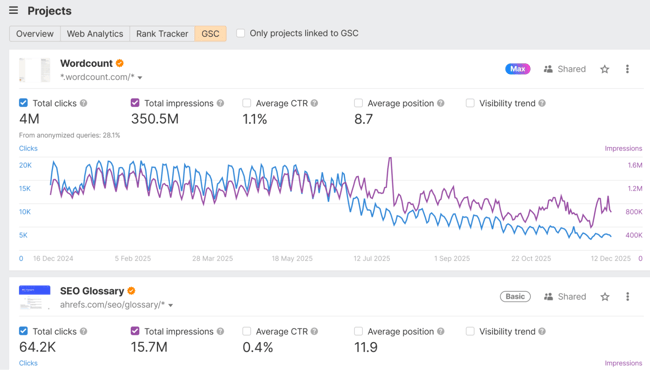
Ahrefs is an AI marketing platform that combines SEO intelligence, backlink analysis, content research, and AI-driven search visibility tracking.
Key Features
- Site Explorer for backlink and organic traffic analysis across competitor domains
- Keywords Explorer with keyword clusters, AI suggestions, search intent classification and SERP history
- Content Explorer to find high-performing content by topic and identify potential links
- AI search visibility tracking across organic LLM prompts with custom prompt monitoring
Prices: Starts at $129/month billed monthly or $108/month billed annually.
What I like: Ahrefs’ Content Explorer is useful for working on content strategies. It allows marketers to search for the highest-traffic content on any topic, filtered by date, domain rating, and linked domains, and it uncovers competitive gaps missed by keyword research alone.
Best for: SEO strategists and content teams who need comprehensive competitive intelligence alongside keyword and backlink data and want to integrate AI visibility tracking into the same platform rather than manage it separately.
(Are you looking for more tools? Check out this list 53 Free Content Writing Tools to Improve Your Workflow.)
Frequently asked questions about content optimization tools
How are content optimization tools different from SEO optimization tools?
Content optimization tools support research, letter writing, on-page optimization, testing, and reporting. SEO optimization tools cover a wider range of search tasks such as: B. Keyword research, audits, tracking and technical analysis.
Most high-performing content teams use both SEO tools to set strategic direction and identify opportunities and content optimization tools to ensure what is published is competitive enough to be successful.
Are there really free content optimization tools?
Google Search Console is free and provides the basic performance data for all content optimization efforts. For content teams with a real need for optimization, a paid tool is typically required to get the depth of competitive analysis and keyword coverage they need.
What content optimization tools integrate best with HubSpot?
HubSpot’s SEO tools, Content Hub, and AEO platform integrate natively, eliminating the need for data synchronization and linking performance metrics directly to contacts, pipeline, and revenue. Among third-party tools, both SEMrush and Ahrefs offer HubSpot integrations that display keyword and performance data in the CRM.
How do I measure the ROI of content optimization software?
The most reliable approach is to establish a performance baseline before using a tool and then measure changes in organic sessions, keyword rankings, leads generated, and influenced pipeline over a period of at least 90 days. Specifically for AI search, content teams should also track changes in brand citation frequency across major AI platforms in addition to traditional search metrics. Tools like HubSpot that link content performance to CRM data make this mapping much easier.
What is the best AI content optimization tool for small teams?
AI content optimization tools speed up copy creation, make recommendations, and automate workflows. For teams already using HubSpot, Content Hub’s AI content writer handles the creation, development, and on-page optimization of briefs in a single environment, reducing the number of tools a small team must manage.
Build a content optimization stack that works in 2026.
Content optimization is a system that includes strategy, creation, structure, and measurement, not a single step in the publishing process.
I’ve worked with content teams at varying levels of maturity, and the ones who get the best results treat content optimization as a discipline. And it starts with better tools and a clear system for using them.
For most content teams, that means full-stack content optimization runs through HubSpot because it connects the parts that typically stay siled: SEO recommendations, AI writing, AEO visibility, and CRM-mapped performance reporting.
For content teams who don’t know where to start, this is Content marketing planning templates are a great first step to building a structured, measurable content program that makes optimization work.