

Growth experiments are a structured approach to testing ideas across the customer journey to discover what drives measurable business growth. Experimentation improves channel-by-channel optimization as marketing teams push for measurable, repeatable growth despite tight budgets.
The pressure is real. At HubSpot State of marketing in 2026 According to a report, 73% of marketers say their budgets and ROI are under greater scrutiny, while 83% of teams say leadership expects them to deliver even more content. The natural response for teams is to test more. As the buyer’s journey becomes scattered and unpredictable, growth marketers must learn what drives acquisition and retention quickly—and what signals are worth scaling.
HubSpot Marketing Hub provides teams a place to run experiments, segment audiences, and measure results across the funnel.
Table of contents
What are growth experiments?
Growth experiments are a structured approach to testing ideas across the customer journey to discover what drives measurable growth. Marketing leaders use experiments to test messaging type, timing, and journey design. Teams can then scale what works over time.
Unlike isolated testing, growth experiments focus on validated learning. Every experiment begins with a hypothesis. Marketers decide which metrics determine success and then run the experiment on a specific audience. The results can be used to make marketing decisions or improve future testing.
Growth experiments vs. CRO vs. A/B testing
The difference between growth experiments, conversion rate optimization (CRO), and A/B testing is the scope and intent.
- A/B testing compares variations.
- CRO is improving Conversion on a defined path, e.g. B. a landing page, a registration form or a checkout.
- Growth experiments tests broader hypotheses that can influence multiple stages of the funnel.
Growth experiments often use A/B testing and CRO tactics, but uses these tactics to validate broader marketing strategies. A growth manager might test a new segment, adjust positioning, experiment with a dedicated landing page, and change follow-up emails. The goal is to identify repeatable growth levers, not just improve an asset.
Whether the goal is to validate a full-funnel growth hypothesis, improve conversion on a key journey, or compare two variants in a clean A/B test, HubSpot Marketing Hub gives teams the tools to run experiments. Get started with free HubSpot A/B testing kitthen use advanced tools like scout or Audience segments convert individual tests into a repeatable experimentation process.
Growth Experiments vs. CRO vs. A/B Testing: Comparison Chart
Why growth experiments are important now
Growth teams can no longer stick to a fixed channel playbook and expect stable results because the buyer journey is far too fragmented. By polling a response engine, using AI mode, and scrolling Reddit and TikTok, shoppers from anywhere learn more about your products.
Marketers are looking for their most effective channels and want to optimize them. So, teams need a quick but reliable way to find out where acquisitions are happening. They then need to test which activation experiences drive momentum and which marketing tactics generate increased demand.
HubSpots Loop marketing model is based on an experimental way of thinking. With Loop, marketers create systems in which teams constantly experiment with which marketing strategies drive demand, acquisition, and retention. Teams using the Loop are constantly experimenting. The result is data-driven learning that can improve marketing strategy across all lifecycle stages simultaneously.
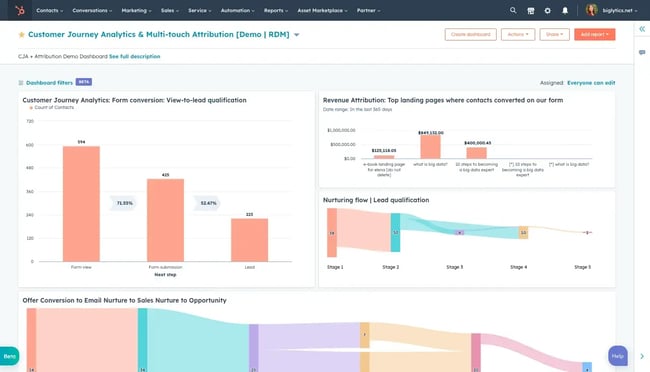
Marketing Hub helps teams run experiments and apply insights faster. Marketers can define new audience segments and provide content that appeals to each person. You can also use A/B testing and measure impact across all lifecycle stages advanced marketing reporting.
How to create a strategy for growth experiments
Successful growth experiments follow a structured approach. Marketers should define the scope, ownership, and success of the experiment before striking in A/B testing. Start with a clear business problem and translate that challenge into a hypothesis. From there, teams can design an experiment with established guardrails to gather insights.
1. Start with a growth question.
Most teams start with ideas like “Test a new headline” or “Try LinkedIn ads.” Growth teams start with a business question tied to a bottleneck or pain point. By starting with a real challenge, experiments focus on growth and strategy refinement rather than asset optimization.
Before growth marketers lift a finger, ask themselves:
- Why are visitors with high purchase intent not being activated?
- Which ICP converts to the pipeline the fastest?
- Which product promotion predicts customer loyalty?
- What acquisition source drives expansion sales?
Each of the questions above links experimentation to results. For example, if a question asks, “Which audience converts to the pipeline the fastest?” Growth teams will likely run the following experiments:
- Testing different landing pages with different ICPs.
- Test messaging variation by industry.
- Comparing demo CTAs to free tool CTAs.
- Try different timings for sales tracking.
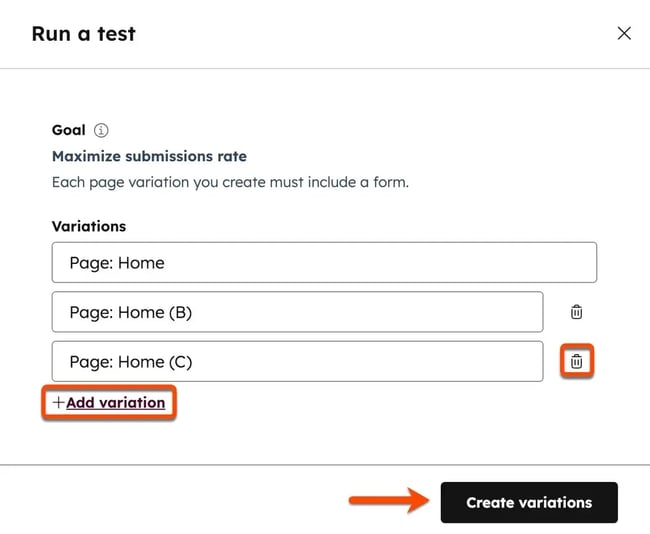
HubSpot Marketing Hub supports a variety of experiments. Marketers can segment campaigns by audience so teams can test different ICPs. Teams can also run adaptive testing across campaigns and landing pages.
2. Align experiments across teams.
Growth experiments fail when marketers conduct isolated experiments. Growth marketing, lifecycle marketing, product marketing and demand generation should consult each other before conducting experiments.
Each of these teams influences a different part of the customer journey. For example, lifecycle marketing teams influence activation and retention behavior. When these teams experiment independently, conflict arises. Demand generation can increase traffic, but the lifecycle does not activate users.
Teams can run cross-functional or tandem experiments while focusing on the same growth goals. Typically, experiments focus on phases of the customer journey where teams experience the highest drop-off or lowest engagement.
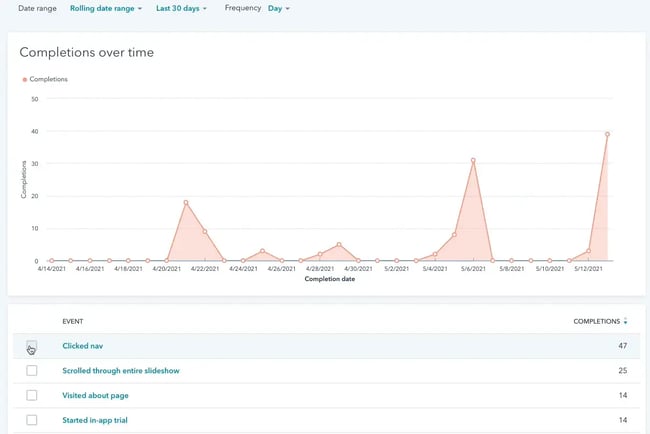
Pro tip: To operationalize testing, marketing managers use HubSpot CRM Track behavioral events on specific user actions And Segment users based on lifecycle milestones. Watch a free lesson on this Create behavioral events in HubSpot.
3. Prioritize experiments based on impact and learning value.
Growth teams prioritize experiments based on how much they expect to learn and how valuable those insights are to the company. High-learning experiments Answer basic questions such as: “Which ICP converts fastest?” “What value proposition activates users?” “Which onboarding step promotes customer loyalty?”
High-impact testing affecting multiple channels at the same time. Experiments with little learning effort Optimization of elements close to the surface. Key color tests, minor layout changes, or small text variations rarely change the growth trajectory. You can improve the conversion locally, but do not provide reusable insights.
To set the right priorities, growth teams evaluate experiments based on:
- Potential impact on sales.
- Learning value across all channels.
- Time to implement.
- Confidence in the hypothesis.
- Ability to scale results.
For example, testing a new ICP has high learning value as the results influence paid media, outbound, positioning and lifecycle. Testing a CTA color has little learning value because it only applies to one page and is usually part of the CRO.
Pro tip: For more information about designing experiments, check out HubSpot’s guides to designing experiments for your website and running the perfect marketing experiment. )
4. Design experiments that include multiple touchpoints.
Growth experiments span multiple assets and test a comprehensive customer experience. When these elements change simultaneously, the results reveal whether the hypothesis actually influences growth and provides reusable insights.
For example, teams may want to test a CFO persona. However, insights will be limited if ads are still targeting general audiences and onboarding is targeting product users. Instead, growth teams test the entire experience together, including:
- Target group targeting.
- Message targeting.
- Conversion paths.
- Activation experience.
To enable this consolidated approach, marketers choose Marketing Hub for its comprehensive experience testing by combining segmentation, AI-powered A/B testing, and personalization. HubSpot acts as an all-in-one system for driving growth.
5. Define success metrics linked to business results.
Click-through rate, open rate, impressions, and page views are helpful signals that show how much engagement a piece of content is receiving. However, these performance metrics may improve as the pipeline declines. Growth experiments require metrics that are closely linked to business results. Examples of strong primary metrics include:
- Sign up for the activation price.
- Opportunity Rate Demo.
- Activation to retention rate.
- Free conversion to paid version.
- Expansion proceeds.
Also, Track downstream impacts. If activation improves, does retention also increase? Does pipeline quality change as signups increase? This ensures that experiments drive real growth, not individual optimizations.
Marketing Hub reporting enables teams to track experiments across lifecycle stages and link campaign performance to pipeline and revenue results. Marketers can then evaluate experiments based on business impact rather than engagement metrics.
6. Turn experiment results into repeatable growth games.
Growth experiments Just works when validated insights are scaled beyond the original test. If results stay within one campaign, page, or channel, the experiment has no real impact on growth. Once a result proves to be consistent over a meaningful sample size or segment, turn these insights into a repeatable game. Apply the winning variable – audience, message, offer, or activation trigger – throughout the funnel.
For example, if a value proposition improves activation, that insight becomes a repeatable play. Marketers can update website language, paid campaigns, lifecycle emails, and onboarding prompts to reflect the experiment’s messaging. Instead of a successful test, an organization now has a reusable growth lever.
How to build a culture of experimentation across teams
Building a culture of experimentation requires more than encouraging teams to test ideas. Growth leaders say it comes down to shared business goals, lean processes and tight feedback loops that make experimentation part of everyday work.
Use structured workshops to turn experimentation into a shared team practice.
Building a culture of experimentation requires more than just nurturing ideas. Teams need a structured way to generate hypotheses, assign responsibilities, and pressure concepts across functions. To fix this problem, Olga AndrienkoChief Marketing Officer at Foxteryformer VP of Brand at SEMrush, designed ideation workshops.
She says, “One time I created an in-person session where we first brainstormed the ideas we wanted to bring to life. Everyone could join in, split into groups, and then the groups presented their ideas. Then I asked for volunteers who would own the ideas they liked.”
According to Andrienko, the workshop ended with seven tables, each with an idea contributor. The format gave everyone a role and encouraged the further development of ideas.
“The rest of the group was divided into teams of three and traveled from table to table. Each team had five minutes per table to explain the idea in more detail, consider metrics, details, advertising, production, etc. Later we implemented two of seven ideas,” explains Andrienko.
Protect experimentation from complex project management.
One of the quickest ways to stop experimentation is to treat it like traditional project management. As documentation increases and approvals multiply, teams lose the speed that makes experimentation valuable in the first place.
“The more documentation, review cycles, and approval levels you add, the more an “experiment” ceases to be an experiment and becomes a project. Growth experiments are not “quarterly projects.” “Projects don’t create the fast feedback loops that make experiments valuable in the first place,” he says Ryan Carruthers, a growth marketer at Supademo.
Carruthers saw this firsthand when he joined Supademo. His instinct was to create detailed planning documents before putting anything into action. The result was slower experimentation and lost momentum. Following feedback from the CEO, Carruthers built a simpler documentation system so he could spend more time conducting tests.
“Now we just have a lightweight Notion database with simple fields: what you want to test, what success looks like, what you need to do and when you will evaluate it,” Carruthers continues. “Stakeholders answer yes or no. That’s all.”
Make sure everyone understands why experimentation is important to the company.
Accordingly Lemon.io Head of Growth Anna DolynskaExperiments must have a direct connection to something the entire company cares about. With a common goal, teams are more likely to conduct tests and adopt an experimental mindset.
“Abstract ‘let’s test more’ orders don’t move cross-functional teams. Concrete problems that can’t be ignored do,” says Dolynska.
Dolynska illustrates this with an example from Lemon.io, which helps startups hire web developers. The team found that the people searching for React developers were a high-intent audience. However, the homepage was too comprehensive to address this specific issue.
“Then we realized the gap was actually larger, and we created over 600 pages targeting specific roles, technologies, regions and industries,” she said.
Dolynska emphasizes that the new web strategy was a cross-functional project from day one – technology, sales, product and marketing were equally involved and implemented accordingly. The coordination across teams only worked because everyone deeply understood why the experiment was important.
Build faster feedback loops into the way teams work.
Experiments are easier to scale across teams when they are integrated into the operating model. Instead of linear campaigns, growth and marketing teams need to be more flexible. Teams should conduct smaller, quick experiments to quickly validate new ideas.
“At HubSpot, we know that the marketing landscape is changing (thanks to AI), and to keep up we need to experiment. Now our entire culture is expected to evolve faster. In fact, to address this change, we have developed a completely new marketing approach – loop marketing – in which experimentation plays an important role,” he shares Kaitlin MillikenSenior Program Manager at HubSpot
At HubSpot, Milliken says, campaigns adapt based on early User feedback
“A few years ago, we did things in a linear fashion: first we decided what to do, then we set the budget, we executed it, and only then we waited for the results,” says Milliken. “By iterating based on early signals, experimentation and innovation become part of how teams work.”
Pitfalls and solutions for growth experiments
To achieve real results that drive growth, experiments must be well designed. Avoid unnecessarily complex tests and ensure that all key metrics can be measured. Once a hypothesis is validated, teams must also create a plan to act on those findings.
These are the lessons experienced growth marketers learned the hard way so you don’t repeat the same mistakes.
Don’t scale insights, scale artifacts.
Teams can conduct an experiment and prove their hypothesis. But even if the work stops there, initiatives can still fail. Marketers need to take insights from experiments and apply them to real-world strategies.
“The most common mistake I have seen and experienced myself is that successful experiments are not truly scalable,” concluded Lemon.io’s Anna Dolynska. “So you validate a hypothesis, the metrics seem strong, and then… nothing moves.”
Dolynska returned to the experiment, which led her team to create 600 pages of messages tailored to the messages of different audiences. While these sites saw a conversion rate of around 20% to SQL visitors within a few months of launch, in her opinion, “sustaining and scaling this result proved more difficult than achieving it.”
Teams need to plan how they will scale their results and delegate a clear owner for the subsequent work.
Log experiments to prevent testing repeated hypotheses.
A culture of experimentation means that multiple teams conduct experiments at the same time. Marketers need to log their tests to prevent them from revising or testing the same hypothesis multiple times.
Marketers should document their work and share the results across teams. Be sure to cover both successful and failed tests. Dolynska’s team writes a short autopsy for each experiment with four main sections.
- What we tested
- What we saw
- Why we stopped
- What we would do differently
“Without documented reasons for failure, teams return to the same hypotheses 12 to 18 months later—usually after some team or priority shifts—and spend months relearning what they had already learned,” says Dolynska.
Address measurement gaps to make experiments actionable.
Before you begin an experiment, consider what you want to measure and how those measurements will be collected. If measurement gaps exist, teams may need to find new tools to collect important data.
In emerging disciplines like AEO, closing measurement gaps can be particularly difficult.
“When we switched to AEO, we initially started running experiments to see how product mentions and keyword saturation would improve performance. But we didn’t know what to measure. We knew we had to make the switch, but we didn’t have the right tools to measure it at first,” says Kaitlin Milliken of HubSpot.
However, Milliken shares that experiments became easier to evaluate and iterate after the team developed AEO measurement tools for AI share-of-voice.
“HubSpot AEO helped us achieve a 1,850% increase in qualified leads through AI. Only then have we proven our hypothesis and confirmed that we are on the right track,” she says.
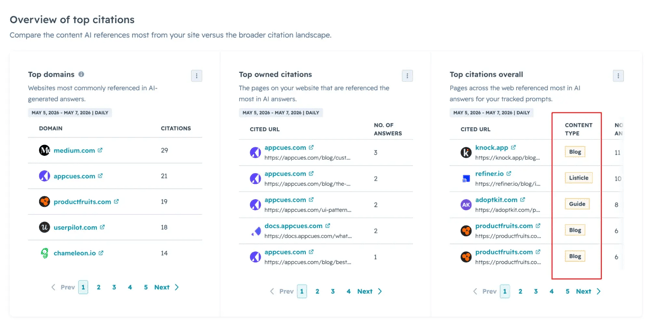
HubSpot AEO Tracks brand visibility in LLMs, sentiment, prompt performance, competitor presence, and most cited content type. It also analyzes your website and gives concrete AEO recommendations on what you should improve to increase your AI share of voice.
Start with the smallest version of the experiment.
Experiments often stall when teams are eager to design them at full scale rather than testing the smallest viable version. What starts as a quick validation turns into a cross-functional initiative that is simply too complex to ship. So the idea dies before it is tested.
Ryan Carruthers saw this trap unfold.
He says, “We wanted to test an uncontrolled product experience where nonprofit grant seekers could enter the funding they wanted and start using the product right away. Simple idea. But it never delivered. As we explored it, we realized it touched user onboarding, required homepage changes that needed to be signed off all the way to the CEO, and suddenly what had been a two-week experiment had turned into a quarterly initiative to take us from SLG to true PLG.”
Carruthers points out that they could have done the experiment if they had asked themselves: What is the smallest version that we could actually use?
Frequently asked questions about growth experiments
How many experiments should we do at the same time?
Run as many experiments as your team can properly design, measure, and learn from. For most growth teams, this means starting with two to five simultaneous experiments tied to a clear goal. Prioritize fewer experiments with meaningful impact across the entire customer journey. Tests that impact acquisition, activation, or onboarding produce reusable insights.
When should we stop or extend an experiment?
Stop an experiment when statistical certainty is achieved and the result is clear, or when early data shows that the hypothesis is invalid and continuation does not change the result. Expand an experiment If the results are suggestive but inconclusive, the sample size is too small or external factors have distorted the performance.
Do we need a dedicated growth team to get started?
No – companies can start with growth experiments within existing marketing, product or lifecycle teams. The most important requirement is shared responsibility and a simple process for prioritizing hypotheses, conducting tests and documenting results. Without this structure, experiments remain isolated and learning cannot scale.
A dedicated growth team becomes useful as experimentation volume increases and testing begins that spans multiple teams. In this phase, a growth function helps coordinate the cross-functional rollout and ensure that successful experiments are scaled.
What tools do we need to get started?
To get started, you don’t need a complex experiment stack. Start with product analytics, marketing automation, A/B testing tools, and a shared experimentation backlog. HubSpot Marketing Hub has all the tools listed in one system that prevents spread.
Turn experimentation into repeatable growth.
How quickly teams validate a hypothesis, connect the insights to other parts of the journey, and scale what works is fundamental to growth experiments. However, teams need tools to make this happen. The HubSpot Marketing Hub brings together segmentation, A/B testing, personalization, and advanced custom reporting in one place, so insights don’t stay within a campaign.
Once marketers have the tools and fresh perspective to experiment with growth, they can quickly validate hypotheses, conduct precise testing, and make adjustments on the fly.