

A CRM is like a teenager’s diary – full of sensitive information. But instead of school stories and secrets, it stores contact records, purchase histories, support conversations and, for some, health information or payment details.
Without proper CRM compliance, someone on your team could be doing something risky with that data right now. And it’s not malicious; It is the nature of working with private data in a digital space.
Accordingly IBMThe average data breach now costs companies $4.88 million and probably even more in customer trust. Most teams know they need to do something about CRM compliance, but few know where to start.
This guide cuts through the noise. I explain what CRM compliance actually means, general business regulations, technical controls to look for in a CRM, and how to create a CRM compliance program that your team will actually follow.
Table of contents
What is CRM Compliance?
Your CRM knows a lot about people. Names, emails, purchase history, support tickets, health information and financial information; Depending on your industry, a single contact record can contain more personal information than most filing cabinets ever have.
Because so much private data is communicated and documented, rules must be in place to prevent its compromise or misuse. This is exactly why CRM compliance exists.
CRM compliance is the ongoing process of aligning your CRM data practices with the laws, security standards, contractual obligations and internal policies that govern the handling of customer data. This is not a one-time exam. It is a living program that describes how your customer data is collected, stored, used and deleted.
Because multiple teams interact with the CRM, CRM compliance is a shared responsibility across marketing, sales, service, operations, IT and legal.
In practice, this means that CRM compliance can look like this:
- Marketing, obtaining and recording consent before sending emails.
- Sales only have access to the records of the accounts assigned to them.
- Ops can delete a contact upon request within 30 days.
- IT uses an audit log to prove who changed what and when.
- The Legal Department ensures that data sent to third-party tools complies with transfer rules.
Think of it this way: Unlike the diary lying under the mattress, dozens of people across multiple teams access your CRM every day, and that’s exactly why CRM compliance can’t be an afterthought.
Want a refresher on what a CRM actually does? Checkout HubSpot CRM Overview.
Why CRM compliance is important
The short version? The risks associated with non-compliance are real, but so are the benefits that come from compliance.
Risks: The cost of poor CRM compliance
Regulatory scrutiny of CRM compliance is increasing. Just think of recent high-profile performances Instagram data breaches or Elon Musk’s DOGE.
Cisco points out 53% of consumers are now aware of data protection laws and a growing proportion (36% compared to 28% last year) are actively exercising their data rights by submitting requests for access, correction, deletion or transfer.
Greater consumer awareness means more Data Subject Requests (DSRs), more control and higher expectations of the companies that own their data. Companies that fail to do this face hefty fines.
According to the IBM 2024 Violation Report, non-compliance is now associated with a 22.7% increase in companies paying fines over $50,000.
Rewards: Confidence that converts
Now, the business case for compliance is not just about coins and cents saved. Arguably the most valuable gain from CRM compliance is customer trust.
Today, 88% of consumers believe a company’s data reputation is important when making business decisions, and 86% say trust directly inspires them to buy or use its products. The same survey found that 74% of Americans are actively concerned about how companies handle their personal information. So there is no sleeping when it comes to CRM data security.
Your customers may not be aware of a well-run CRM compliance program, but it is one of the most important factors in maintaining your relationship with them. CRM compliance and secure data directly impact pipeline, retention and lifetime value.
Pro tip: I’ve found that teams with documented consent and retention processes complete compliance reviews in days instead of months. These upfront operational investments are small compared to the fees and lost revenue following a breach or regulatory investigation.
HubSpot Smart CRM is equipped with consent logging, role-based access, and audit trails so your compliance foundation is in place before you even need it.
Start protecting your customer data today. Try HubSpot Smart CRM for free.
Which laws and standards apply to CRM compliance
CRM compliance does not exist in a regulatory vacuum. When handling customer data, there are multiple overlapping laws and standards to consider depending on your industry, region, and type of data you process.
For example, a US healthcare company serving EU patients could face GDPR, HIPAA and PCI DSS at the same time.
Below is an understandable breakdown of some of the most well-known regulatory frameworks. However, be sure to consult qualified legal counsel to confirm your specific obligations.
|
Regulation/norm |
Who it applies to |
Key CRM commitments |
Maximum penalties |
|
GDPR |
Any organization that processes data of EU/EEA citizens |
Consent, Legal Basis, DSRs, Deletion, DPAs, Violation Notification (72 hrs) |
€20 million or 4% of global sales |
|
Businesses serving California residents that meet size thresholds |
Right to information, deletion, objection to sale, disclosure of data and non-discrimination |
$7,500 per willful violation |
|
|
US healthcare companies and their business partners |
PHI access controls, audit trails, BAAs, encryption, breach reporting |
Up to $1.9 million per violation category per year |
|
|
Any organization that stores, processes or transmits cardholder data |
Encryption, access controls, logging, vulnerability management |
$5,000-$100,000 per month pending compliance |
|
|
SaaS and cloud service provider |
Security, availability, confidentiality, processing integrity, data protection |
No direct fines; Loss of supplier contracts |
|
|
Any organization seeking international security certification |
ISMS controls, risk assessment, access management and incident response |
loss of certification; Impact on reputation |
A few important ones Special features to note:
- The GDPR applies to you even if you are based in the US if you process data from EU residents.
- HIPAA only covers Protected Health Information (PHI). However, if your CRM stores health data, you will likely need a Business Associate Agreement (BAA) with your CRM provider.
- SOC 2 and ISO 27001 are voluntary certifications, but corporate buyers are increasingly demanding them before signing contracts.
For a deeper insight into the GDPR in particular, see HubSpot’s guide to GDPR compliance.
CRM security policies and required controls
Any major compliance framework requires a set of technical controls in your CRM to execute and maintain compliance.
Let me work through each one with you.
Encryption and key management
A compliant CRM must encrypt data in transit and at rest. In other words: it must be made unreadable.
In transit means that the data transferred between your browser, your CRM and any connected tools is protected by TLS (Transport Layer Security). At rest means that data stored in databases, backups and logs is encrypted using AES-256 or equivalent standards.
Key management or ownership of the encryption keys is equally important.
Enterprise-class CRMs should offer customer-managed keys for organizations that require them under HIPAA or ISO 27001.
HubSpot Smart CRM By default, encrypts all data in transit and at rest. For enterprise customers with advanced compliance requirements, HubSpot supports additional security configurations.
Check current certifications and download safety reports at trust.hubspot.com.
Role-based access and least privilege
That secret diary we were talking about? There is only one reader: the person who wrote it (hopefully). Your CRM can consist of dozens, if not thousands, which is why controlling who sees what is one of the most important things you can do.
Role-based access control (RBAC) means each user can only see and do what their job requires in your CRM.
For example, a sales representative shouldn’t have access to executive compensation data and a marketing intern shouldn’t be able to bulk delete contact records.
Following “Principle of least privilege” makes sense, especially for larger organizations. Even within a role, permissions should be as narrow as possible. This will minimize the impact if an account is compromised.
Here’s an example of what that might look like:
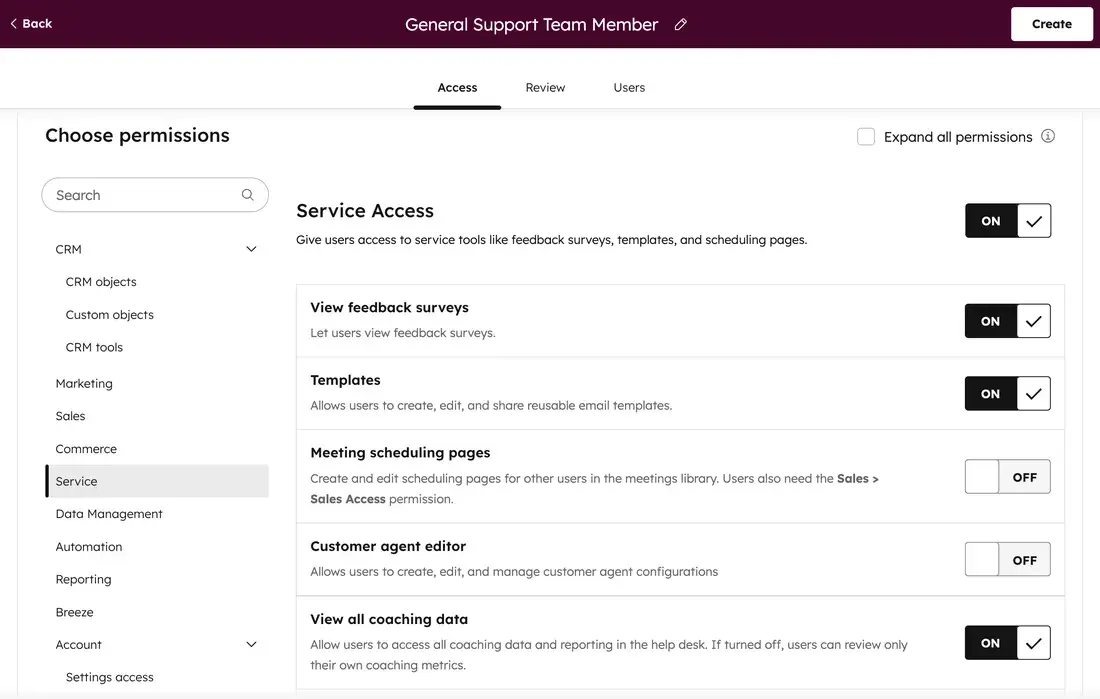
- Define user roles (administrator, manager, representative, read-only) with granular permissions.
- Restrict access to records by team, territory, or contract phase.
- Update access when employees change roles or leave the company.
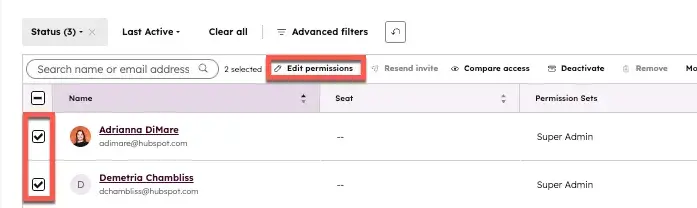
User and permission settings are also available across all HubSpot accounts.
Authentication, SSO and MFA
Weak credentials are the most common cause of data breaches. According to IBM’s 2024 report, it took an average of 292 days to detect and contain breaches involving stolen or compromised credentials such as passwords and usernames.
To protect against this, a compliant CRM should require:
- Multi-factor authentication (MFA) for all users, especially administrators. This occurs when you log into your account but are then required to “confirm” your identity by, among other things, entering a code sent to you via SMS or clicking a link in your email.
- Single Sign On (SSO) Integration with your identity provider (e.g. Okta, Azure AD, Google Workspace). This logs users into a single system that gives them access to all the tools they need.
- Session timeouts and automatic logout after inactivity. This way, if you leave your workplace for a long time, no one can snoop around.
- IP allowlist for organizations with fixed location teams.
Audit trails and change history
An audit trail is a timed log of all important actions in your CRM, including:
- Who created a record?
- Who changes a field?
- Who exports data?
- Who creates reports?
Regulators and auditors look for this during investigations to get a better idea of where something may have gone wrong.
Without audit trails or change history, you cannot:
- Prove that a consent record has not been retroactively changed.
- Determine who deleted a contact and when.
- Show an auditor that access was immediately revoked after an employee left.
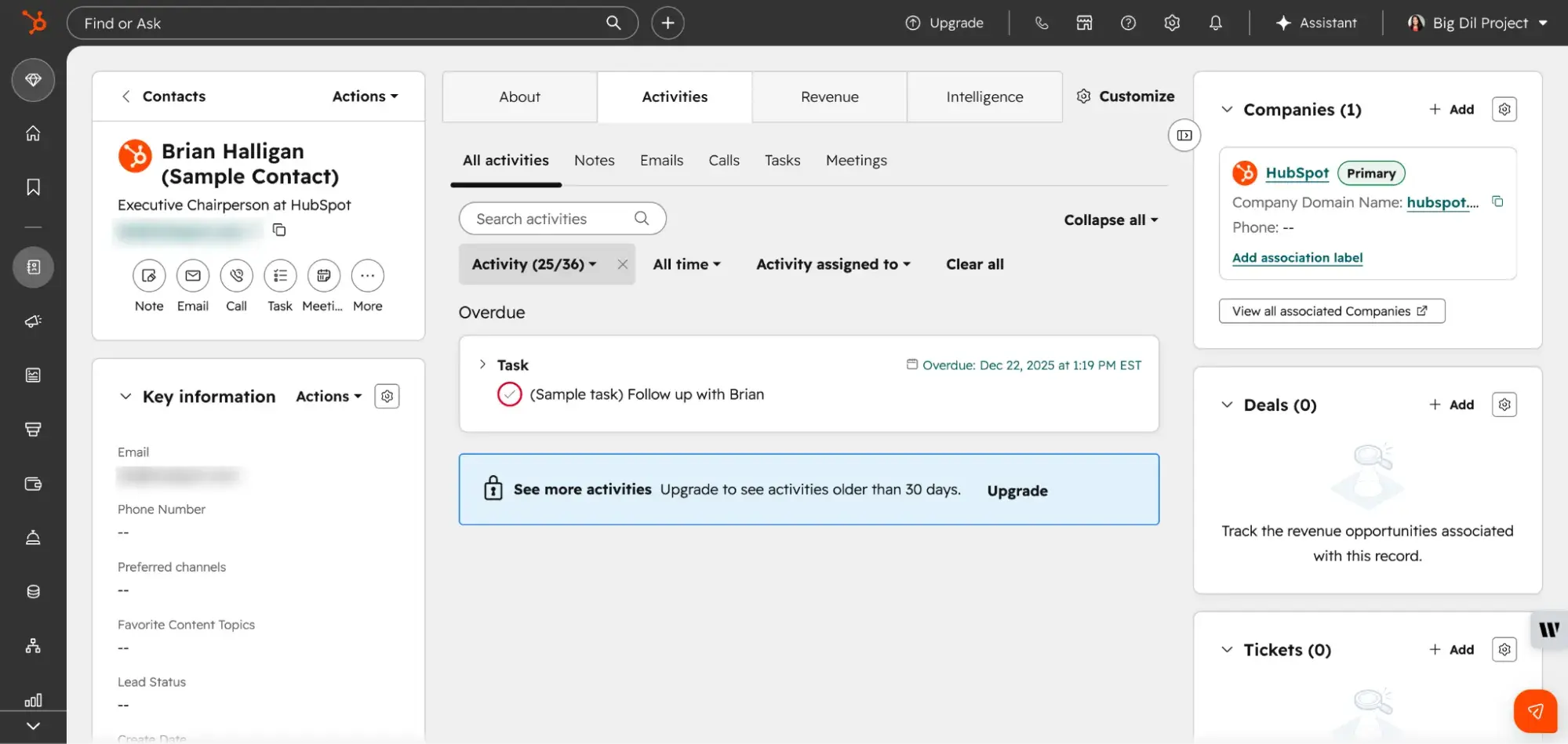
HubSpot Smart CRM keeps detailed activity logs for contacts, companies, deals, and admin actions in addition to asset editing. These logs can be exported for auditing purposes.
Backup, recovery and data residency
Many compliance frameworks require that data can be restored in the event of a breach or incident and that all backups remain within certain geographic boundaries. And that makes perfect sense.
This is like backing up your photo files to an external hard drive you have at home just in case something happens to your laptop or phone.
Here’s what you need to know:
- Backup and Restore: Your CRM provider should perform regular automated backups with defined recovery point objectives (RPO) and recovery time objectives (RTO).
- Data residency: The GDPR requires that data of EU citizens not be transferred to countries without sufficient protection. For some organizations, this means that CRM data can only be hosted in certain regions (EU, US, APAC). Therefore, check where your provider’s data centers are located and explore location options.
How to create a CRM compliance program
Ok, so knowing the rules is the easy part. Building a CRM compliance program that actually works, your team follows, auditors approve, and your CRM enforces takes effort. These steps will help make the process a little less painful.
Step 1: Map your data and systems.
You can’t protect what you don’t know you have. keyword Data Mapping.
Data mapping is the process of documentation:
- The types of personal data your organization collects
- where it comes from
- how it flows through your systems
- who can access it and
- when it is deleted
It’s like drawing a map of the lifecycle of your data, from the moment a visitor fills out a form on your website to the moment their record is deleted from your CRM, your email tool, and all the integrations in between.
According to the GDPR, this card is called a List of processing activities (ROPA), and maintaining one is a legal requirement for most organizations processing EU personal data. Even if GDPR doesn’t apply to you, a data card is the most useful document you can have when a regulator, auditor or legal team asks questions.
Here’s how to build one:
1. Take inventory: List every category of personal data in your CRM, including custom properties. Answer four questions each:
- What data do we collect? (e.g. name, email, phone, IP address, health information, payment information)
- Where does it come from? (e.g. web form, list import, integration, manual entry, enrichment tool)
- Where are we going? (e.g. email tools, advertising platforms, analytics, data warehouses)
- How long do we keep it? And is this actually documented somewhere? (i.e. 90 days, 2 years, indefinitely)
2. Trace each category back to its origin (source attribution). A form submission, a CSV import, an API push, and a manual entry all come with different risks and consent requirements.
3. Track where the data goes (flow mapping). Document where each category goes after it is entered into the CRM. Which tools receive it via sync or API? Does your email platform receive the full contact record or just name and email? This ensures that no data goes unnoticed.
4. Document who can see and edit what (access mapping). Note which roles and teams can view or edit each category. Sensitive fields like health records or payment information should have a much shorter access list than standard contact fields.
5. Assign a retention period to each category (retention assignment). Describe how data is stored and deleted. “We keep it until we no longer need it” is not a retention policy.
6. Mark your highest risk categories (risk labeling). IIdentify highly sensitive categories that require additional controls: health data, payment data, data of minors, and data of contacts in regulated regions such as the EU or California.
In practice, teams that do this manually (usually in a spreadsheet) spend weeks doing it and end up with an outdated document before it’s finished. The map will only remain correct if it is updated when your stack changes. That’s why tools are important.
HubSpot Data Hub gives teams visibility into data lineage across its integrations and connected systems. This makes your data card a living document rather than a one-off project.
Pro tip: When mapping data, start with the highest risk data categories. Health information, payment data and contact data in regulated regions (EU, California) are at the highest compliance risk. Classify these first, apply controls, and then work outward to categories with lower sensitivity.
A complete data card also makes each further step in this program easier.
Step 2: Operationalize consent and preferences.
Consent management is where most teams have the biggest gaps. Marketing records consent in a system, sales ignores it, and service overrides it. This is not malicious; It’s just a mistake that can happen when you’re working with a lot of moving parts.
The solution? Create one Consent Program The:
- Records the legal basis for each contact (i.e. your reason for retaining the data, e.g. consent, legitimate interest, contract, etc.).
- Records when and how consent was obtained and through which channel.
- Takes opt-outs into account immediately on all broadcast channels.
- Captures channel preferences (email, SMS, phone) separately. Consent for one channel does not cover all channels.
HubSpot Smart CRM Stores contact-level consent and communication subscription data with field-level history. This means you have a defensible, time-stamped record for each person.
For more details on CCPA-specific consent requirements, see HubSpot’s CCPA Compliance Guide.
Step 3: Set retention and automatic deletion.
There is liability for all customer data you store. Retention policies determine how long you retain each category of data and what happens when that time expires.
In this step, you want to define these schedules and use automation to be more efficient.
For example, you can use workflow automation in HubSpot to notify you when deletion deadlines are approaching or to suppress tasks when retention periods expire. This helps you keep up with regulations without any manual effort or thinking.
A viable retention framework looks like this:
|
Data category |
Recommended storage |
Action at expiration |
|
Active customer contacts |
Duration of relationship + 3 years |
Archive or delete according to legal retention policy |
|
Potential Contacts (No Conversion) |
12-24 months after last engagement |
Delete or suppress |
|
Marketing Consent Records |
Duration of relationship + 5 years |
Retained for official defense |
|
Support tickets |
3-5 years depending on jurisdiction |
Delete PII, retain ticket metadata |
|
Payment data in CRM fields |
As short as possible; Use a payment processor |
Delete immediately after editing |
Step 4: Establish a process for fulfilling Data Subject Requests (DSRs).
GDPR, CCPA, and most modern data protection laws provide individuals with rights over their personal data. These are called data subject requests or consumer rights requests.
This may include inquiries:
- Access/portability: The person wants to know what you own and get a copy.
- Correction: Individuals want inaccurate data to be corrected.
- Deletion/deletion: The person wants their data to be completely deleted.
- Restriction: The individual requests to pause processing while a dispute is resolved.
GDPR requires you to respond to DSRs within 30 days. Without a tool that can quickly view, export, and delete contact-level data, this is nearly impossible. Therefore, it is important to have a repeatable process.
Tools like HubSpot’s Smart CRM make this much easier to manage. This allows you to search for a contact’s record, export it to an appropriate format, and delete all related records, including activity logs and form submissions.
Step 5: Train teams and verify access.
Technical controls only work if the people using the system know how to use them and why. In my experience, that means training.
Your compliance training should include at least the following:
- What data is in the CRM and why is it sensitive?
- How to handle a DSR when it comes in via email or support ticket.
- What to do if a breach or data leak is suspected?
- Which fields are restricted and why.
I also recommend conducting quarterly access reviews. Simply pull the user list from your CRM and look for accounts that should have been deactivated, such as: B. old employees, contractors and partners. Dormant accounts with highly privileged access are a common attack vector.
Step 6: Report, review and improve.
Compliance is not a goal. It’s a cycle. You need regular reviews to keep the program current as regulations change, your stack changes, and your business grows.
Create a simple compliance calendar with:
- Monthly: Access review, retention workflow review, DSR queue review.
- Quarterly: consent check, integration check, training completion check.
- Annually: full data mapping update, provider security audit, policy update.
For more information about CRM data curation best practices, see HubSpot’s CRM data curation guide.
How to enforce CRM compliance in your technology
A written policy is necessary but not sufficient. The only way to reliably enforce compliance is to build it into the system. This is what it looks like:
|
Compliance requirement |
Here’s how to enforce it in your CRM |
|
Consent is required before sending an email |
Block sending to contacts without a valid consent status; Use subscription types |
|
Retention period of 24 months |
The workflow automatically triggers deletion/suppression after 24 months |
|
Access is limited to assigned accounts |
RBAC rules limit the visibility of records by team or territory assignment |
|
The DSR must be completed within 30 days |
The intake form creates a time-stamped task. SLA alerts fire on day 25 |
|
Audit log required for field changes |
Enable field-level history for all sensitive properties in CRM settings |
|
Minimization of integration data |
Use sync filters to share only required fields with connected tools |
Responding to incidents in your CRM context
Data breaches involving CRM data require a coordinated response.
GDPR requires you to be notified within 72 hours of becoming aware of a breach, while HIPAA requires affected individuals and HHS to be notified within 60 days.
In yours CRM incident response plan, contain:
- Recognition: How do you know if CRM data has been accessed without authorization? Audit logs and alerts for unusual activity are your first line of defense.
- Containment: How can you revoke access, suspend affected accounts, and prevent further data export?
- Evaluation: Can you determine which records were affected and by whom?
- Notification: Do you know which contacts are based in the EU or California or covered by HIPAA? Your CRM segmentation should ensure this can be answered in minutes, not days.
- Documentation: For regulatory defense, each step of the response should be logged with time stamps.
For more information on the basics of digital security, see HubSpot’s guide to online security and eCommerce protection.
How to choose a CRM with compliance features
Not all CRMs are designed for compliance. That’s why when evaluating options, I look for platforms that view compliance as infrastructure rather than an afterthought.
Vendor security and governance checklist
Use this checklist when evaluating a CRM provider. We’ll walk through it using HubSpot as an example.
|
What you should pay attention to |
What you should ask |
HubSpot |
|
Certifications |
SOC 2 Type II, ISO 27001, GDPR ready, HIPAA ready? |
✓ SOC 2 Type II, ISO 27001, HIPAA BAA available |
|
Encryption |
Data encrypted at rest and in transit? Customer managed keys available? |
✓ AES-256 at rest, TLS in transit |
|
Access controls |
Granular RBAC, field-level permissions, record-level visibility? |
✓ Supported by team and permission set controls |
|
Authentication |
SSO (SAML 2.0), MFA, session management, IP allowlist? |
✓ SSO, MFA and IP allowlist available |
|
Audit logging |
Field level history, admin action logs, exportable audit log? |
✓ Activity logs, exportable data |
|
Data residency |
Data center location options, EU hosting available? |
✓ Data center options, including EU |
|
DSR support |
Can you export and delete a single contact’s full profile? |
✓ Full export and deletion of contacts is supported |
Check HubSpots Certifications and controls can be found here
Proactively evaluate your CRM for these features. My experience has taught me that the best time to address compliance is before you need it, not when a problem arises. For example, a CRM that cannot create an audit trail or fulfill a DSR in less than an hour represents a major compliance burden. Plan ahead.
How to manage integrations without compromising CRM compliance
Here’s a statistic that should chill any RevOps leader: IBM’s 2024 breach report found that 35% of all data breaches involved shadow data, or data that companies didn’t know existed and that was stored in systems they hadn’t fully inventoried.
One of the most common culprits is integration. Every tool connected to your CRM poses a potential compliance risk.
Marketing automation, advertising platforms, analytics tools, data enrichment services, outbound dialers, and customer success platforms all receive a copy of a subset of your CRM data. And without supervision, they are a risk.
Principles of integration governance
Integration governance means maintaining the same compliance standards for your connected technology stack as your core CRM.
The four rules I follow:
- Share the minimum necessary data. Only sync the fields that each tool actually needs. If your ad platform requires email addresses but not phone numbers, exclude phone numbers from your sync. HubSpot Data Hub enables sync filtering so you can control exactly which fields flow to which tools.
- Apply lAPI scopes with Eastern privileges. As with data, when connecting tools via API or OAuth, only require or allow the permissions the integration actually needs. Avoid connectors that request administrator-level access for read-only workflows.
- Have an aPP approval process. Require approval from IT or RevOps before a team member installs a new CRM integration. Shadow apps that sync CRM data without governance review are a common source of unintentional data exposure.
- Have oOngoing monitoring. Set up alerts for unusual data export volumes, new integration activities, or sync errors that could indicate misconfigured data flows.
Pro tip: An often overlooked risk is data broker enrichment services.
If you connect a third-party enrichment tool that appends data to your CRM records, you must verify that the source data was collected legally and that storing it in your CRM complies with your privacy policy.
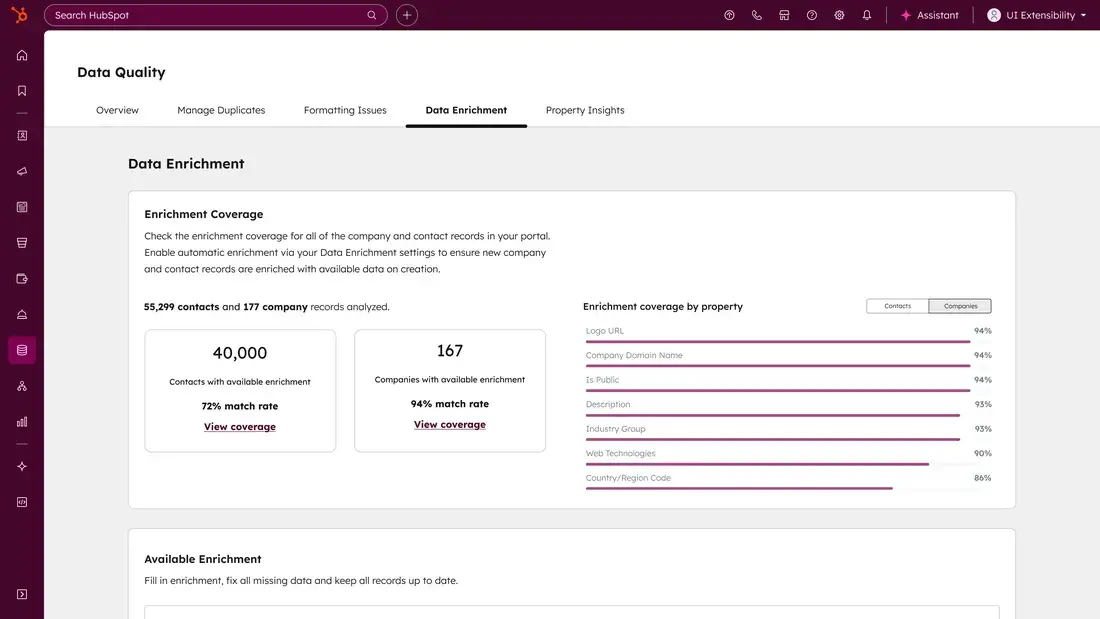
This is particularly relevant under the GDPR, where the legal basis for processing must include data received from third parties.
For more information about how data synchronization impacts compliance, see HubSpot’s Guide to Data Sync. For more information about CRM optimization, see HubSpot’s CRM optimization guide.
Where AI fits into CRM compliance
AI in CRM is already here. The question is: How do you use it without creating new compliance risks?
IBM’s report found that companies that used AI and automation for security reduced the cost of security breaches by an average of $2.2 million compared to companies that didn’t use them. Therefore, if implemented correctly, AI can be a compliance asset.
The bad news: AI systems that process personal data without appropriate controls can introduce new risks around bias, scope of consent, data minimization and accountability.
Secure AI patterns for CRM compliance
In my experience, these are the AI use cases that are both high-quality and compliance-safe:
- Preference-aware public relations: This means that AI-generated emails take into account the subscription types and channel preferences already recorded in the CRM. The AI works with data that the contact has already agreed to receive.
- Access ratings: AI can find dormant accounts, overprivileged users, and unusual login patterns for human review.
- Automation of retention tasks: AI triggers review workflows when records reach retention periods and flags them for a team member to review rather than automatically deleting them.
- Detecting consent gaps: AI flags contacts who are missing required consent fields before including them in a campaign.
- DSR preparation: AI collects all data associated with a contact record via connected tools, puts together a draft export, and highlights gaps for human review before the package is sent.
The pattern in every safe AI use case? AI handles data collection and creation. A human reviews and approves. Anthropic calls this a “human-in-the-loop” design and it is the right model for compliance-sensitive workflows.
Breeze Copilot from HubSpot And Breeze agents are designed with this in mind. You make recommendations, design content, and prepare workflows, but your team reviews and confirms before anything is executed.
Pro tip: Before using AI for your CRM data, perform a quick compliance check. Ask yourself:
• What personal data does the model access or process?
• Is this use consistent with the consent and legal basis on file?
• Is there a human verification step before the output reaches the customer?
• Is AI activity logged in the audit trail?
If you cannot answer the question with “yes”. all fourdrive slower and evaluate more carefully.
For background information on AI assistants in marketing workflows, see HubSpot’s guide to AI in marketing.
CRM Compliance FAQs
Can a CRM be HIPAA compliant?
Compliance is determined by your behavior, not a tool, but a CRM may have features or policies to better enable HIPAA compliance.
If your CRM stores or processes protected health information (PHI), you must do the following:
- Sign a Business Associate Agreement (BAA) with your CRM provider.
- Configure access controls, audit logging, and encryption in accordance with HIPAA requirements.
- Ensure that no PHI is sent to connected integrations that do not have their own BAAs.
HubSpot offers HIPAA-ready configurations for qualified corporate customers, including the ability to sign a BAA. For more information, contact HubSpot’s sales team.
How do I make my existing CRM compliant without migrating it?
Most compliance gaps in existing CRM implementations can be resolved without a full migration. Start here:
- Review your current user list and revoke excess permissions.
- Enable MFA and SSO if you haven’t already.
- Enable field-level history for sensitive properties.
- Create a consent field and populate it using reliable source documentation for existing contacts.
- Set up at least one retention workflow with automatic suppression.
- Review your top integrations and apply sync filters.
By following these steps, you will see a significant increase in compliance that lasts days, not months. To get started, use HubSpot’s CRM data cleansing resources: HubSpot’s Guide to Cleaning Your CRM Data.
How do I effectively check CRM compliance?
A CRM compliance audit should cover four areas:
- Accuracy of data mapping: Does your documented data still match what is actually in the CRM?
- Access control review: Are user permissions appropriate for current roles? Are there dormant accounts?
- Consent and retention: Are the consent fields filled out and up to date? Are retention workflows triggered correctly?
- Integration governance: Were new tools connected without review? Are the sync filters still configured correctly?
I use this as a quarterly checklist rather than an annual event. Quarterly reviews detect discrepancies before they become a violation.
How should we deal with international data residency?
If you have contacts in the EU, you need to understand where your CRM data is physically stored and how it is transferred. Here’s what you should do:
- Check your CRM provider’s data center locations and whether EU hosting is available.
- If data is transferred outside the EU, confirm the legal mechanism (standard contractual clauses, adequacy decision, etc.).
- Check your integration stack – if your CRM syncs with a US-based analytics tool and that data includes EU residents, the transfer must be covered.
- Document all data transfer mechanisms as part of your GDPR Record of Processing Activities (ROPA).
How do I use AI in CRM without compromising privacy?
Using AI in your CRM doesn’t necessarily have to mean higher data risk. Just make sure you consider the following:
- Data minimization: AI models should only access the data they need for a specific task. Don’t give AI access to your entire CRM.
- Scope-related permissions: AI agents should operate under the same RBAC rules as human users.
- Audit logging: Any AI action that touches personal data should be logged with the same details as human actions.
- Human verification: Any output that reaches a customer or triggers a data change requires human approval first.
Breeze Copilot from HubSpot was developed with these principles in mind. It supports your team rather than replacing their judgment in compliance-related decisions.
We trust CRM compliance
Ok, maybe that’s not the case with your CRM The similar to a teenager’s diary. You can’t just write down someone’s name and number and then forget about them. Because unlike a journal, your CRM contains more than just contact information. A CRM maintains your customers’ trust in your company to protect and not misuse the information they share with you.
For this reason, CRM compliance is non-negotiable. Ideally, you’ll outline this process before you start entering information. However, if you’re already using a CRM, it’s never too late to start.
Map your data, block access, document consent, set retention rules and control your integrations. If you consistently follow these six things, you will be ahead of most companies.
If you’re ready to deploy the right infrastructure behind this program, HubSpot Smart CRM offers consent management, audit logging, role-based access, and data controls so your team can actually maintain—not just strive for—compliance.