

As AI search changes the way customers discover and evaluate brands, tools like Profound are becoming increasingly important to help marketers measure the visibility of AI-generated answers. However, as budgets tighten, new AI visibility capabilities emerge, and integration requirements increase, many teams are actively looking for alternatives to Profound AI.
The changing nature of AI search is already impacting performance metrics. According to HubSpot State of Marketing Report58% of marketers say that while traditional search traffic is declining, AI recommendation traffic conveys significantly higher intent. At the same time, 75% of marketers now use five or more different marketing channels, further increasing the fragmentation of discovery. It’s no surprise that marketing teams are investing in AI search monitoring tools like Profound.
In this guide, discover eight profound alternatives that marketing teams can actually use. To help marketing leaders quickly find the right solution, they are divided into three categories: tools for cross-platform LLM monitoring, tools with regional prompts and reports, and platforms that include Google’s AI Overviews (AIO) tracking.
Table of contents
Quick tips for profound alternatives
Below is a full breakdown of each tool and for easy comparison, here is a table.
Why consider profound alternatives now?
AI visibility can help marketers with campaign planning, brand positioning, and marketing leaders reporting performance to stakeholders. But the challenge isn’t just finding a tool that tracks AI mentions. It’s about finding something that a team will actually use consistently and that finance will approve without pushback.
Ideally, marketing teams choose a platform that they can move to now and grow with, and scale with. Tool migrations put a strain on time, resources and budget. Switching multiple times can affect continuity of reporting and strategic dynamics. AI search insights quickly become disjointed metrics rather than decision drivers if they are not integrated into reporting cycles, quarterly planning, or content roadmaps. Here are some of the top reasons why marketing teams are looking for alternatives to Profound AI.
Prices
Profound’s entry-level package starts at $99/month. Although it feels accessible, this level only focuses on ChatGPT tracking. As teams expand their monitoring needs to additional LLMs, prompts, or reporting capabilities, prices increase significantly: the Growth plan costs $399 per month and still only allows tracking across three AI SEO tools. After that, there are Enterprise tiers with custom pricing.
For teams scaling AI visibility across markets or business units, this jump is steep. Comprehensive AI tools from competitors like Peec AI offer more AI tools at lower entry levels.
In my experience, price discussions rarely come down to whether a tool is “good”. They depend on whether finance can clearly see the value compared to alternatives. The scrutiny intensifies when leadership sees separate line items for SEO software, AI visibility tracking, reporting tools and CRM integrations. And when there are Profound AI alternatives that consolidate some of these capabilities – or integrate more cleanly into the existing stack – Profound is often the one that gets questioned first.
Missing features
Capability gaps are another common reason why marketing teams look for Profound AI alternatives. Profound specializes in LLM monitoring, but some companies want cross-platform tracking that includes traditional SEO, AI overviews, and generative search in one dashboard.
For example, SEMrush, a Profound AI alternative, now includes AI overview tracking in addition to keyword rankings, backlinks, and technical audits. This unified visibility can simplify reporting.
Tracking visibility is useful, but without structured workflows to convert insights into briefs, updates, and campaigns, data is unhelpful. Marketing leaders increasingly want tools that move from measurement to action, not just monitoring.
What is important here are platforms that close the gap between insights and implementation. HubSpot Content Hub enables the creation and management of briefs from AI insights, helping marketing teams operationalize templates, briefs, and reusable content patterns that support extractable responses at scale.
Seating restrictions
The seating structure may seem like a small detail, but it can become a practical limitation. In Profound’s lowest tier, marketers are limited to one seat. This could work for individual consultants or lean teams. But once AI visibility becomes a shared responsibility for SEO, search generative experience (SGE) content, brand, and demand generation, a standalone setup creates bottlenecks.
The $399/month Growth plan expands access to seats (with a minimum of three users), but this price increase can feel disproportionate if a team’s primary need is collaborative access rather than advanced monitoring. Some Profound alternatives or lower-cost competitors offer more generous seating allotments at comparable prices, making it easier to accept across departments.
Easy reporting
When it comes to reporting, AI visibility tools either prove their worth or create tension. The time spent adds up when teams have to manually export reports or pull data from multiple sources. If dashboards are not customizable for different stakeholders – SEO managers, CMOs, and sales managers – insights remain siled and not acted upon.
More and more teams are looking for ways to bridge the gap between insights and execution. Breeze AI Suite automates repetitive workflows from AI insights to actions. This reduces manual reporting effort and helps teams activate visibility data faster across content, SEO, and campaign workflows.
Top profound alternatives
Comprehensive alternatives help marketing teams track brand visibility in AI-generated responses, but only the strongest options have been considered in this roundup.
Tools for cross-platform LLM monitoring
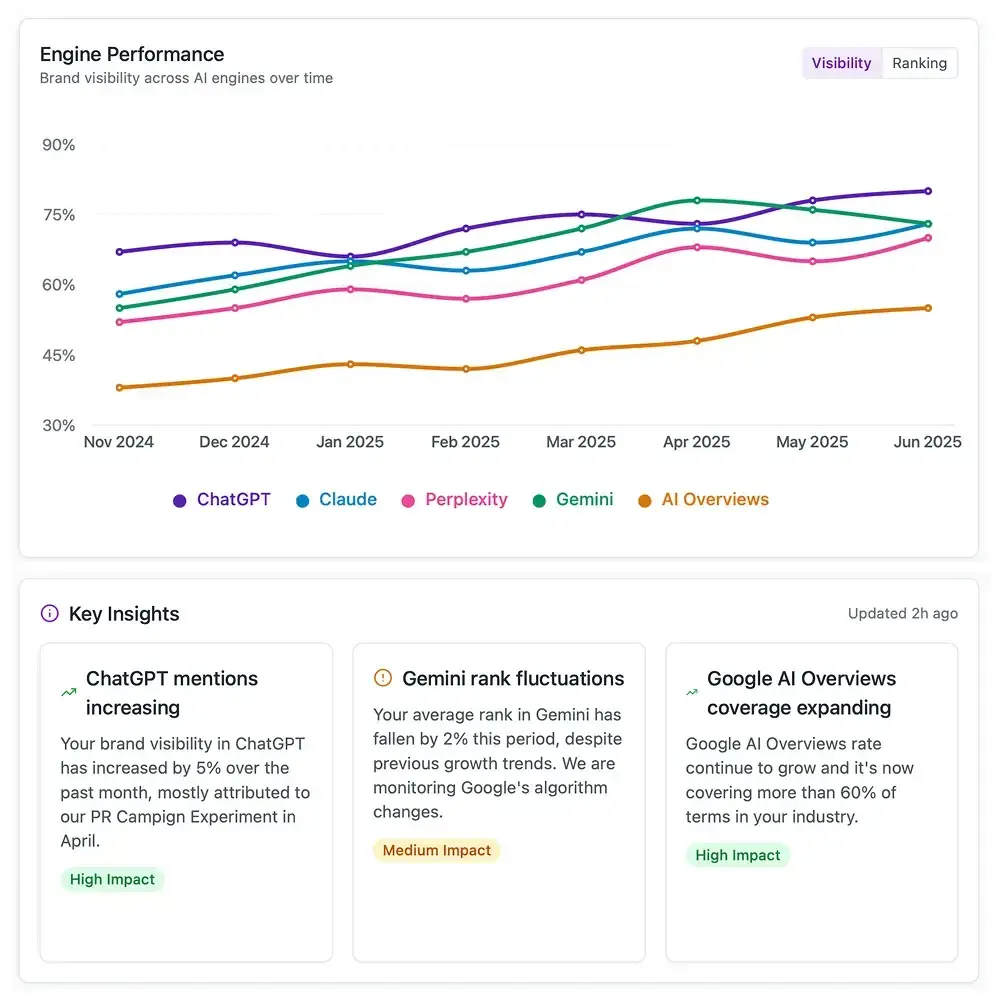
Some of the best Profound alternatives support cross-platform LLM monitoring (ChatGPT, Perplexity, Gemini, Claude, AI Overviews) and effective tools offer regional prompts, report exports, and CRM integration.
AEO grader
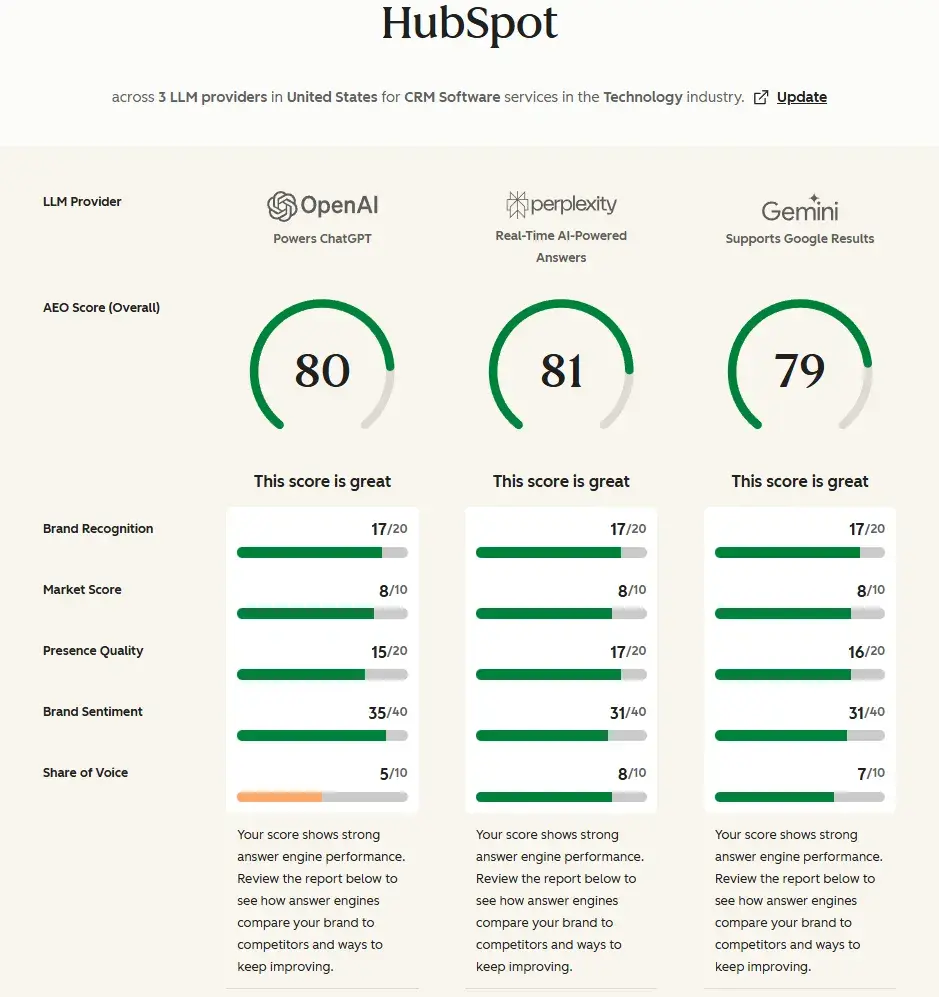
HubSpots AEO grader provides a snapshot of this any AEO visibility of the website, so marketers can use it to analyze their own website or competitors. If a team is interested in comparing AI visibility with a free Profound AI alternative, AEO Grader is one of the most practical starting points available today.
AEO Grader provides free basic diagnostics for AI search visibilityThis makes it ideal for teams that need benchmarking data before committing to a paid platform.
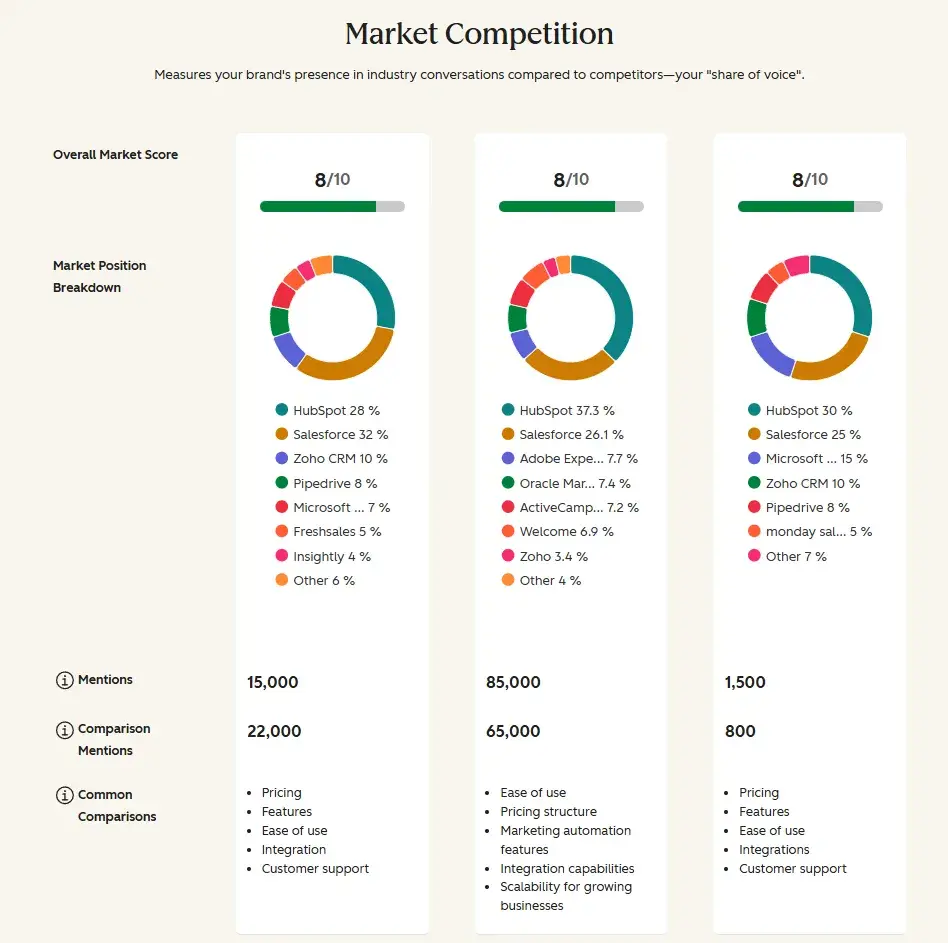
Once users submit their email, they can access more in-depth analytics showing how their domain is performing on AI-driven platforms. Each AI platform – ChatGPT, Perplexity and Gemini – has a column in the report and the data is structured in a manageable, well-structured and easy-to-read format.
The report goes beyond simply tracking visibility and breaks down competitive positioning, awareness, and market performance. Here is the market competition report:
AEO Grader provides actionable recommendations to help marketers improve AI visibility across search platforms.
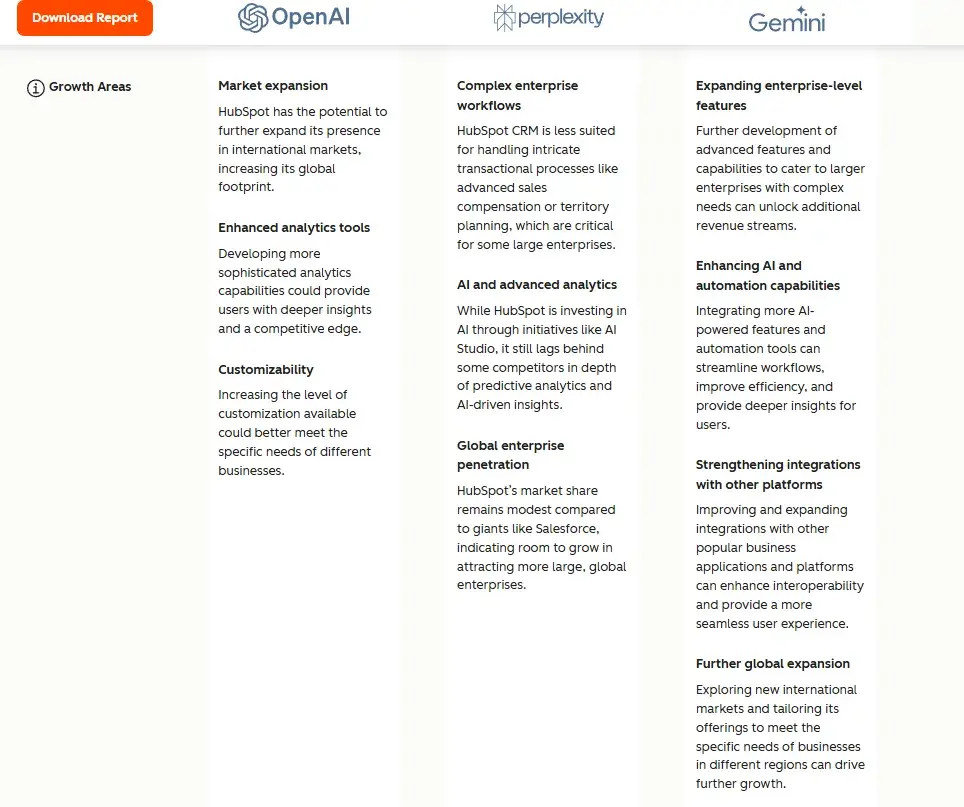
The AI search tool offers:
- Brand awareness statisticsincluding market position, brand archetype, mention depth, source quality and more.
- Complete domain analysis Highlighting key strengths, market evolution and insights refined by the AI platform.
- Contextual narrative themes linked to the domain.
- Sentiment analysis This shows how positively various AI tools cite the brand.
Unlike many of Profound AI’s competing tools that require immediate subscription commitments, this free grader allows teams to compare performance before investing further. This makes it particularly useful for marketing leaders who need data to justify future spending on AI visibility.
When marketing leaders are evaluating alternatives to Profound AI and want a low-risk starting point, this tool provides powerful insights without the need for enterprise pricing.
Key Features
- Free AI visibility snapshot on three major AI search platforms.
- competitive positioning and sentiment analysis, This allows marketers to see how their brand is performing.
- Actionable recommendations to improve AEO best practices.
Advantages
- Completely free basic diagnostics with strategic insights.
- Leadership-friendly reporting This helps justify further investment.
Disadvantages
- Not a complete ongoing monitoring solution (designed as a benchmark rather than continuous tracking).
Best for: Teams wanting to start with a free baseline option
Why I like HubSpot’s AEO Grader: For me, the best thing about the AEO Grader is that it is free. I often use it as part of pitch work to clients so we can all get a feel for how their site is performing before investing in paid tools. For some customers, the AEO Grader is also enough to fulfill their LLM visibility requests.
XFunnel
HubSpot was recently acquired XFunneland positions it as its advanced solution for in-depth AEO analysis and strategy. While AEO Grader offers a powerful free benchmark, XFunnel is designed for teams that want continuous monitoring, competitive intelligence, and controlled experimentation at scale.
While many Profound AI alternatives focus primarily on tracking brand mentions, XFunnel takes it a step further. It simulates real buyer inquiries, maps the AI-driven customer journey and tests optimization strategies in real time. This makes it particularly useful for companies that view AI visibility as a growth channel and not just a reporting metric.
One of the outstanding features of XFunnel is the AI query simulation. The platform uses nine data sources to simulate the real-world queries buyers make to AI search engines. It maps the entire buyer journey and shows exactly where and how a brand appears in AI-generated responses.
XFunnel offers reporting within the tool itself And integrates directly with Google Analytics 4, enabling marketing teams to link AI presence to broader performance metrics.
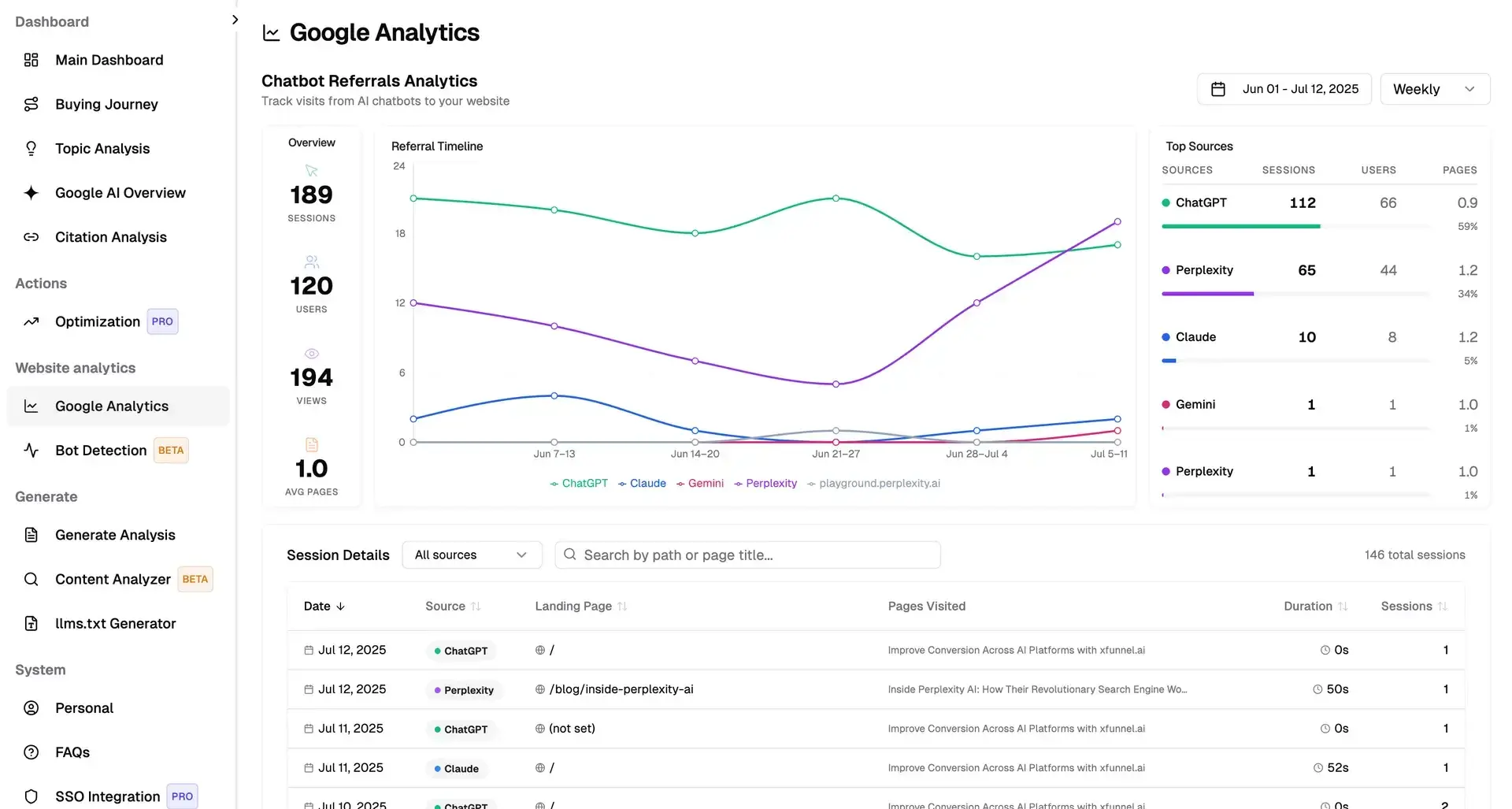
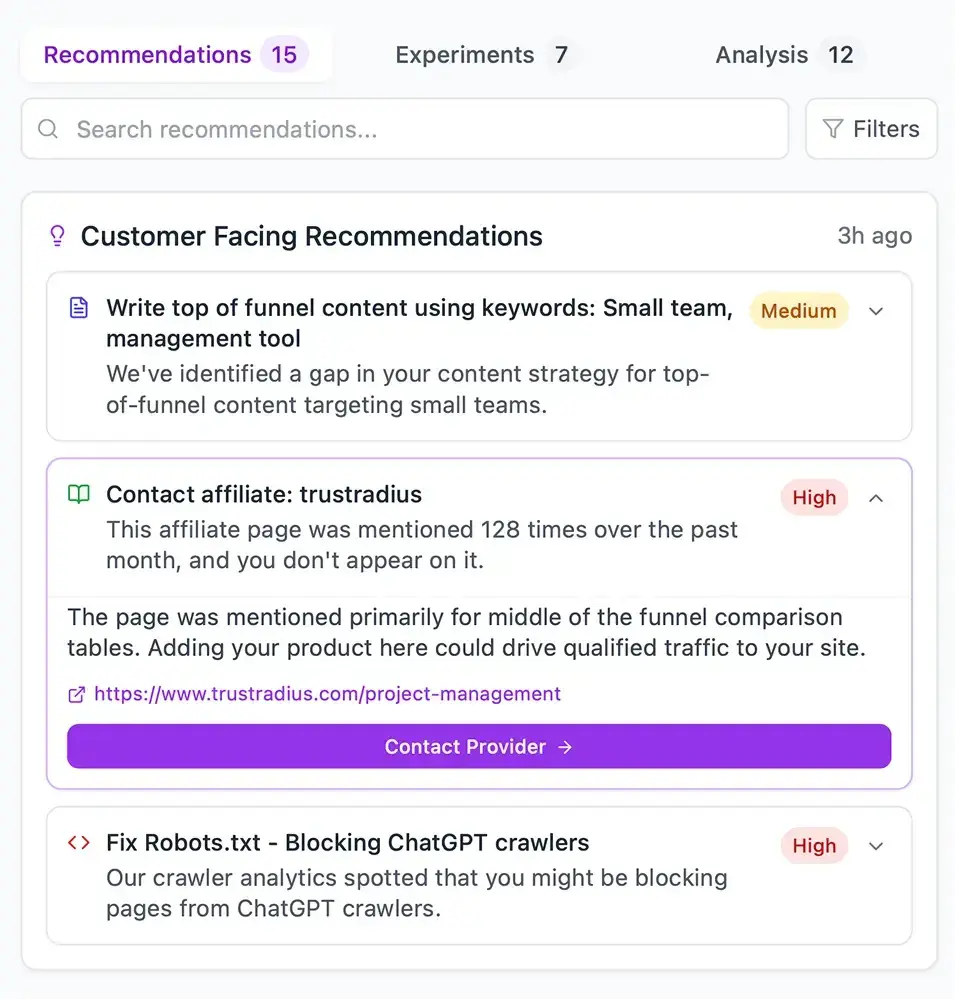
XFunnel makes strategies implementable. Its AI engine runs controlled experiments and provides structured AEO recommendations, from content improvements to technical improvements, while tracking visibility impact over time.
Key Features
- AI query simulation Using nine data sources to map the entire AI-driven buyer journey.
- Competitive intelligence tracking Brand mentions, rankings and sentiment on major AI platforms.
- Strategic experimentation framework that tests optimizations and measures AI visibility Real-time impact.
Advantages
- Designed for AI transparency across the funnel with experiments and measurable impact.
- Integrated with GA4 to connect AI exposure to broader analytics workflows.
Disadvantages
- More robust than smaller teams may need.
Best for: AEO strategy and enterprise-level experimentation
Bluefish.AI
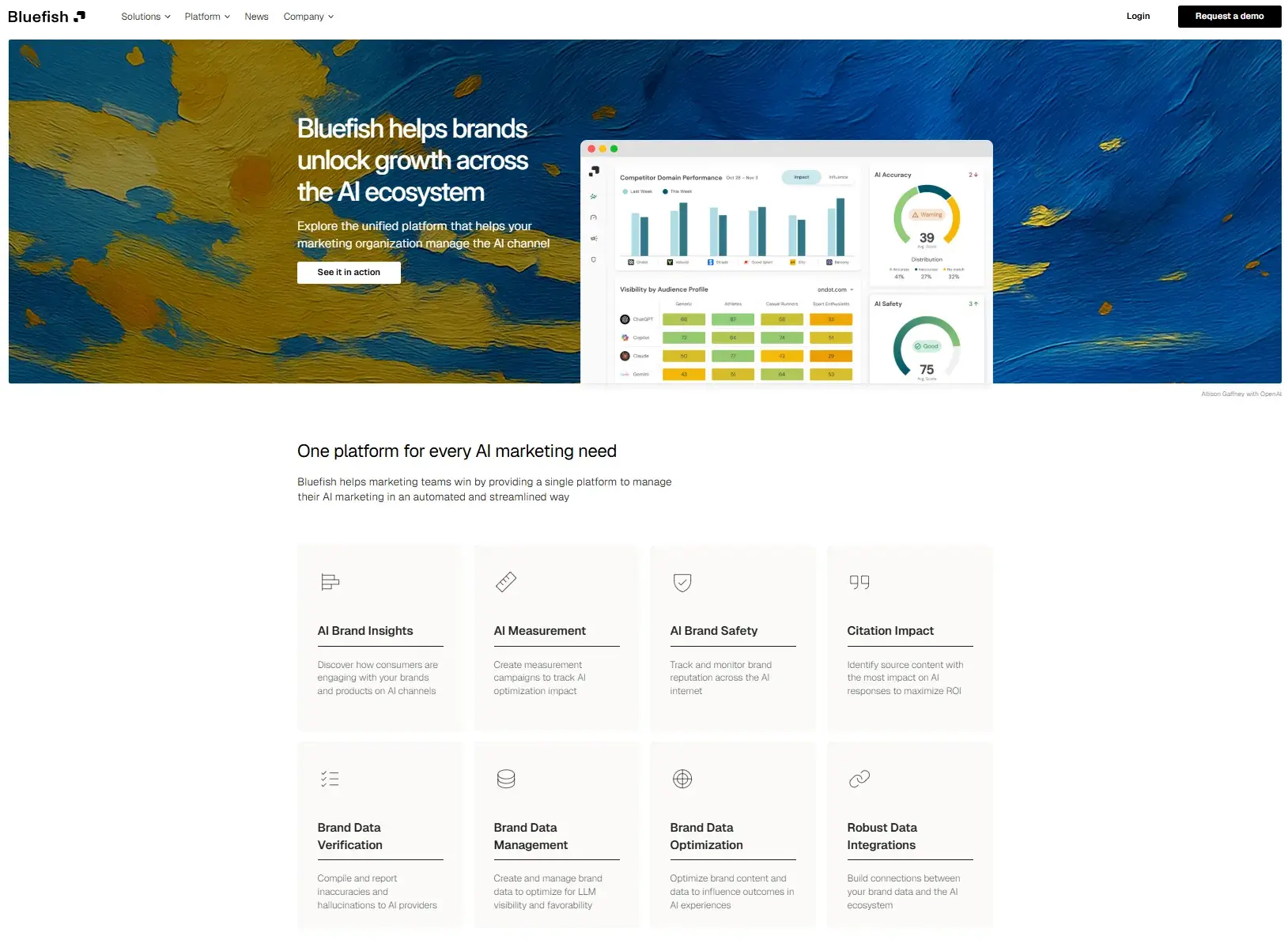
Bluefish AI is an AI visibility and brand safety platform designed to help companies monitor how their brand is represented in AI-generated responses, with a focus on governance and risk management.
While many Profound AEO alternatives focus primarily on share of voice and citation tracking, Bluefish differentiates itself by prioritizing misinformation alerts, contextual accuracy, and reputation monitoring. This makes it particularly relevant for regulated industries such as healthcare, finance and legal, where the representation of a brand in AI responses can have compliance implications.
Key Features
- Brand safety monitoring with alerts for misinformation or harmful AI associations.
- Context-rich reports focus on display accuracy across major AI platforms.
Advantages
- Strong governance and risk management focus for compliance-focused teams.
Disadvantages
- Less growth-oriented analysis compared to GEO tools designed for deep competitive AEO optimization.
Prices
Bluefish AI does not provide pricing details. Interested teams must Contact Bluefish sales and speak to them directly.
Why I like Bluefish: I like Bluefish’s attention-driven approach. If an AI system misrepresents a brand or gives inaccurate information, marketers don’t want to find out in a report until weeks later. Real-time alerts help marketing teams act quickly and proactively manage brand risks, especially in regulated industries.
Best for: Teams that need transparency in governance and risk management
Waikay
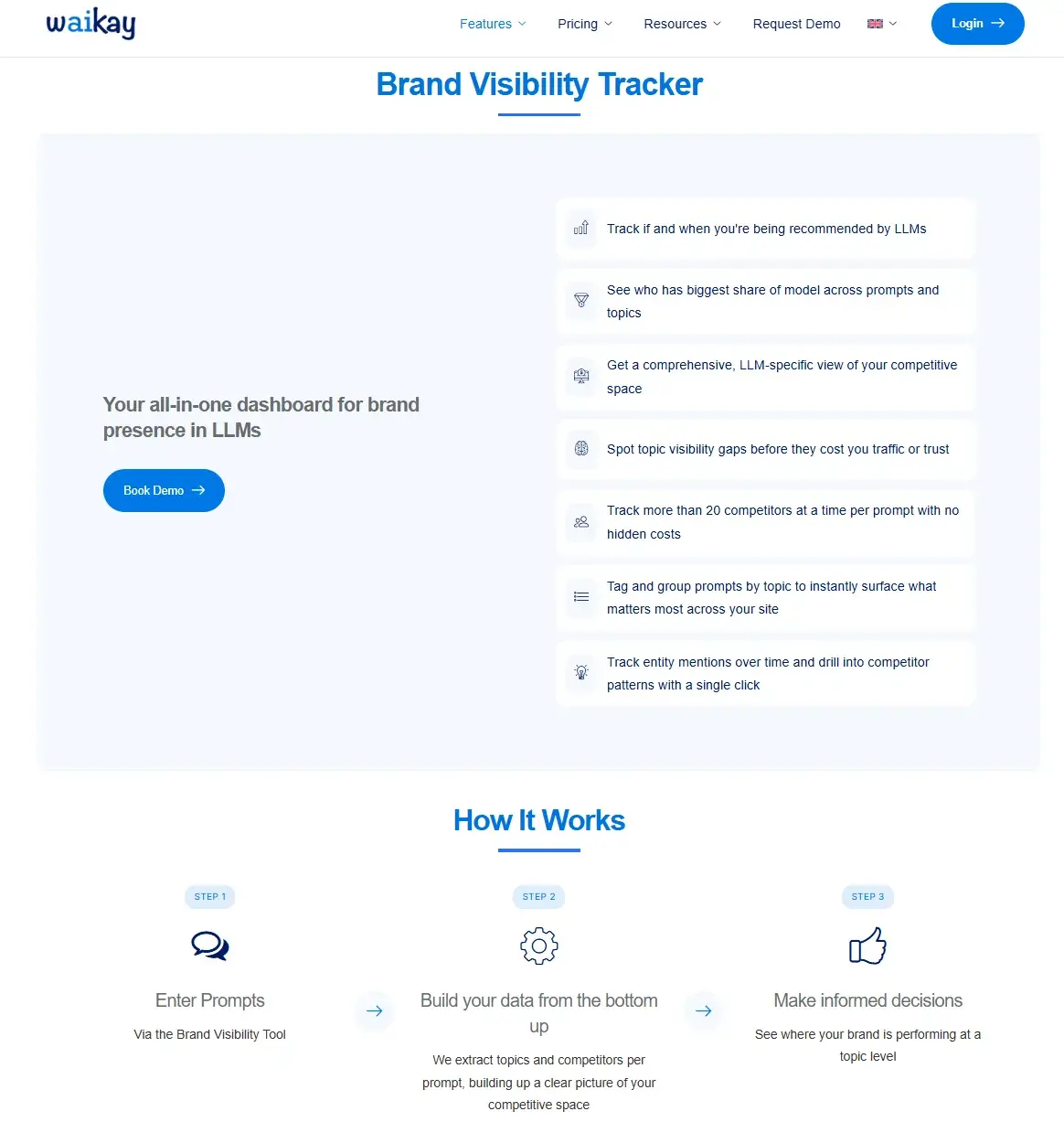
Waikay is an AI visibility platform based on the idea of showing what AI systems actually understand and represent about a brandrather than just counting mentions or citations. It helps teams track brand presence across LLMs, uncover knowledge gaps, and convert these insights into prioritized action plans based on model results and underlying source data.
Key Features
- Brand visibility tracking, which shows how often a brand appears in major AI models and who the competition is.
- Topic and factual reports that highlight knowledge gaps and sources that influence AI responses.
Advantages
- Focuses on a deeper understanding of AI perception and actionable intelligence that goes beyond simple mentions.
Disadvantages
- Platform coverage and model breadth may be more limited than more comprehensive AI visibility suites like Profound or Nightwatch.
Prices
- Small teams: $69.95/month
- Large teams: $199.95/month
- Larger projects: $444.00/month
Best for: Measuring what AI white about your brand
Tools with regional prompts and reports
Night watch
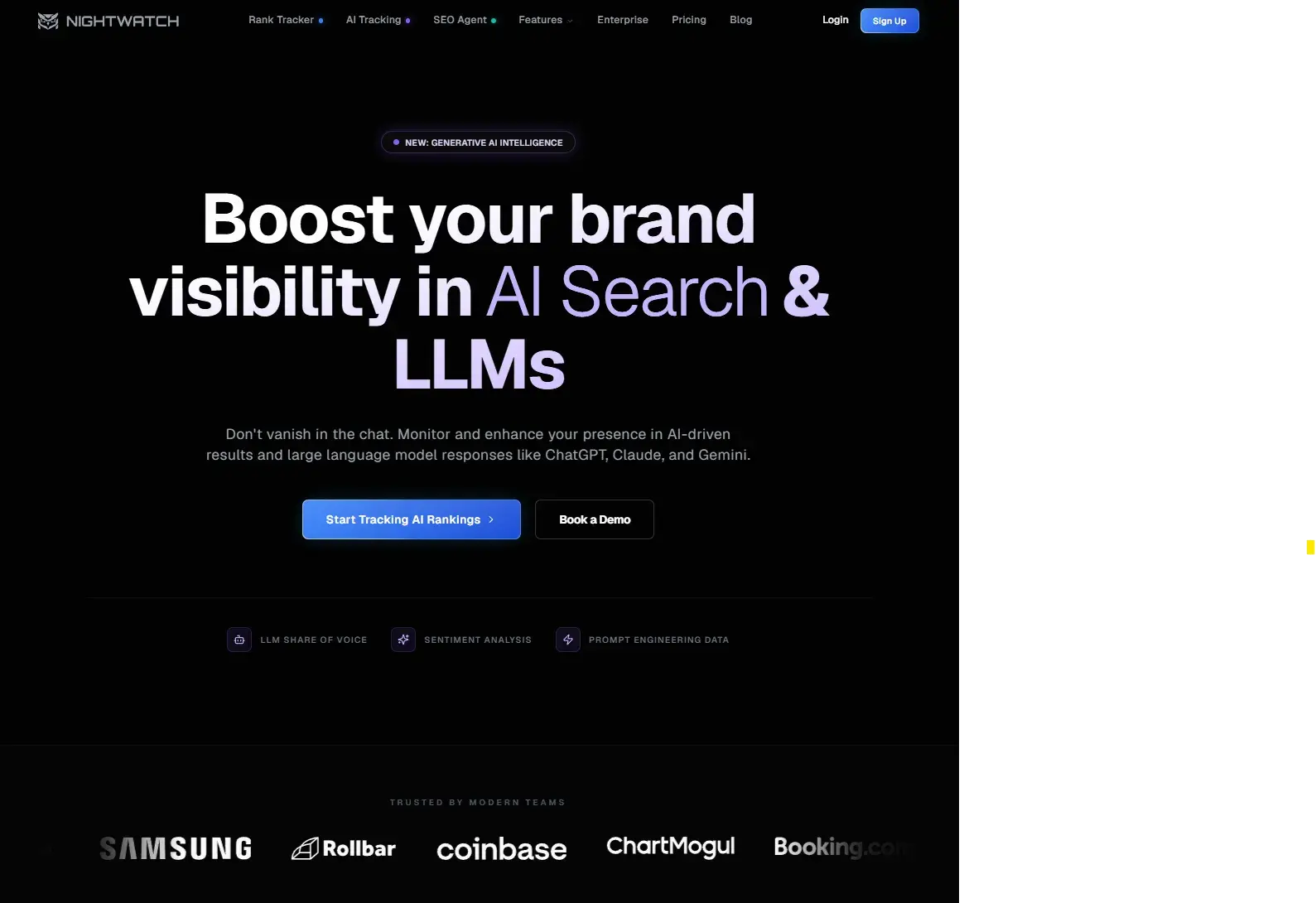
Night watch is a cost-effective yet comprehensive alternative for teams that want both AI visibility tracking and traditional SEO ranking monitoring on a single platform. Compared to many Profound AI competing tools, Nightwatch emphasizes breadth. It tracks LLM spending and monitors live web searches that use AI systems to collect real-time information.
While some platforms only focus on AI-generated responses, Nightwatch combines multi-model LLM monitoring with traditional rank tracking across 100,000+ global locations. For marketing teams that don’t want separate subscriptions for AI search and SEO, this unified dashboard can simplify reporting and reduce tool overload.
Key Features
- Multi-model LLM monitoring via ChatGPT, Claude, Perplexity and Google AI Overviews.
- Integrated traditional SEO ranking tracking alongside AI visibility data.
Advantages
- Significantly lower starting price (starting at $32/month) with a 14-day free trial and self-service sign-up.
Disadvantages
- The extended range of functions and the dual-tracking approach may require training time for teams new to AI monitoring.
Prices
Nightwatch’s pricing assumes that its teams pursue both SEO and AI. Pricing is based on the number of keywords, websites and competitors tracked. AI Tracking costs +$99/month per 100 prompts.
- Starter: $32/month
- Optimize: $82/month
- Agency: $559/month
- Company: Individual prices
Why I like Nightwatch: I’ve been using Nightwatch for traditional SEO for years, and I love the Chrome extension for quick, on-the-fly ranking checks. It makes daily SEO validation effortless. Although AI tracking isn’t yet built into the extension for free, having both AI visibility and rank tracking on an affordable platform is a huge benefit.
Best for: Monitor regions and combine AI and traditional SEO tracking on a budget
Scrunch AI
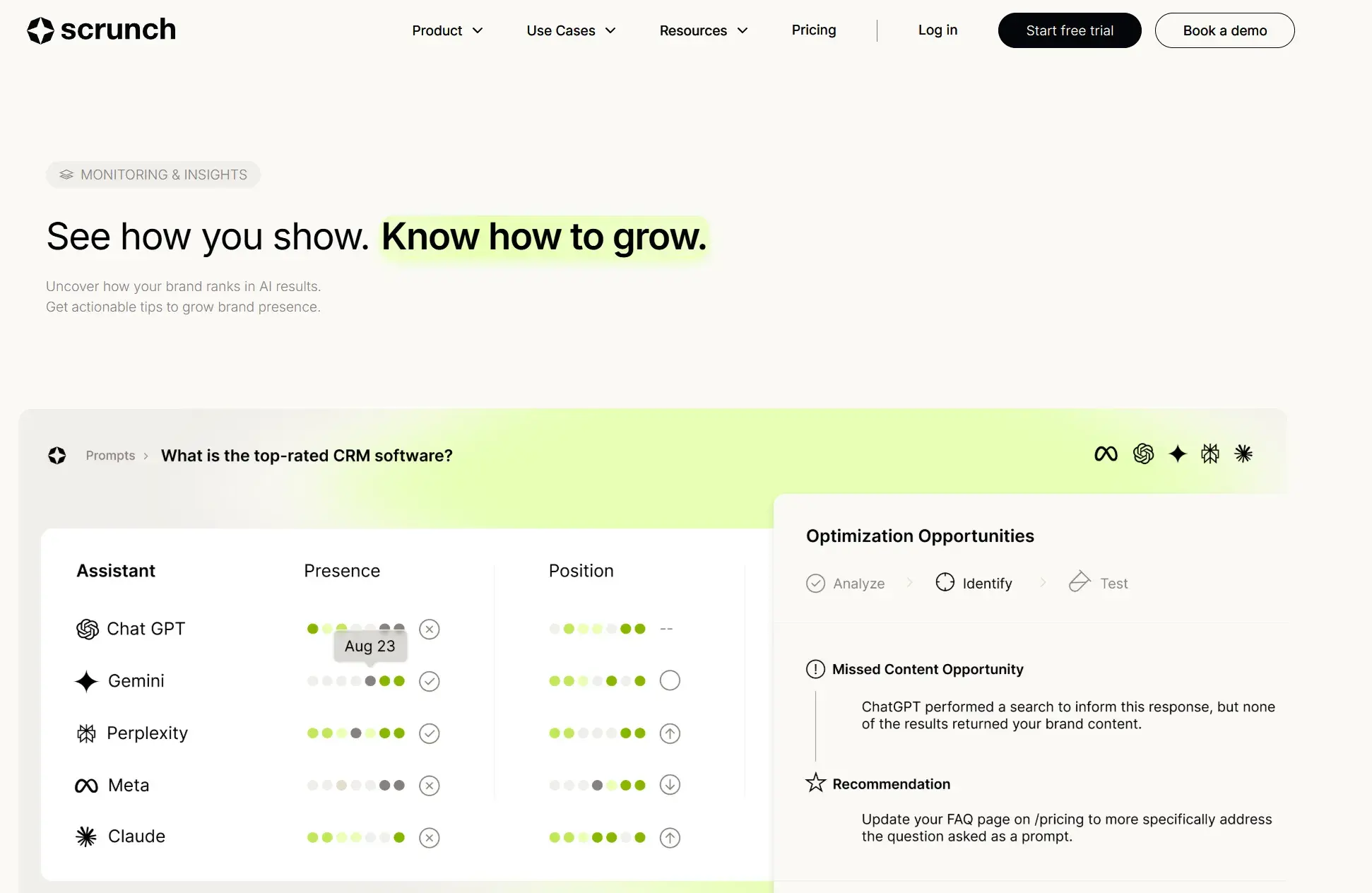
Scrunch AI is a brand visibility and optimization platform built for the age of AI search. It helps marketing teams track how their brand appears on various generative AI platforms. The tool provides insight into AEO trends, instant performance, citations and AI-driven traffic data. Scrunch’s dashboards focus on quick analysis, competitive insights, sentiment tracking, and early-stage optimization workflows that make it easier for teams to understand Where And How Your content appears in AI responses.
Key Features
- Tracks brand visibilityfast performance, citations and AI traffic trends across major LLMs and AI search engines.
- Provides sentiment analysis and competitive benchmarking to show how AI perceives a brand compared to others.
Advantages
- Easy-to-use dashboards with granular visibility and quote filtering and sentiment insights that help teams quickly assess where they rank in AI search results.
Disadvantages
- Primarily a monitoring tool. Actionable optimization guides and content execution workflows are more limited compared to platforms that generate briefs or direct content optimization steps.
Prices
Scrunch AI starts at $250/month and includes tracking for four LLMs (ChatGPT, Perplexity, Google AIO, and Copilot). To access all nine LLMs, teams need the Enterprise package with individual pricing.
Best for: Mid-market and enterprise teams focused on multi-LLM brand visibility and competitive insights.
Tools that include AI overview tracking
Peec AI
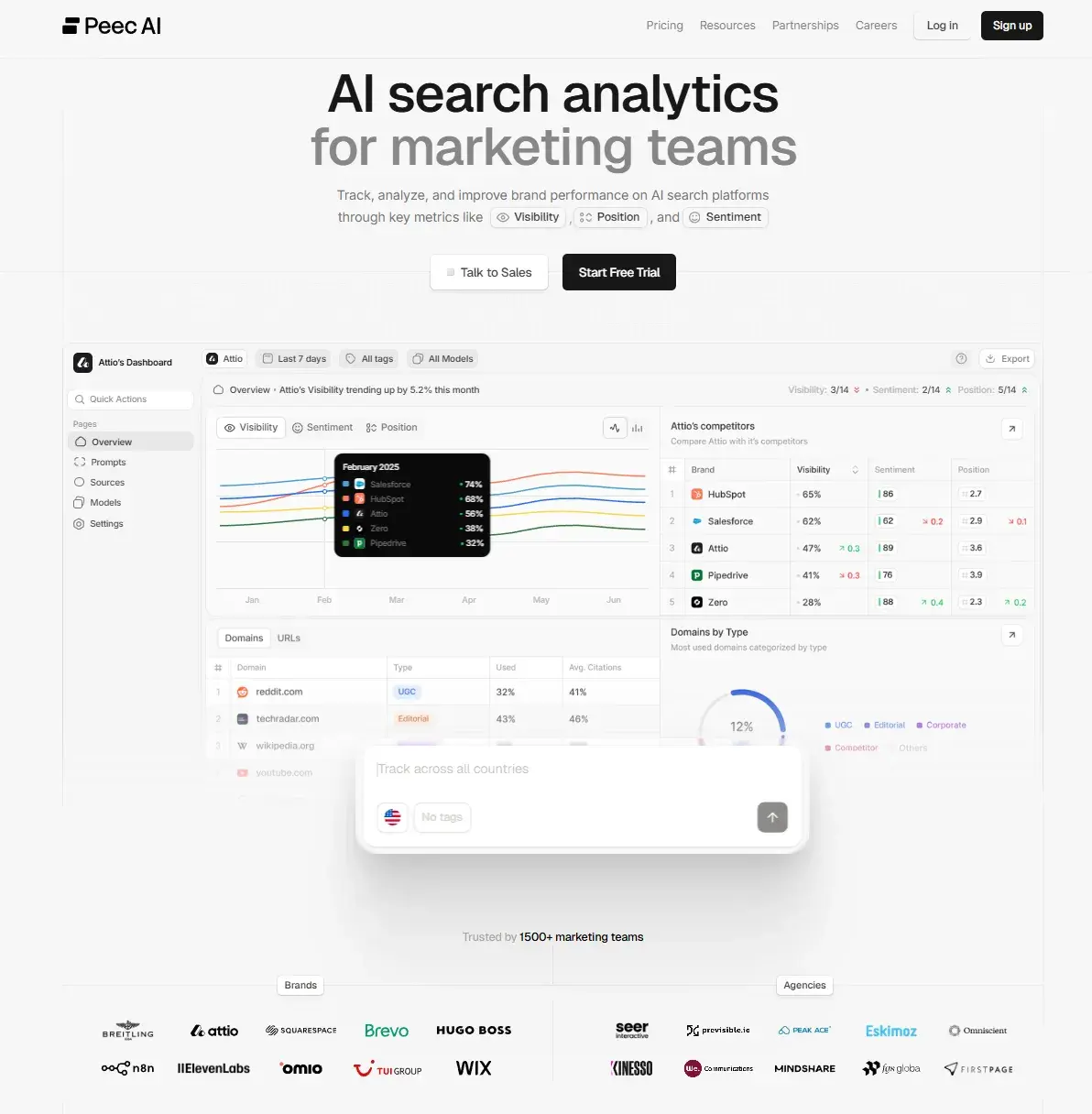
Peec AI is an AI visibility and search analytics platform designed to help marketing teams track how often their brand appears in AI-generated responses on platforms like ChatGPT, Perplexity, and Google AI Overviews. For teams exploring budget-friendly Profound alternatives, Peec offers a convenient middle ground between basic tracking and enterprise-class tools.
The platform focuses on clear dashboards, competitive benchmarking and structured recommendations. It is particularly attractive for startups, mid-sized teams and agencies that want to validate AEO performance without committing to enterprise pricing.
Key Features
- AI visibility tracking in ChatGPT, Perplexity and Google AI Overviews (available with additional motors as add-ons).
- Integrated action framework which divides optimization into on-page and off-page recommendations.
Advantages
- Competitive pricing with a 7-day free trial and entry-level plans that start lower than many Profound AI competing tools.
Disadvantages
- Add-ons or higher tiers may be required for broader coverage and integration of AI engineswhich limits scalability for complex business needs.
Prices
Try Peec free for seven days. Paid packages for these AI costs:
- Starter: $75/month
- Per: $169/month
- Company: custom
Best for: Cost-effective cross-platform AI visibility tracking
Semrush AIO
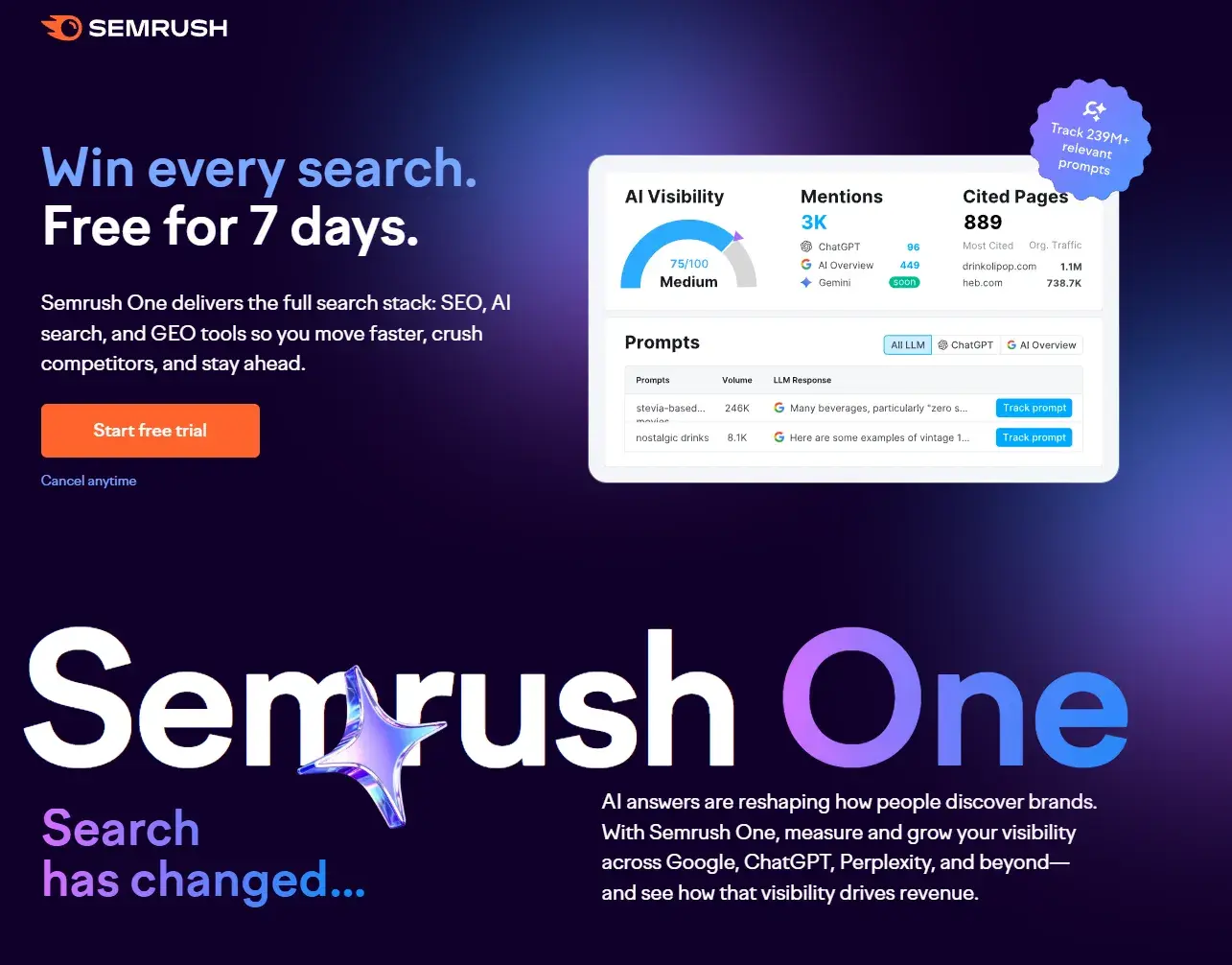
SEMrush One is a comprehensive SEO tool that now fully covers the AI search landscape. This tool allows marketers to track how their domains appear in Google’s AI Overviews, LLMs, and AI Searches like Gemini and ChatGPT, as well as traditional SERP (SEO Search Engine Results Page) features. Instead of treating AI visibility as a separate channel, Semrush integrates AI tracking into its existing platform, which also includes keyword and position tracking, competitive analysis workflows, and more.
Key Features
- Tracks visibility in Google AI Overviews alongside traditional organic rankings.
- Integrates AI appearance data into existing keyword tracking and reporting dashboards.
Advantages
- Consistent reporting via traditional SEO, AI-driven SERP features and AI search tools.
Disadvantages
- It’s quite expensive and can outperform smaller companies.
Prices
SEMrush is the most expensive tool, but also the most complete and efficient as it tracks SEO and AEO. It starts with classic SEO tracking, then AI tracking costs $99/month/domain.
- Per: $117.33/month
- Guru: $208.33/month
- Business: $416.66/month
Why I like SEMrush: I have been using SEMrush for years and feel that SEMrush (as the industry leader in SEO tracking) is a trusted source and a well-positioned tool for AI enhancement. If new platforms promise accurate AI tracking, established tools with a comprehensive search data infrastructure are more likely to be reliable.
Best for: Comprehensive SEO and AI tracking
How to choose the right alternative to Profound
Not all Profound AI alternatives are created equal. The right choice depends less on flashy dashboards and more on how well the tool fits a company’s budget, coverage requirements, reporting expectations, and internal workflows. Here’s a handy way to evaluate the options.
Budget and pricing structure
Look beyond the starting price. Consider seating restrictions, time caps, regional surcharges, export restrictions, and whether prices scale with brand monitoring.
Platform coverage (LLMs and AI search engines)
Make sure the tool tracks visibility where your audience is actually searching. Some platforms only monitor Google AI Overviews or ChatGPT, while others track prompt-based results across generative engines.
Reporting rhythm and export functions
Ask how often data is updated and whether reports can be exported for executives or customers. Snapshot dashboards are helpful, but actionable reports are better. In more advanced setups, it’s important to link visibility data to sales – especially since then HubSpot Smart CRM connects AI visibility insights with pipeline reports – and helps teams demonstrate business impact, not just presence.
Region complexity and fast localization
If a company operates in multiple cities, states, or countries, generic prompts aren’t enough. Teams need tools that enable location-based testing and multilingual prompts.
Integration and workflow activation
AI visibility tracking shouldn’t happen in isolation. The best platforms help marketers operationalize insights, not just observe them. This is where orchestration becomes crucial. HubSpot Marketing Hub orchestrates campaigns based on AI-identified topics and helps teams connect SEO tools with AEO strategies and coordinate cross-channel advertising and curation around responsive content.
Pro tip: When putting yourself to the test, start with a benchmark. HubSpots AEO grader provides free, basic diagnostics of AI search visibility and helps marketing leaders determine whether a premium subscription is warranted.
Frequently Asked Questions About Profound Alternatives
What is the best alternative to Profound?
There is no one “best” alternative – it depends on your goals. If a marketing team wants comprehensive SEO and AI visibility tracking on one platform, enterprise SEO suites like Semrush AIO stand out. For pure multi-LLM monitoring and timely testing, tools like PEEC.AI or Bluefish.AI may be more suitable. The key is to match the tool’s strengths to the team’s needs and priorities, whether exploring AI overviews, regional prompt performance, or integrating visibility into campaign execution.
How much does Profound AI cost?
Profound AI’s tiered pricing starts at $82.50/month for the starter package, billed annually. The Growth Package costs $332.50/month and is billed annually. After that, the custom enterprise price applies.
Are there free AEO tools similar to Profound?
HubSpots AEO grader is a free AEO tool, similar to Profound. It provides free, basic AI search visibility diagnostics so marketers can evaluate brand presence before investing in a paid solution. Free tools are useful for exploration, but they often lack the sustained monitoring or exports needed for strategic reporting.
Which tool should I use instead of Profound for small businesses?
Small businesses often benefit from lower-cost or integrated platforms that don’t require separate contracts for AI and SEO. Tools like Peec AI or Nightwatch are cheaper. But comprehensive all-in-one SEO suites like SEMrush One can prove to be more affordable considering you only need one tool.
Is Scrunch AI or PeecC AI a better alternative to Profound?
Both Scrunch AI and Peec AI are good alternatives to Profound. Peec AI is strong in multi-LLM monitoring and rapid testing, making it a good fit for teams that prioritize cross-platform visibility. Scrunch AI excels at social listening and audience insights with AI augmentation, which can complement AEO tracking but may not provide the same depth of AI search visibility capabilities.
Transform AI visibility into measurable growth.
AI visibility is quickly becoming a competitive advantage, but only if marketers put the insights into action. The first step is to track where a brand appears in AI-generated responses. The true value comes from using this data to refine messaging, update content, prioritize topics, and guide campaign planning.
If marketing leaders are still unsure where they stand, they should start by benchmarking using free tools like HubSpot’s AEO grader. You can always update your tech stack later. By establishing a baseline, marketers gain clarity on whether AI visibility is already impacting their brand recognition – and where gaps exist. From there, they can make a smarter decision about whether they need advanced multi-LLM monitoring, region-based prompts, or more comprehensive reporting capabilities.
In my experience, tools are of no use to marketers if they aren’t actually used. I’ve seen teams invest in sophisticated platforms just to keep the dashboards from gathering dust. It’s far better to start small, build internal adoption, and integrate AI visibility tracking into existing workflows before scaling. When insights become part of weekly reporting, content planning, and campaign execution, they can lead to measurable growth.