
Google just released documentation about what they call it Open Knowledge Format (OKF). It provides a standardized way for agents to access knowledge through very simple directories of Markdown files. While storing files in Markdown is nothing new, Google is now creating a specific standard that agents can understand without the need for special software or other platforms.
While the examples Google gives mostly relate to using agents to analyze your data (e.g. from BigQuery), I think OKF represents so much more. It’s entirely possible for any company to organize its knowledge – both public and for internal company use – in an open knowledge format, making it incredibly easy for agents to do things with it.
Follow me in this video as I go through Google’s documentation:
The shift from SEO to agent accessibility
This new format could change the way we approach SEO. We will move from work aimed at getting found by search engines to making business knowledge accessible so that agents can use it to complete tasks. I assume that we will see a high demand for OKF specialists who understand how to transform a company’s data and process chaos into a clean knowledge graph. We may need a new acronym for what we do because it really isn’t SEO, GEO or even Agentic Search Optimization!
Understanding OKF knowledge packages
A The OKF bundle is just a directory of Markdown files. Each file represents a single concept or unit of knowledge. Instead of turning everyone around website Extract certain ones into a Markdown file concepts. A single web page can end up producing a whole bunch of concept Markdown files.
These packages begin with metadata known as YAML front matter, which tells the agent the type of content, title, and relevant tags. This allows agents to quickly analyze what a file is about without having to read all the text first.
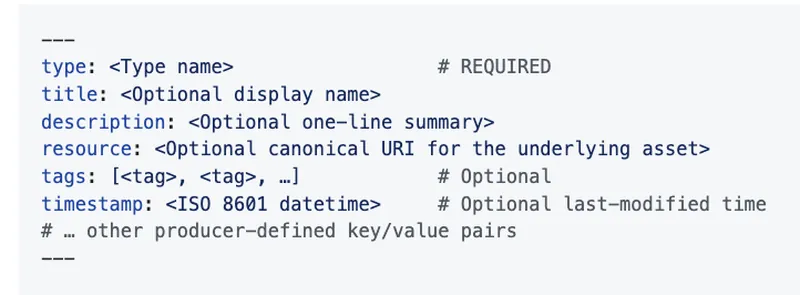
(These examples come from Google spec.md file for OKF.)
The YAML front matter is followed by the body. It can contain anything. It is written in Markdown and can use headings, lists, tables, code blocks and more.
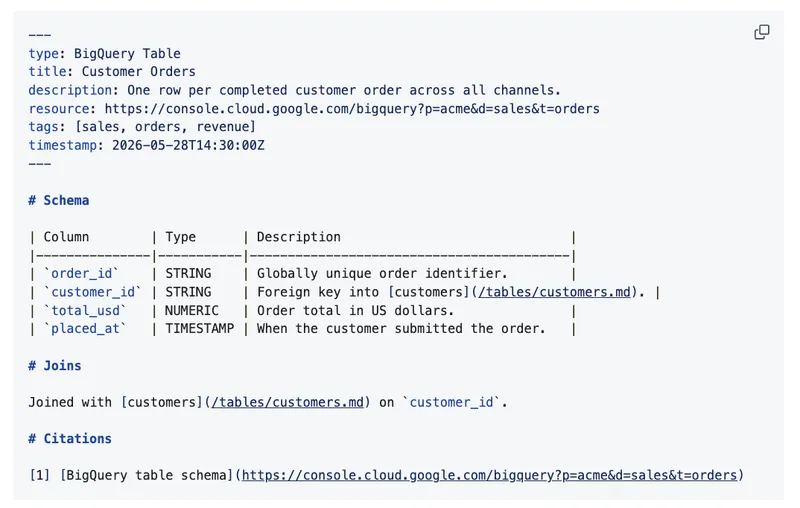
So basically the YAML front matter is like an index card that tells agents what’s in this package, and the body is where your wisdom, data and processes are stored. The fascinating thing is that there is no standard format for the body. You can insert anything you want here. Because the format for finding information is standardized, agents know how to find exactly what they need and may even find information about what to do with that information, provided your company processes are also documented in your knowledge file.
This system means agents don’t have to cram all their knowledge into their context window and run RAG on top of it. Rather, they can look at the format and find out exactly which parts of the knowledge will help them.
The LLM Wiki Pattern
This format formalizes the LLM wiki pattern described by Andrej Karpathy. The idea is that an agent doesn’t just retrieve raw documents creates and maintains a permanent wiki of your knowledge. When you add new information, your agent doesn’t just index it. It reads it, extracts key insights, and integrates them into an existing knowledge base. It can even identify where new data contradicts old claims, creating a living synthesis of your expertise. It can link related concepts together to create a knowledge base for your business. Karpathy also describes a Lint function that periodically checks your system to find inconsistencies or things that need updating.
Prediction: SEOs who can create good OKF bundles will be in demand
There are already tools that you can use to convert your web pages into an OKF bundle. Suganthan Mohanadasan has one here. It’s worth playing with!
However, I think that creating a customized OKF for a company requires significant skills. You need to thoroughly understand a company, the concepts it has information about, its processes that can be documented, and anything else that should be included in the open knowledge format package. You’ll be building a brain for this company, not just Markdown versions of pages. The brain can be used internally or parts of it can be sold to others and integrated into the intelligence of other companies that can use its intelligence. And it will be necessary to preserve this brain as it evolves and the OKF standard evolves.
That’s why I encourage you to play around with creating OKF packages – so you can develop expertise. Remember that the standard is new and will likely change.
New sources of income for expert knowledge
One of the most exciting aspects of OKF is the ability to sell knowledge packs. I should mention that this isn’t specifically mentioned in Google’s documentation. I assume this will happen with OKF. Imagine a lawyer, accountant, or SEO expert selling an OKF package of their proprietary processes. You can purchase these packages and integrate them directly into your own system. This leads us to a world where those with deep expertise are rewarded for sharing structured knowledge that agents can immediately implement.
My early attempts to create an OKF from my data
I shared the OKF documentation with Antigravity and played around with creating an OKF version of the information I recently wrote (mostly internally, not publicly) in my traffic decline reviews. The system I created extracted the important concepts from multiple documents and saved each as a Markdown file. I could then visualize them in a diagram and see which concepts relate to each other.
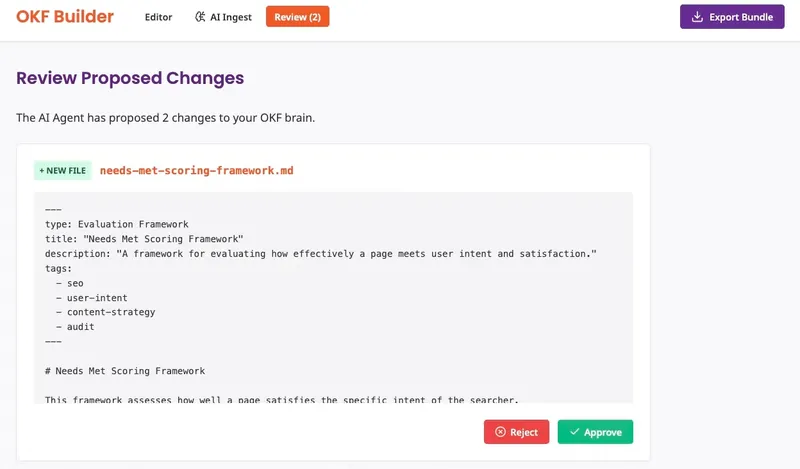
Each of these nodes in the graphic below is a single concept taken from my writing. Some concepts relate to each other.

I could then use an LLM that queries this OKF. In this case I used Gemini-3-flash-preview. (At this point I think this is the best model considering speed, accuracy and cost.)
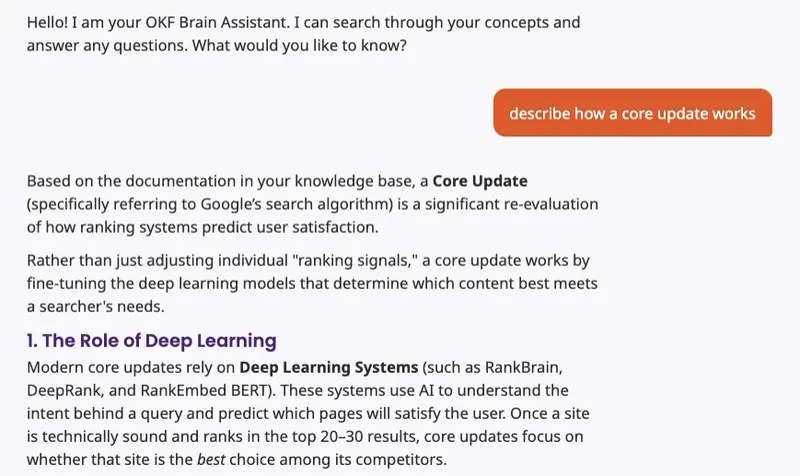
Please note that this is a very early test version and only included three training documents written by me. I will improve this system significantly over time. I also want to experiment with using Google Agent development kit To create agents that can do things with my knowledge. I would strongly encourage you to create an OKF yourself!
Getting started with OKF
OKF helps us no longer have to format everything for machines. Instead, we can focus on learning and sharing insights while the agents do the categorization. I pasted these links into NotebookLM below and then spent time in the Gemini app using the notebook as a source. Once I finally understood the concepts, I switched to Antigravity and used the NotebookLM MCP to give Antigravity the necessary information. You could also just skip the notebook and give Antigravity the Github links directly. In hindsight, that’s what I’ll do next time. Reading a summary of the Github repository was helpful for me when brainstorming with Gemini, but accessing the repository itself seems better for Antigravity.
Google’s documentation on OKF:
Google’s information on Github about the spec.md file for OKF:
https://github.com/GoogleCloudPlatform/knowledge-catalog/blob/main/okf/SPEC.md
Andrej Karpathy in the LLM Wiki:
https://gist.github.com/karpathy/442a6bf555914893e9891c11519de94f
You can try this prompt in Gemini. It’s especially good if you have storage enabled.
Here is a notebook (or here are links) with information from Google about the Open Knowledge Format. Help me understand how I can use this in my life and business. Give me 20 ideas for things I could create using this format.
Or, Join us in the search bar for the latest news on search and AI. Or better yet, join my paid community where we call regularly to brainstorm on the use of AI and I also share tips and ideas.