
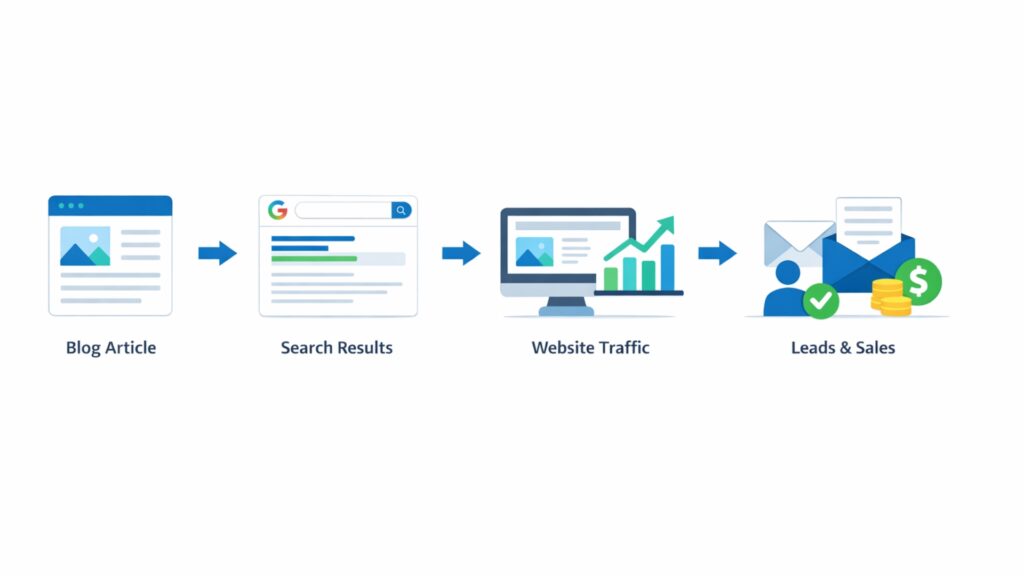
As a business owner, you’ve probably wondered whether it’s still worth adding a blog to your website. With social media, paid advertising, and short-form content everywhere, blogging can seem outdated compared to social media. But search behavior says otherwise.
We’ve been in the online space for more than a decade and things change frequently and sometimes drastically, but we can say with certainty: having a blog for your business is never a bad thing.
People still search Google every day for questions and problems and make purchasing decisions. A well-built business blog answers these search queries and ensures steady traffic without you having to pay for every click.
Running a blog for your business is not just about writing articles. It’s a visibility tool, a trust builder, and a long-term traffic asset when done right.
A well-planned blog supports your key service pages by answering frequently asked questions and providing context before a customer reaches out to you. This helps readers understand what you have to offer and helps search engines understand your business better.
The key is to do it with structure and purpose, not random contributions.
Key insights
- A company blog improves search visibility and organic traffic
- Blog content builds trust and answers buyer questions early
- Structured blog posts can generate leads over time
- Blogging works best with clear topics and keyword intent
- Simple systems and tools make blog management easier
Table of contents
What is a business blog?
A business blog is not an online diary. It is a searchable library of answers to products, services, and customer problems.
Each article targets a specific topic, question, or objection your customer may have. When optimized correctly, these articles will appear in search results and attract people who are already interested in the topic.
This means blog visitors often go there on purpose. You don’t just scroll. They are looking for solutions that you already offer.
A business blog also supports:
- Search engine results page (SERP) rankings.
- Brand authority
- Customer training
- Email list growth
- Lead generation
It works like a long-term traffic driver rather than a one-time campaign, especially when supported by one evergreen content strategy This creates more and more search traffic over time.
Can a blog help grow my online business?

Yes. A blog helps search engines understand what your business does and who it serves.
Google and other search engines rely on context to decide which websites to show for different searches. Blog posts provide that context. Each article explains your services, answers frequently asked questions, and shows how your company helps solve specific problems.
The more helpful information you post, the easier it is for search engines to connect your business with the right people. Over time, this increases the likelihood that your website will appear when potential customers are looking for answers about what you have to offer.
Blogs also provide useful references to other websites. Helpful guides and explanations are more likely to be shared or linked to than sales pages, helping to strengthen your online presence even further.
When should I start a blog for my business?

If you have at least one clear problem that you can solve for your audience, your business could benefit from a blog. The blog’s job is to introduce topics surrounding this problem and showcase your brand as the answer. It’s important to note: Blogging is not a short-term gain, but a long-term endeavor.
It usually takes months before you realize the benefits of creating consistent content for your business website.
As mentioned, search engines need time to catalog your website and get enough context to understand where to display your content.
If you’re still unsure about whether a blog might be of use to you, see if any of these apply to you:
- Customers keep asking questions
- Services require explanation
- Products must be compared
- Local search visibility is important
- Trust is important before purchasing
If any of these statements are relevant to your business, a blog would be a good idea. Service businesses in general benefit greatly from blogs. Local services, consultants, agencies, clinics and specialist retailers often gain strong search engine optimization (SEO) traction through educational articles.
Long story short: If you’re in an industry where customers search before they buy, blogging helps.
When blogging may not be the first priority

Blogging is powerful, but if blogging itself isn’t your business, it’s not always the first step you should take.
A blog should wait if:
- The website is not yet complete
- Core service pages are missing
- There is no keyword strategy
- No one can maintain publishing consistency
A weak blog with random posts performs worse than no blog at all.
The basic pages come first. Then blog content supports them.
Step by step: How to start a business blog the right way
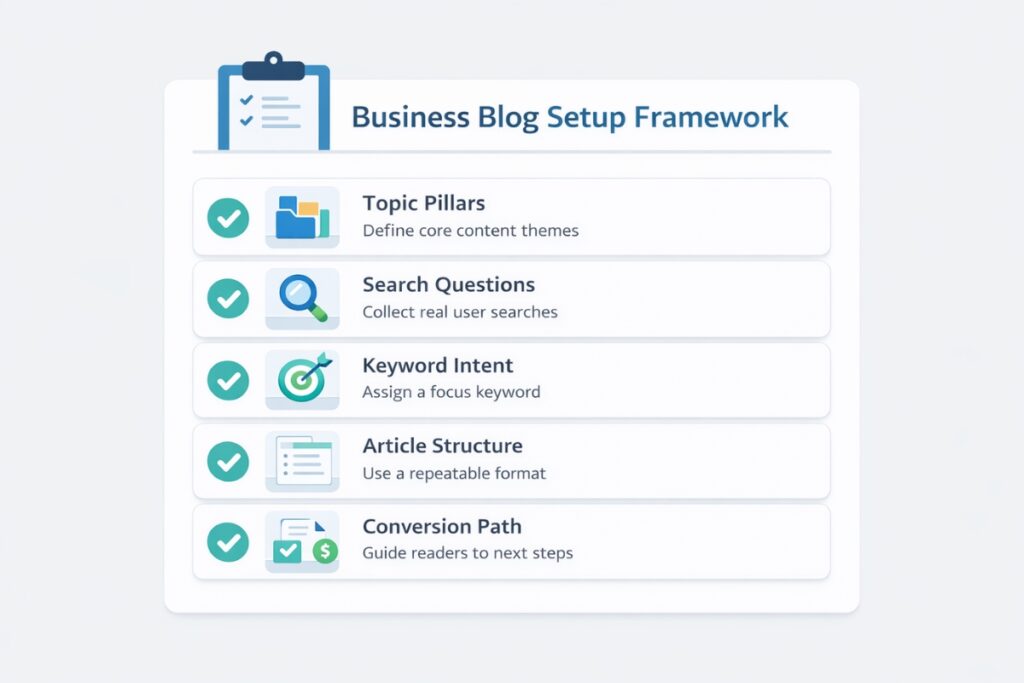
This process keeps blogging simple, focused, and results-oriented. The goal is not volume first. The goal is useful, searchable content that supports your main business pages.
Step 1: Define the main topic pillars
Choose 3 to 5 core topics that are directly related to services or products. These become pillars of content and form the foundation of a clear Content strategyto help search engines understand your business.
Examples include pricing guides, buyer training, comparisons, how-tos, and error prevention articles. Any future post should fit into one of these pillars.
Quick checkpoint: If a post doesn’t support a main topic, it probably doesn’t belong on the company blog.
Step 2: Collect real search questions
Strong blog topics come from real buyer questions. These questions often come from customer conversations and appear in search autocomplete.
(Insert a screenshot of an example of Google search autocomplete.)
Focus on phrases like “How,” “What,” “Best,” “Cost,” “Compare,” and “It’s Worth It.” These signal intent to solve problems and produce better results than general topics.
Simple working rule: A search question corresponds to a blog post.
Step 3: Assign one keyword intent per article
Each article should target one main keyword intent. Mixing multiple independent intents weakens ranking potential.
A clean structure includes:
- Keyword in the title
- Keyword in the first paragraph
- Supporting subheadings that break the main topic into smaller, easy-to-read sections
- related secondary phrases that support the main topic and reflect how people search
Clarity is more important than clever formulations. Direct language performs better.
Step 4: Use a repeatable article structure
A repeatable structure speeds publishing, improves readability, and can be especially helpful when you’re just starting to create written content.
Recommended layout:
- Problem introduction
- why it is important
- Step by step solution
- Examples or checklist
- next action
This allows you to write efficiently and consistently.
Step 5: Add a simple conversion path
Every blog post should lead the reader to a clear next step. This could be downloading a checklist, booking a call, viewing a services page, or accessing a helpful guide on the topic you are reading.
The next step should feel like a natural continuation of the article rather than a sales push. When the promotion matches the content, readers are more likely to engage and move toward the goal of becoming a customer.
Checklist for quick blog setup
- Choose 3 to 5 topic pillars
- Collect 20 customer questions
- Assign a keyword to each post
- Use a repeatable structure
- Consider how blogs lead to conversions
What do I write about in my business blog?
Strong business blog topics answer buyer-stage questions instead of promoting the company. Educational content gains authority faster and is ranked more consistently, especially when there is a difference between them Content strategy vs. content marketing is clearly understood during planning.
Powerful topic categories include cost breakdowns, product comparisons, beginner’s guides, error avoidance, and decision-making checklists.
A reliable topic formula works well across industries:
Example: Problem + Decision + Context in Action
Blog topic: How to choose the right accountant for a small business
Problem:
Many small business owners are unsure about hiring an accountant and are afraid of choosing the wrong one.
Decision:
The reader is trying to decide what to look for when comparing accounting services.
Context:
The article explains what matters most to small businesses, such as industry experience, pricing structure, and ongoing support.
Another effective method is the “sales conversation mirror”. If a question is answered repeatedly in consultations, it should be available as a blog post.
Quick topic quality test
Weak topic:
Company news update
Strong topic:
How to choose the right service provider
Ready-to-use topic prompts:
- How much does it cost?
- best option for
- What you should know before buying
- Mistakes to avoid
- Step-by-step instructions to
- Beginner’s Guide to
- Compare X with Y
- How long does it take?
- Is it worth it?
- What happens if you don’t?
These correspond directly to search behavior.
How blogging leads to leads and sales
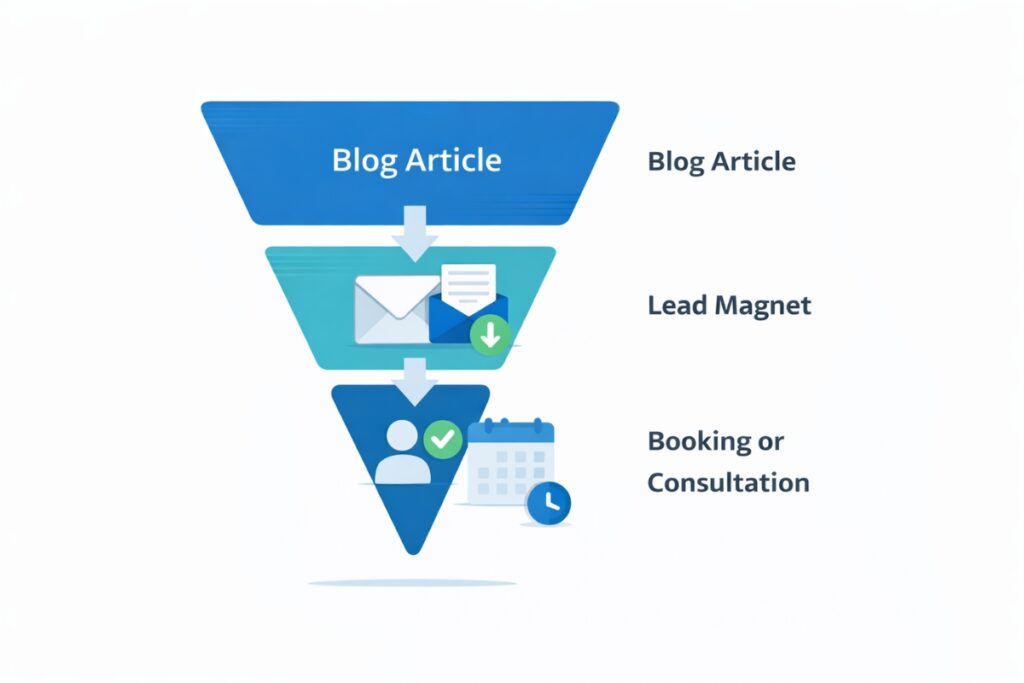
Business blogging supports the entire buying process, not just traffic generation, and plays a central role in a structured one Local business content strategy that moves the reader from awareness to appointment. Different item types serve differently Funnel stages.
Top-of-funnel posts attract attention seekers. Comparison and decision-making aids support the consideration. Process and price contributions help buyers in the decision phase.
A simple conversion path looks like this:
Educational Articles → Checklist or Guide → Contact or Booking Page
Lead capture works best when the resource fits the article topic. A pricing guide goes well with a budget checklist. A guide pairs well with a starter template.
Call-to-action placement should feel like a continuation of the topic rather than a sales interruption. Contextual CTAs convert better than generic banners.
What is a call to action (CTA)?
A call to action, often abbreviated as a CTA, is a prompt that tells the reader what to do next. This could be downloading a guide, booking a call, requesting a quote or visiting a services page.
In blog posts, a CTA should be helpful and relevant to the topic, not intrusive. The best CTAs naturally continue the conversation by offering the next logical step after reading the article.
How often should a business blog post?

Consistency is more important than volume, so the frequency of publishing depends on how much bandwidth you have to produce that content.
A realistic schedule:
- 1 to 2 posts per month for small teams
- weekly posts for growth-oriented brands
Quality and relevance are more important than frequency. One strong article can outperform ten weak ones.
Remember that search traffic increases over time. Blog growth for businesses that pop up regularly is gradual but steady.
What results can a business blog realistically expect?
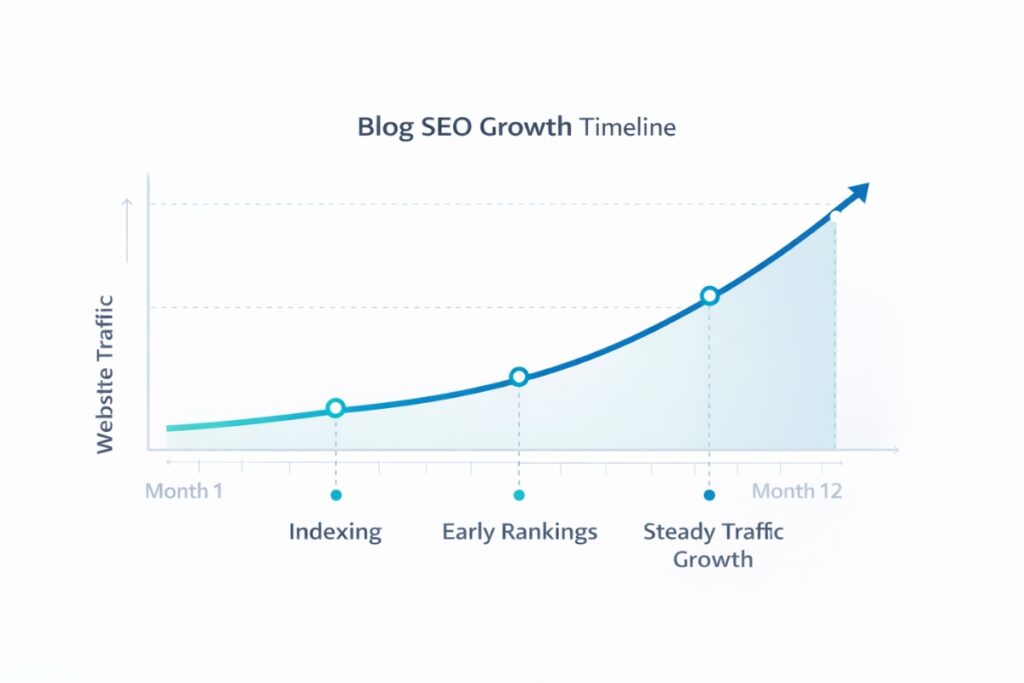
Blog results are not instantaneous but cumulative. In the first few months, the focus is on getting your posts indexed by search engines and ranking your content, not traffic spikes.
You should think of blogging as building a long-term content asset and expect it to be more like a snowball effect than turning on a tap and getting leads right away (like paid ads).
Typical patterns look like this:
Months 1 to 3: Indexing and early impressions
Months 3 to 6: The first keyword rankings are displayed
Months 6 to 12: Steady traffic growth begins
In competitive industries it may take longer, while niche and local topics often develop more quickly.
Traffic usually grows in shifts. Some posts rank first, then clusters collectively gain importance. Leads often lag behind traffic because readers return multiple times before converting.
Common Business Blogging Mistakes to Avoid

Many business blogs perform poorly due to simple structural errors rather than a lack of effort. These problems are common and are usually easy to fix.
Writing without keyword intent. If a post is created without a clear search query, it will rarely be discovered. Defining the target keyword first will keep the article focused and searchable.
Publication on independent topics. Blogs perform better when posts stay within clear pillar categories, or Keyword clusterstied to core services.
Only create short blog posts. These posts often lack ranking depth or enough context for search engines to rank them appropriately.
Older posts will not be updated. If the blog content on your website becomes outdated or outdated, it will gradually lose traffic.
Only write advertising posts. Promotional sites have their place, but you also want to reach the portion of your potential customers that are looking for issue-oriented content.
No use of internal links. An internal link is a link provided in the text of your article that directs the reader to another page on your website.
You will notice that in this post we have linked to many articles we have written that address the topics presented in this post.
Links like these are important for many reasons, but especially for the following reasons:
- They give your reader the next steps
- They provide additional context to search engines
- They show search engines and readers that you fully understand your topic
- Linking pages improves the search visibility of all linked pages
Tools that make business blogging easier
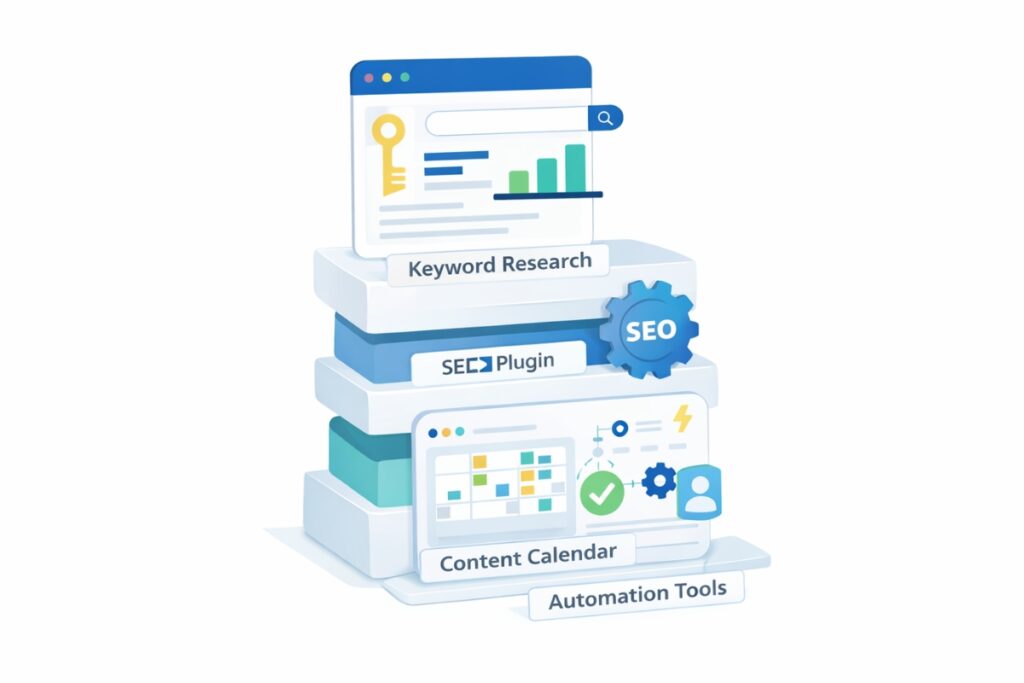
Blogging doesn’t require complex software stacks. Simple systems work best and these look different for every company.
Helpful tools include:
For businesses that already manage leads and funnels, some marketing platforms like GHL Systems can connect blog leads with automated follow-up flows. This is only important if lead capture is part of the strategy.
Otherwise, a simple blogging setup as part of your website will suffice.
Final answer: Should a company have a blog?

Yes. A business blog is one of the most reliable assets available online for long-term visibility and a mainstay of a strong business Content strategy for small businesses.
It builds search presence and answers customer questions before first contact. When structured correctly, blog content continues to work long after it’s published.
The key is simplicity:
- clear topics
- Keyword intent
- helpful structure
- steady publication rhythm
For businesses planning to start their own blog, starting with a simple structure and a focused topic plan is often the quickest path to results. A clean setup outperforms a complex one every time.
Frequently asked questions
Yes. Blogging remains one of the most reliable ways to generate organic search traffic because helpful articles continue to attract search traffic over time. For small businesses, blog posts answer specific customer questions and build trust before a buyer even makes contact, improving conversion rates over time.
Most corporate blogs achieve measurable search visibility within three to six months, depending on competition and topic difficulty. SEO promotes growth, meaning each quality article strengthens the entire domain and improves future ranking potential.
There is no set number, but many companies only gain traction after publishing 20 to 30 well-optimized, targeted articles. Strong topic focus and usefulness are far more important than mere publication volume.
Yes. Updating older blog posts improves accuracy, relevance, and rankings. Search engines prefer updated content, especially when statistics, examples and internal links are properly maintained.
A well-structured blog can generate leads through downloadable resources, advice links, pricing guides and decision checklists. Educational content attracts early buyers, who often later convert through follow-up systems or service sites.
Consistency is important, but the frequency can be realistic. Even two high-quality articles per month can create momentum if you choose a strategic topic. Many companies batch content or use structured publishing systems to ensure consistent output.