
I’ve spent the last year watching marketing teams struggle to understand why their organic traffic reports tell one story while their pipeline tells another. The missing link is almost always the need for AI search analytics tools.
When a prospect asks ChatGPT, “What is the best CRM for a mid-sized SaaS company?” And your brand doesn’t appear in the response, no SERP rank tracker in the world will tell you that – at least not yet. This is exactly the gap that AI search analytics tools are designed to fill and why every growth-oriented team now needs at least one in their tech stack.
In this guide, you’ll learn what these tools do, what features really matter, and which platforms are recommended depending on team size, budget, and use case.
I’ll also explain how to establish a credible baseline and use your data to drive real content and distribution decisions.
Table of contents
What are AI search analytics tools?
AI search analytics tools are software platforms that track how and where a brand appears in responses generated by AI-powered answer engines and chatbots, including ChatGPT, Google AI Overviews, Perplexity, Gemini and Claude.
- Prompts
- Quotes
- Brand mentions
- Feeling
- AI referral traffic
- share of the vote
The distinction is important because the consumer behavior behind the two is truly different.
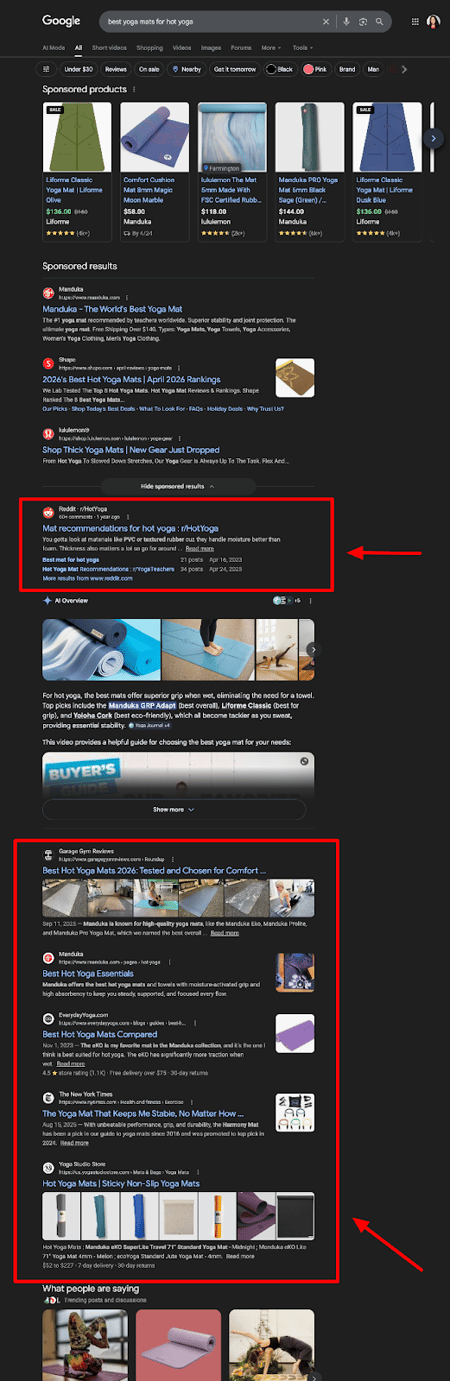
When someone searches Google for “best yoga mats for home workouts,” they probably expect to see a ranking and choose where to click.
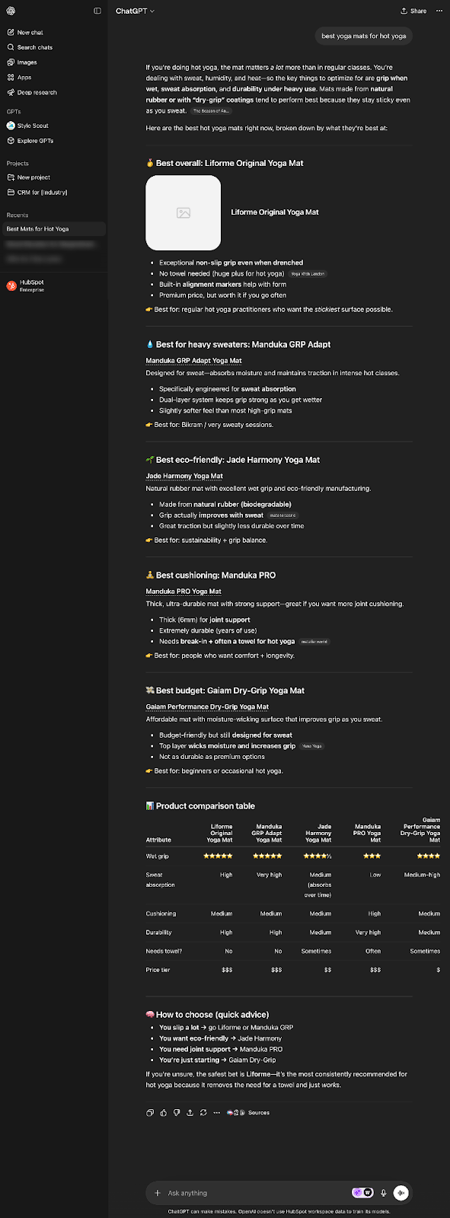
When someone asks ChatGPT the same question, the model synthesizes a direct recommendation, and companies either appear in these recommendations or not.
Read: ChatGPT Product Recommendations: How to Make Sure You’re One in 2026
Why are they important?
Experts suggest AI search traffic could overtake traditional organic search traffic Within the next two to four years, AI-guided visitors are already converting 4.4x faster than organic visitors from traditional search.
The impact of AI search results is already significant.
Google AI overviews now appear in around 25% of search queriesbased on Semrush analysis – an increase of 13% in March 2025. ChatGPT has surpassed 800 million weekly active users. And 73% of B2B buyers now use AI tools in their purchase research processaccording to a March 2026 synthesis of 680 million AI citations.
Still, only 22% of marketers are currently tracking AI visibility, meaning the competitive window is still open for early movers.
How marketing teams use AI search analytics tools
AI search analytics tools support four core marketing workflows, each of which addresses a blind spot that traditional analytics platforms cannot address.
- Content planning: Understanding which prompts trigger AI responses in your category will reveal gaps that your existing content isn’t filling.
- Brand monitoring: By tracking when, how, and in what context AI systems mention your brand, you can identify reputational risks that traditional media monitoring completely misses.
- Competitive Intelligence: Seeing which competitors appear alongside your brand – or instead – for high-intent prompts creates a new category of market signals.
- Attribution: By linking AI citations to referral traffic and conversion rates, brands finally have a feedback loop to prove ROI on AEO and GEO investments.
For deeper strategic context on how AI is transforming the marketing stack, the free HubSpot AI Web Analytics Guide is a useful companion read.
Features to look for in AI search analytics tools
The AI visibility platform category has evolved rapidly, and the maturity of the tools varies significantly between providers. My experience evaluating these platforms has taught me that the features can be divided into two areas: basic visibility features and operational requirements.
Both are required before committing to a paid subscription.
Core Visibility Features
Platform coverage
A brand can appear in 90% of prompts on one platform and are completely absent on anothertherefore, multi-platform tracking is not optional.
At the very least, you should follow ChatGPT, Gemini, and Perplexity because this is the case three largest platforms by user base and have the strongest influence on purchasing research. Reporting on Google AI Overviews, Microsoft Copilot, and Claude expands the brand signal, but is only meaningful if your audience actively uses these platforms.
HubSpot AEO tracks ChatGPT at all levels, including Free, while paid accounts add Perplexity and Gemini. Additional platforms are in the works.
Prompt follow-up
The ability to define and monitor specific conversation prompts (i.e. the actual questions buyers enter into AI systems) is the key metric in this category.
Look for tools that allow teams to enter their own prompts and suggest others based on industry and competitors. The quality and relevance of the prompt library directly determines how useful the visibility data will be.
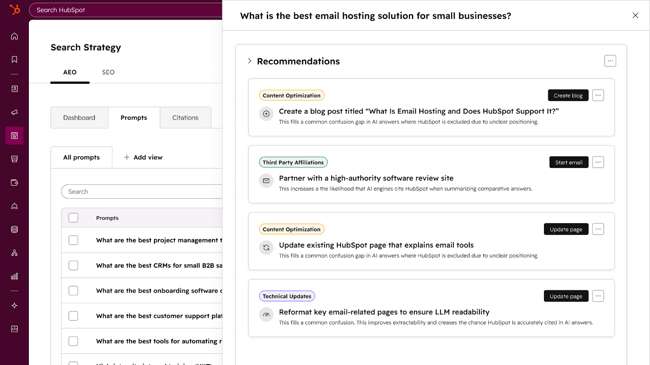
In HubSpot AEOThe Prompts The tab is where marketers manage which questions they track and see how their brand performs on each individual question.
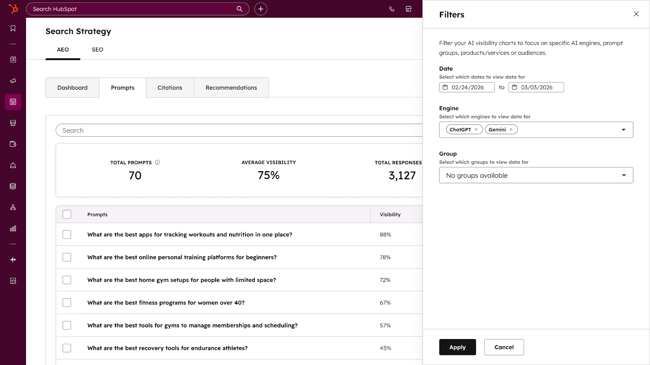
Teams can also view recommendations and group prompts by product line or customer segment, making it easier to analyze performance for specific areas of the business.
Citation and mention analysis
In addition to knowing whether the brand appears, marketers need to know which URLs AI systems are citing, how often, and in what position. The specific URLs help teams better understand which pages are working and what needs to be done to achieve their goals.
Non-linked mentions are also important. AI systems often reference brands without a hyperlink, and these mentions still shape perception. Tools that separate linked quotes from brand mentions provide a more complete picture.
The Quotes The HubSpot AEO tab breaks down exactly which sources the AI gets data from.
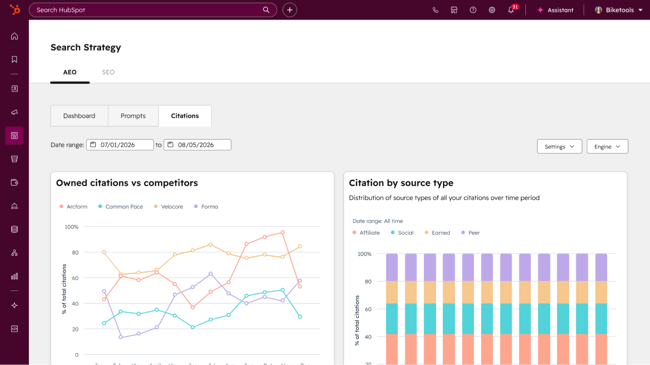
You can see which content types are cited the most (listicles, blog posts, product pages, news articles, etc.), which channels those citations come from (your own website, earned media, review sites, user-generated content like Reddit, etc.), and which specific domains are cited the most.
There is also a competitive view that shows how often AI cites a website compared to competitors and how often a brand is mentioned in the citations overall.
Sentiment analysis
Do AI systems describe your brand positively, negatively or neutrally? Sentiment scoring at the mention or citation level shows whether the AI presence is helping or hurting the brand. It also detects reputation issues before they show up in conversion data.
In addition to brand visibility in HubSpot AEOThere is a “Sentiment Analysis” tab. This measures how positively or negatively a brand is described in AI-generated answers on a scale from -100% to +100%.
Competitive benchmarking
Share of voice, or the percentage of AI responses in a given category that comprise a brand compared to its competitors, is the key performance indicator in this space. Knowing competitor traffic in general can also help marketers gain context.
Look for tools like HubSpot AEO This allows teams to track a defined group of competitors and show where the brand is winning or losing.
Operational requirements
Key visibility features are only half the battle. How a tool handles data history, alerts, and integrations determines whether it fits into a real team’s workflow.
Historical data
AI visibility shifts with model updates, changes in training data, and seasonal demand patterns. Without historical trends, marketers cannot distinguish real improvement from model volatility. Look for at least 90 days of historical data, ideally longer.
Alerting
Visibility can change overnight when a major publication covers a competitor or when a model update reweights its training data. Notifications about significant mention increases, citation losses, or competitor overtakes allow teams to respond in near real-time instead of tracking changes in a monthly report.
HubSpot AEOfor example, offers weekly points tracking and trend alerts.
Exports and integrations
AI visibility data becomes much more accurate and actionable when linked to the tools a team already uses (e.g. Google Analytics, Search Console, Slack, Looker Studio, CMS).
Through native exports to CSV or direct integrations, teams can incorporate AI visibility into existing reporting cadence. HubSpot AEO fully integrates with existing HubSpot workflows and tools (like Content Hub And Marketing Hub), as well as third-party tools like Reddit and TikTok.
Governance and access control
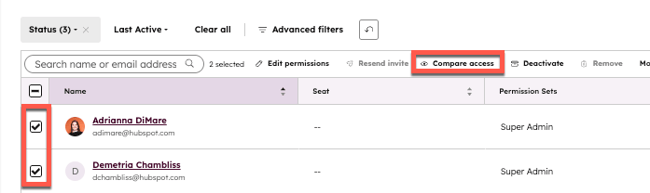
Enterprise teams managing multiple brands or regional markets need workplace separation, role-based permissions, and ideally compliance certifications such as SOC 2 Type II. For large enterprises, these are not nice-to-haves; These are requirements that ensure that a company’s activities remain safe and organized.
Have tools like HubSpot Robust user permission settings to help with that.
Checklist for a quick vendor demo
Before any sales call or test, I recommend going through this list to stress test the tool based on your actual use case:
- Can I add my own custom prompts or am I limited to the platform’s suggestions?
- Which AI platforms are included in my plan and which require an upgrade?
- How far back does historical data go and how often is it updated?
- Can I export data to CSV and connect to Google Looker Studio or a BI tool?
- Does the tool distinguish between linked quotes and unlinked brand mentions?
- What alerting options are there for significant visibility changes?
Below is a breakdown of the platforms I would use across all platforms The marketing team’s tech stack shortlist, ranked from Free to Enterprise.
I’ve included a coverage comparison chart so you can see the platform trade-offs at a glance. An asterisk
indicates that a feature is only available in higher tiers.
Comparison of AI Search Analytics tool coverage
*Claude monitoring is only available on Profound Enterprise plans. Price current, as of April 2026. 1.
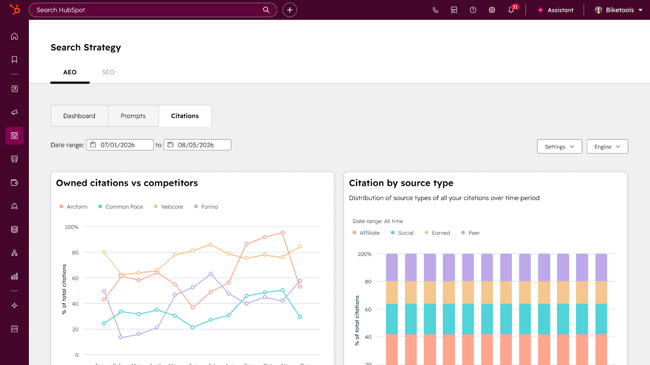
Drift Kings Media AEO’s proprietary Citations vs. Competitors dashboard allows users to track response engine citations by source over a specific period of time Best for:
Tracks daily how a brand appears in AI-generated responses in ChatGPT, Perplexity and Gemini. It analyzes brand mentions, competitor share of voice, and citations – and most importantly, tells teams what to do with the results. The Prompts tab is where marketers manage which questions they track and see how the brand performs on each individual question. Marketers can organize prompts into groups by product line or customer segment, making it easier to analyze performance for specific areas of the business. Prompts are suggested based on the business context and for Marketing Hub
Customers, CRM data makes these suggestions more relevant from day one.
The Citations tab breaks down exactly what sources the AI is drawing from – which types of content are most frequently cited, what channels those citations come from, and which specific domains are most frequently cited. There is also a competitive view that shows how often AI cites your website compared to competitors.
In addition to brand visibility, a sentiment analysis tab measures how positively or negatively a brand is described in AI-generated responses over time. What sets HubSpot AEO
Aside from pure monitoring tools, there is the recommendation layer. Instead of just showing up where a brand does or doesn’t, it delivers prioritized actions – from creating new content to building a presence on third-party platforms that match search engine trust. For Marketing Hub Pro and Enterprise customers, these recommendations connect directly to HubSpot’s content tools. Not ready to commit to a paid plan? Start withHubSpot’s free AEO grader
that gives teams a unique overview of their brand visibility in ChatGPT, Perplexity and Gemini. This option includes sentiment analysis, share of voice, and competitor comparison – with no setup required. This is a good starting point before moving on to ongoing tracking. Pro tip:
Before the first strategy session, run the AEO grader on the brand’s top two competitors. Direct comparison of ratings provides immediate context for where the brand is over- or under-indexed relative to the market and is a compelling foil in a stakeholder deck. What we like:
Daily tracking across three platforms, citation and sentiment analysis, prioritized recommendations, CRM-connected prompt suggestions, and a free grader for teams not yet ready for a paid subscription. Prices:
Free 28 day trial available. The paid plan starts at $50/month or is included with Marketing Hub Pro and Enterprise at no additional cost. 2.
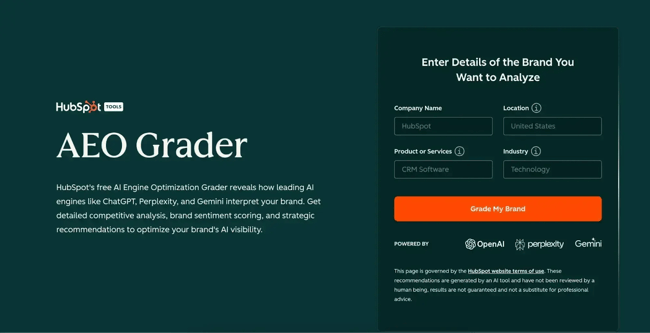
Drift Kings Media AEO Grader allows users to track their brand’s current visibility in response engines like ChatGPT, Perplexity, and Gemini Best for:
Teams new to AI Visibility who want a free, no-setup audit for ChatGPT, Perplexity, and Gemini.
- evaluates your brand based on five evaluated dimensions:
- Sentiment analysis
- Presence quality
- Brand awareness
- share of the vote
Market competition.
Additionally, the results for GPT-5.2, Perplexity and Gemini are cross-validated simultaneously to produce a composite score out of 100 as well as a written interpretation and an exportable report.
What makes it really useful for getting started is that it goes beyond a single score. Marketers receive a narrative theme analysis (the recurring stories that the AI always associates with your brand), a source quality assessment (identifying the publications and domains that influence how the AI perceives you), and a competitive comparison.
For competitive intelligence, the tool accepts any brand name, allowing teams to perform the same analysis on top competitors. HubSpot also offers more in-depthFeatures of the AEO strategy
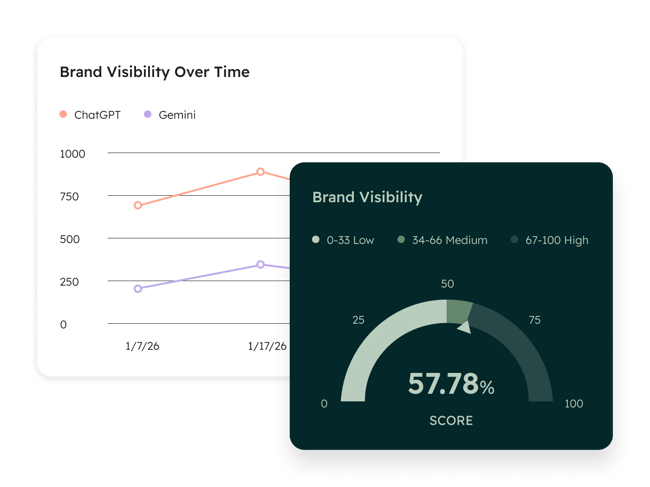
AI search analysis, AEO tool Pro tip:
Run the AEO Grader on your top two competitors before your first strategy session. Comparing results directly gives you an immediate overview of where you are over- or under-indexed relative to the market and is a compelling foil in a stakeholder deck. What we like:
Free, no setup required, performs simultaneous cross-validation on three AI platforms and produces an exportable report with source-level analysis. Good starting point before choosing a paid tool. Prices:
AEO Grader is free for everyone and you can also get started with HubSpot AEO for free. The paid add-on is available for $50/month. 3.
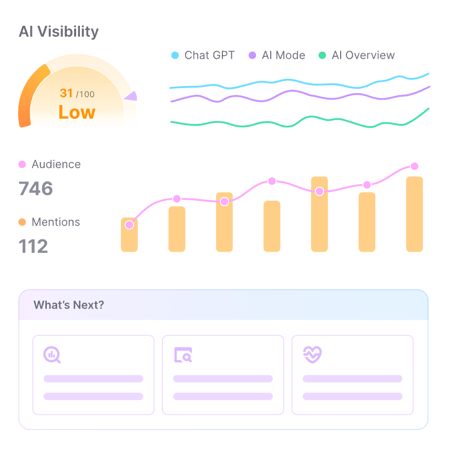
AI search analytics tools, Semrush AI visibility dashboard with visibility score
source Best for:
Teams that already use SEMrush and want SEO and AI visibility on one platform, or agencies that need scalable prompt tracking with competitive benchmarking. If your team is already on SEMrush for keyword research and rank tracking, this is the case AI visibility toolkit
is the natural upgrade path. It tracks brand mentions and visibility in ChatGPT, Google AI Overviews, AI Mode, Perplexity and Gemini.
But the biggest selling point is the integration: teams can see their traditional SEO rankings and your AI visibility on the same platform, at the same reporting cadence, and without context switching. The toolkit is now bundled inSEMrush One
launched in October 2025, combining the full SEO toolkit with AI visibility tracking.
I have found the AI Visibility Score to be a useful executive-level metric. It gives you a single number that you can track over time and compare with the competition. The brand performance reports are the most actionable feature as they reveal week-over-week sentiment swings, source attribution, and competitive positioning. What we like:
All-in-one SEO + AI visibility, strong prompt tracking infrastructure, brand performance reports with attribution, familiar interface for existing SEMrush users. Prices:
SEMrush One Starter starts at $199/month and includes both toolkits. The standalone AI Visibility Toolkit costs $99/month per domain, although the basic plan limits users to 25 custom prompts – and scaling for additional domains or prompt volumes quickly adds to costs. 4.
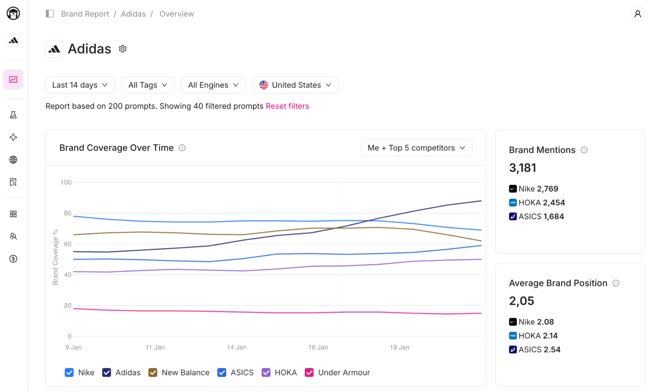
AI search analytics tools Otterly brand coverage over time, dashboard example with adidas
source Best for:
has built a strong reputation as the most accessible pure AI search monitoring tool on the market. It is used by over 20,000 marketers and was named a Gartner Cool Vendor in 2025. It covers ChatGPT, Google AI Overviews, Google AI Mode, Perplexity, Gemini, and Microsoft Copilot, making it the most comprehensive platform coverage in its price range.
The core workflow is based on prompts: users define a library of conversational queries that reflect what their buyers actually type into AI systems, and Otterly automatically runs these prompts across all covered platforms, logging brand mentions, quote URLs, share of voice, and sentiment over time.
Additionally, the Brand Visibility Index and weekly quote change alerts are particularly useful for identifying competitive changes before they appear in the pipeline.
An honest caveat: Otterly is a monitoring-first approach. It offers a clear view of what’s happening, but doesn’t have built-in content creation or optimization features. Marketers need separate tools to act on the insights. What we like:
Coverage for six platforms, clean GEO audit tool, Google Looker Studio connector, weekly citation alerts, agency workspace support. Great value for monitoring focused teams. Prices:
Lite for $29/month (15 prompts), Standard for $189/month (100 prompts), Pro for $989/month (1,000 prompts). Free trial available. For teams that grow beyond the entry level, the price jump is steep. 5.
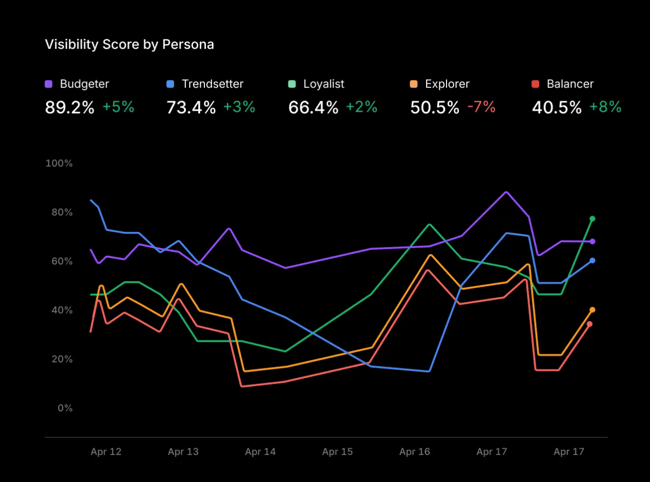
AI search analytics tools, deep visibility by persona dashboard
source Best for:
is the best-funded dedicated AI visibility platform on the market, having raised $58.5 million in Seed, Series A and Series B rounds.
It is designed for organizations with enterprise-wide requirements such as SOC 2 Type II and HIPAA compliance and multi-workspace management. It also covers more than 10 AI models, including enterprise-level Claude, Grok, and DeepSeek.
Profound’s standout feature, in my opinion, is the Conversation Explorer, a real-time window into the real questions of millions of users on AI platforms, with search volume data previously invisible to marketers.
Combined with the AI Visibility Dashboard and Prompt Volumes analysis, it provides content, PR and brand teams with a layer of market intelligence that goes far beyond citation tracking. The platform also includes agents to create AI-optimized content, making it one of the few tools that closes the loop between insights and execution. What we like:
Enterprise security, Conversation Explorer for market research, AI agents for content creation, and the most comprehensive enterprise-level AI model coverage. Best for large companies that take AI search seriously as a strategic priority. Prices:
Starter from $99/month (ChatGPT only), Growth from $399/month, Enterprise Custom. No free trial. 6.
source Best for:
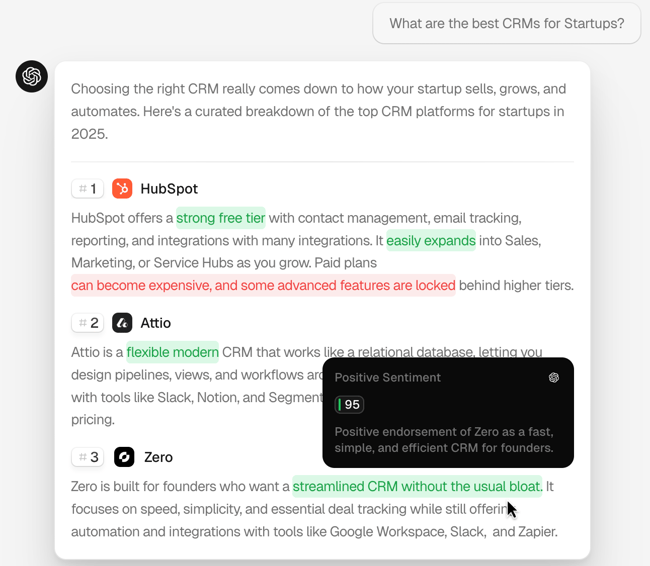
Runs prompts via ChatGPT, Perplexity, and DeepSeek once every 24 hours, with filtering by country IP, AI model, and prompt tags (e.g., audience personality or funnel stage).
This segmentation feature is more detailed than most tools in this price range and is particularly useful for B2B teams pursuing multi-market or multi-persona strategies. What we like:
Granular segmentation by model, region and persona. Daily update frequency. Fast onboarding. Great fit for SaaS teams running structured AEO programs. Prices:
From €89/month. Free trial available. 7.
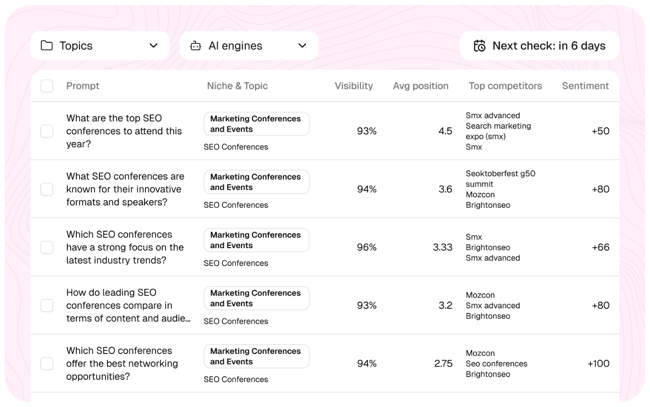
Using AI search analytics tools, users can view prompts and brand mentions
source Best for:
is SE Ranking’s dedicated AI visibility platform. It tracks brand visibility in ChatGPT, Perplexity, Google AI Mode and Gemini with dashboard filters for date, region, topic, competitors, sentiment and AI engine.
The four main metrics (Visibility Score, Rank, Average Position, and Net Sentiment) are immediately displayed at the dashboard level, making it one of the most accessible tools for teams new to the category.
SE Visible is also particularly strong at sentiment tracking. It assesses weekly sentiment swings with a clear net score and breaks down how mentions are worded positively, negatively or neutrally across platforms. What we like:
Intuitive dashboard, strong net sentiment scoring, source analysis for citation strategy, solid fit for agencies integrating AI visibility into their service offering without a steep learning curve. Prices:
Starting at $49/month. Free trial available.
How to create baselines and benchmarks with AI search analytics tools
One of the most common mistakes teams have made is buying an AI visibility platform and immediately trying to optimize it without first determining where they actually stand. Baselining is not optional. Without a baseline, marketers cannot distinguish true improvement from model volatility and demonstrate ROI to stakeholders who need to justify subscription spend. Start running HubSpot’s free AI Search Grader
about the brand and its three biggest competitors. This produces a composite score across five dimensions that have been cross-validated for ChatGPT, Perplexity and Gemini. Export the report. This becomes the team’s T0 benchmark. Use it to start the team’s AI search analytics workflow.
Quick start baseline workflow
Use this workflow to go from zero visibility data to an active monitoring and optimization system in two weeks.
Week 1: Set up your prompt library.
- Week 2: Conduct a citation gap analysis (Document your citation sources.)
- Which domains does AI cite when referring to your brand? Which domains are cited when referring to competitors? This list will be yoursCitation gap analysis
- . These are the publications, review sites, forums, and third-party sources where you need to build or strengthen your presence.
Log your share of voice percentage for each AI platform separately. A brand that dominates Perplexity quotes and has no Google AI Overview presence has a very different plan of action than a brand with the opposite pattern.
Ongoing: Review and update the worksheet weekly.
- Take time each week to review and update all key metrics, including:
- Share of Voice this week compared to last week, by platform
- Newly gained or lost citations with the source domain
- Change in sentiment score, with notable positive or negative impulses emerging
- Competitor Movement: Who won or lost citations in your category?
Priority action item for the week: a piece of content, PR, or technical fix based on the data The goal of a weekly cadence is not to react to every fluctuation – AI models are constantly updated andModel volatility is real
. The goal is to identify directional trends over four to eight week time frames and build your optimization backlog based on these patterns rather than weekly noise.
How to improve AI visibility with insights from these tools
Analyzes without measures are simply pointless. The power of AI search analytics tools relies on translating citation gaps, sentiment signals, and competitive benchmarks into a prioritized content and distribution plan. This is how I would structure it
AI SEO side of this workflow.
Content updates based on citation gap analysis
If your monitoring tool shows a competitor being cited for a call where you are not present, the first question is: Do you have content that directly addresses that call?
- If not, create it. If you do this, check whether it is structured for AI retrieval. This includes:
- Short, removable answer blocks
- Clear headings
- FAQ schema
Original data (which gives AI systems and others a reason to cite you as a primary source.)
New content assets for high-quality promptsAccording to current AirOps research
- There are certain structured content formats that significantly increase AI citation rates. For example:
- Comparison sites with three or more tables receive 25.7% more citations
Shortlist-style pages with an average of fewer than 10 words per sentence receive up to 18.8% more citations.
Use your prompt data to identify the highest volume and highest intent searches in your category, then create content specifically structured to answer those questions clearly and completely.
Authoritative citation structure
AI systems develop their brand understanding from the web sources in their training data. The domains most frequently cited by AI are high-ranking publications, Reddit threads, review platforms, and “Best X” listicles.
Your citation gap analysis will tell you which of these surfaces you are missing. Targeted media outreach, guest posts, and presence on review sites on AI-trusted sources are your most leveraged external actions.
Structured data and technical AI readiness
Schema markup, particularly FAQ page, HowTo, article, and organizational schemas, increases the likelihood that AI systems can correctly extract and map your content.
Review your monitoring tool’s technical audit recommendations and ensure AI crawlers (GPTBot, ClaudeBot, PerplexityBot) have access to your key pages. Blocked crawlers are one of the most common and easiest to fix causes of low AI visibility for established brands.
Cross-channel distribution to expand the AI training signal
Single-source content rarely creates AI trust at scale.As explained in HubSpot’s AEO guide
Consistent brand messaging across multiple trusted platforms – industry publications, forums, YouTube, LinkedIn, review sites – signals to AI systems that there is a reliable consensus from multiple sources about your brand.
AI visibility data can tell marketers which channels are contributing to brand citations and which are not, allowing teams to focus their sales efforts where they will drive the greatest increase in citations.
FAQs about AI Search Analytics Tools
Which AI platforms should marketing teams monitor first? Prioritize the platforms that buyers actually use. For most B2B marketing teams, that means starting with ChatGPT And Google AI overviews, which together account for the largest share of AI-driven referral traffic. ChatGPT now drives 87.4% of all AI recommendation traffic
on websites, while Google AI overviews appear in around 25% of all Google searches and dramatically reduce CTR for the underlying organic results. Add confusion
if the audience leans toward technical or research-oriented buyers whose citation behavior tends to favor high-authority and primary source content. Gemini is worthwhile for consumer-facing brands and any team already invested in the Google ecosystem.
When should you invest in an AI visibility platform instead of developing it yourself?
The build vs. buy decision comes down to speed, coverage, and ongoing maintenance costs. Building a simple prompt tracking system is technically feasible, but engineering and maintenance costs typically exceed the annual subscription to a purpose-built platform – and a homegrown system still natively excludes Google AI Overviews. The recommendation: Buy before construction, at least for the first 6-12 months. Start with HubSpot’s free AEO grader For quarterly brand audits, add a paid monitoring tool like HubSpot AEO
Once a baseline is established and the highest priority platforms and prompts are clear.
How do I prove the ROI of AI visibility improvements? Start segmenting AI referral traffic in Google Analytics 4. HubSpot’s platform groups AI recommendations separately
in Traffic Analytics, which makes it possible to create reports specifically for AI-based visitors. Track conversion rate, time on site, and pipeline attribution for this segment separately from organic and direct channels. The scale to consider: AI search visitors convert at 4.4x the rate
of traditional organic visitors, and SE Ranking data found that AI visitors spend 68% more time on websites than traditional organic visitors. Even small improvements in AI share-of-voice can have an outsized revenue impact relative to the effort invested.
What is the best way to keep up with model updates and volatility?
AI model updates are the single largest source of short-term volatility in AI visibility data. The most practical approach is to maintain a changelog that records key model updates alongside visibility metrics, so that changes in share of voice can be linked to external causes and not assumed to reflect something the team did or didn’t do.
Set up alerts in the monitoring platform for sudden changes in brand mention volume, sentiment score, or competitive positioning. Most platforms notify of material changes within 24 to 48 hours, giving teams time to investigate before a stakeholder asks.
AI search visibility offers many opportunities
The shift to AI-powered search is already changing the way shoppers discover, evaluate and select brands. The teams investing in measurement now will have months of baseline data, a tested prompt library, and an optimization playbook for when their competitors start asking the right questions.
Regardless of budget or team size, the basic principle is the same. Visibility cannot be improved without prior measurement. Start with the free AEO Grader, run it on top competitors, and build from there.