
When I was growing up, MTV’s were the only “Top 10” I cared about Total request live (TRL). When I started working, these were the top 10 results in Google SERP. Now my eyes are turned even higher as we marketers examine how we rank in AI overviews.
According to Google, AI Overviews (also known as position zero) now reach 1.5 billion monthly users in 200 countries and impact both website traffic and marketing results.
The good news? This is no reason to panic. AI overviews reward clarity, structure and real expertise. So if your content is well organized and provides real value (which I hope it does), you’re already halfway there.
Even if that’s not the case, this guide explains exactly how AI digests work, what it takes to get your content cited in them, and how to measure your visibility in a world where a click isn’t always the right indicator of success.
Table of contents
What is an AI overview (and when does it appear?)
An AI summary is an AI-generated summary that appears at the top of Google’s search engine results pages (SERPs) in response to some user queries. Instead of a list of blue links, Google uses AI Overviews to synthesize information from multiple sources to provide a direct, conversational answer right at the top of the page.
A lot has changed in consumer behavior, but the purpose of a Google search hasn’t changed: to show great, original content that provides real value and answers a query.
Accordingly GoogleAI overviews do just that, helping users understand information from multiple sources instead of having to click on different links Perhaps find what you need.
AI overviews are the most likely to appear Long-tail inquiries for educational purposes as transactional or short keyword searches, but why exactly?
Well, longer queries usually mean the user needs a more in-depth explanation, comparison, or step-by-step guide, which AI summaries can provide but traditional results cannot.
For example, searches like “How do you film a music video?” or “What is Total Request Live?” best suited for AI overviews. (Yes, I’m flying my Millennial flag high right now.)
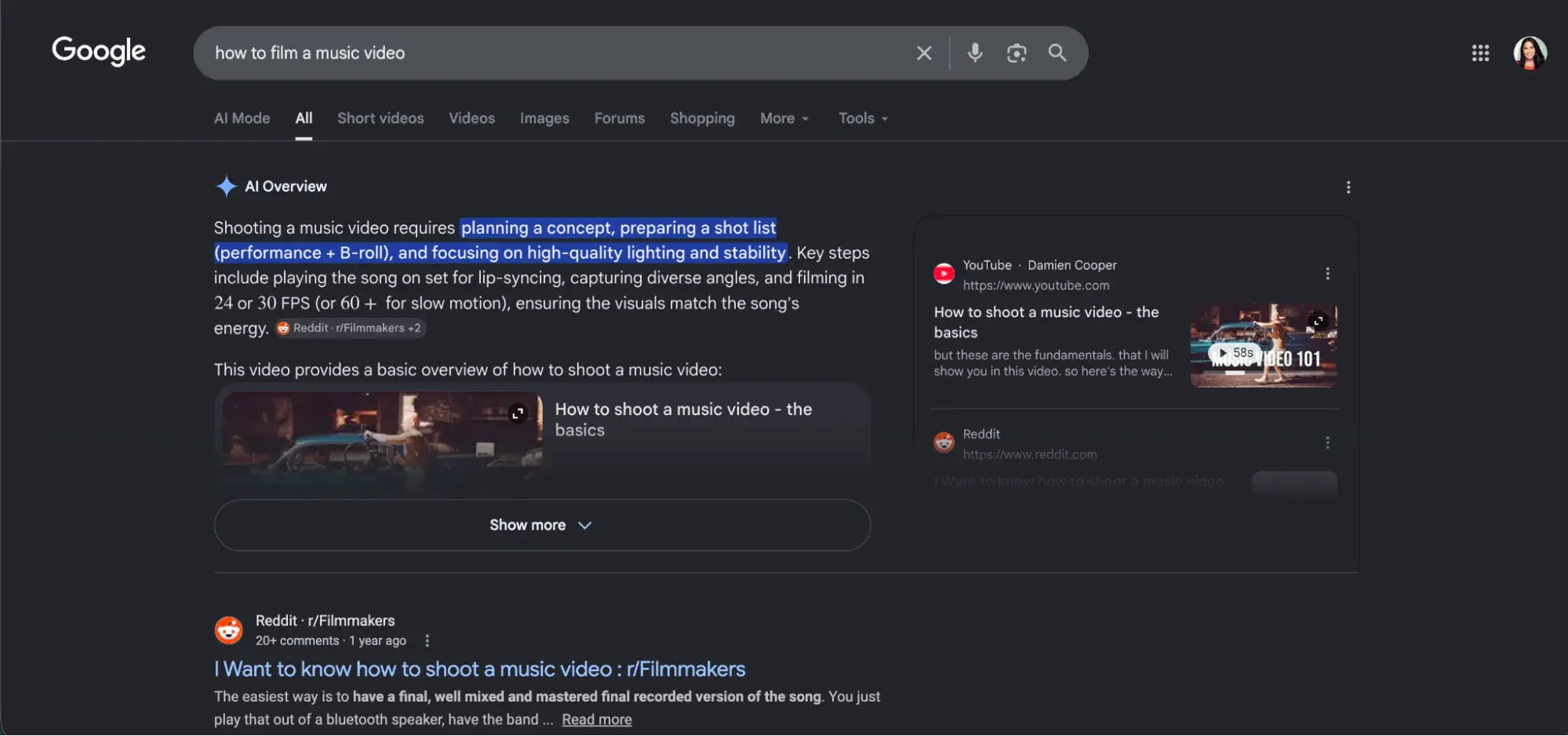
Think about it. When I search for “how to film a music video,” I need detailed instructions to make it successful, right? The AI overview that appears along with the video and more is necessary and appreciated. However, when I searched for something transactional, like “where to buy a CD,” that wasn’t so much the case.
TLDR: AI Overviews gives you what it believes is a direct and accurate answer to your question. Traditional search provides you with resources to help you find the answer yourself.
Why should marketers pursue AI overviews?
Growth data shows how effective AI overviews have been.
Recently, McKinsey found that half of Google results already contain AI-powered features like overviews, and trends predict that number will reach 75% by 2028. Over and beyond Google announced this at I/O 2025 that AI Overviews now reach 1.5 billion monthly users in 200 countries.
This has a huge impact on awareness and traffic, which we explain in more detail in “Killing AI Traffic?? How AI Overviews Impact Organic Website Traffic” and “How AI Impacts SEO.”
Taking all of this into account, the marketing calls are pretty clear. If our marketing content is not structured so that it can be understood and extracted by AI, our brands will be invisible to a huge and growing audience.
This is where response engine optimization (AEO) – sometimes called generative engine optimization – comes into play.
Not sure how you currently perform in AI engines? Find out for free and learn how you can use it to improve HubSpot’s AEO Grader.
How to rank in AI overviews: Understand how answers are structured
Improving visibility in Google AI overviews represents a shift in mindset for marketers, from focusing solely on ranking pages with traditional SEO to also composing answers with AEO.
When a query triggers an AI digest, Google searches multiple sources and retrieves passages that it thinks best answer the question. They are then summarized into a single answer, usually citing multiple sources. You want your brand to be among these quotes.
Here is the distinction that matters most:
- rank means your page will appear in standard search results. (SEO)
- Quote means your content is actually used in the AI-generated response. (AEO)
That’s not the same. You can achieve both, but you can also rank high and never be cited, or be cited without being ranked #1.
Research shows that this is the case everywhere 40-76% of AI overview citations also appear in the top 10 search results. So a significant proportion of citations come from pages outside the top 10. Google selects content based on how well it answers the query, not just its position.
Read: How to use Google AI Search | SEO AI trends
So what does Google look for when selecting content?
1. Clarity and extractability
Content that answers a question directly and succinctly is much easier for AI systems to crawl and uncover for searchers. Google’s official guide to AI search says the best approach is to create content that your readers will actually find useful, rather than content that just technically covers a topic. In other words: offer real value and expertise.
If you’ve been a good content marketer all these years, this shouldn’t come as much of a surprise.
2. Authority and trust signals
This is a mixture of the establishment and completeness of your reporting on a topic, both inside and outside of your own web presence. Think backlinks, brand mentions and current expertise.
3. Easy to paint structure
That means headings, lists, question-based subheadings, human authorship signals, and overall well-defined sections. Research by SE ranking repeatedly finds that well-structured content performs better when it comes to citations in the AI overview.
Now I know what you’re thinking: a lot of this sounds like SEO, and I can’t entirely disagree with you.
However, even though the long, narrative content that SEO promotes performs well in traditional rankings, the actual answer to a question is far less likely to be buried in three paragraphs if it is quoted. AEO’s goal is to ensure that this continues to be the case.
Pro tip: Think of your page as a source document that Google actively cites. The more precisely your content answers a specific question and the easier it is to find that answer, the higher the chance it has of being cited.
Tactics to help you show up in AI overviews
Ok, I have to be honest: nothing about AEO is set in stone.
Marketers old and new, as well as companies large and small, are experimenting to find out exactly what AI will help them uncover. Nothing is confirmed yet, but a few things The tactics are heavily backed by research and even our own experiences here at HubSpot.
Answer-first phrasing
Answer wording is one of the most effective content optimization strategies for Google AI Overviews. This means providing a clear and concise answer immediately after the question title before expand with the context.
For example:
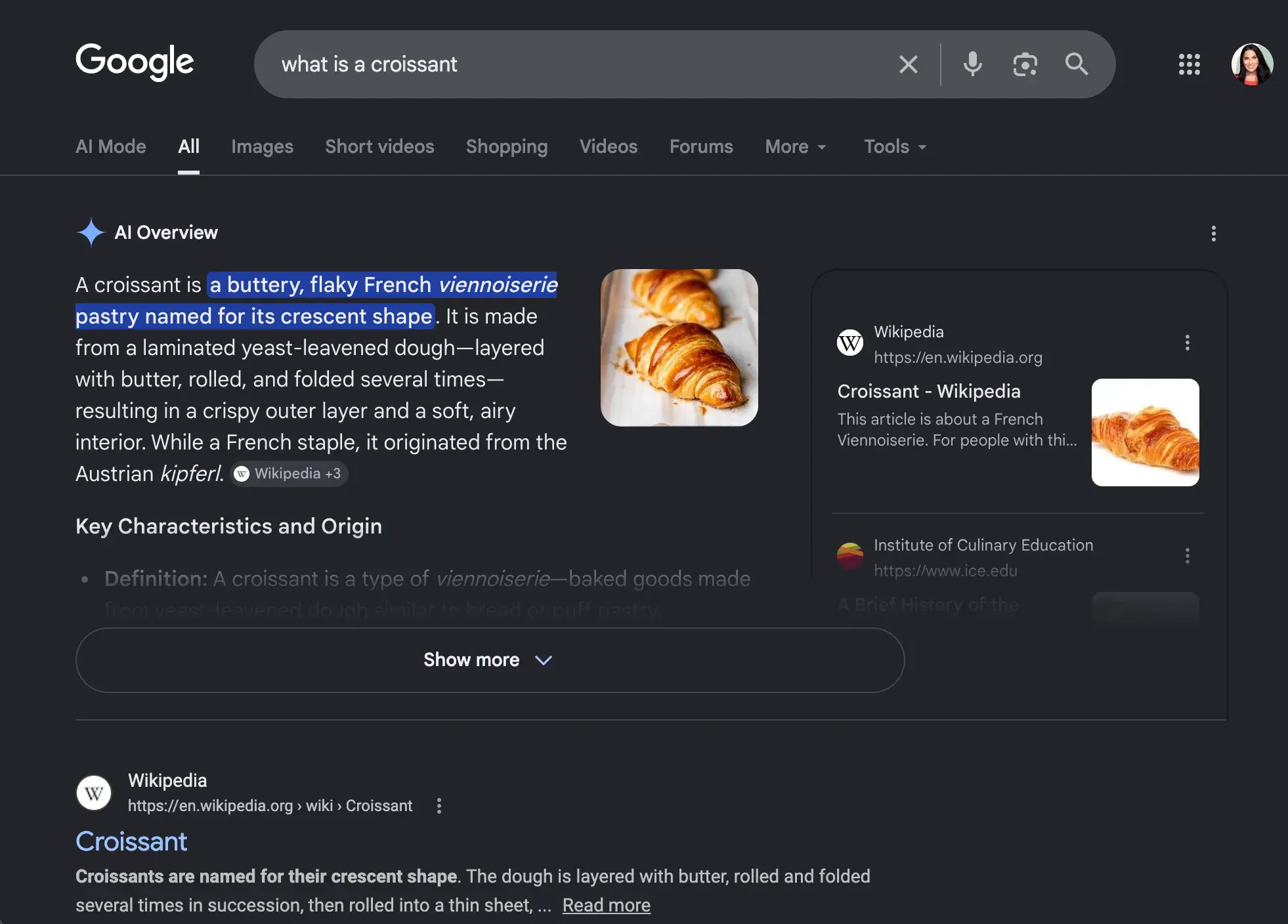
(h2) What is a croissant?
A croissant is a buttery, flaky French dish viennoiserie Pastry named for its crescent shape. It consists of a laminated yeast dough that is layered with butter, rolled and folded several times, resulting in a crispy outer layer and a soft, airy interior.
(You could have just said “delicious,” right?)
This Q&A format works because it reflects how AI systems find information. In the meantime, Studies show that dense paragraphs make it harder for the AI to find what it is looking for, resulting in poorer performance.
When updating an existing article, start by changing key sections to answer questions first, rather than creating new pages. It is the most beneficial edit you can make.
Pro tip: Explore the FAQ schema. More on this shortly.
Long-tail keywords and conversational phrasing
As we know, AI overviews are more likely to appear for informational searches than transactional searches – 99.9% of informative keyword searchesto be exact. And of those, 57.9% are query queries and 46% are long-tail queries with seven or more words. Searches with eight or more words are seven times more likely to trigger an AI summary than shorter searches.
However, marketers must first identify the long-tail keywords focused on questions that trigger AI overviews and that they want to search for.
Start with questions that:
- Require an explanation or synthesis
- Map your core topics and existing content clusters
- Reflect the user’s actual intent (refer to People Also Ask, Google Autocomplete, and your own search console data).
For example, let’s say you sell a search SaaS tool. Instead of targeting “AI SEO,” focus on searches like:
- “How to Improve Visibility in Google AI Overviews”
- “How do AI search optimization tools improve SERP rankings?”
- “What is AI Overview SEO and how does it work?”
Then use colloquial language and phrasing to answer the question fully and accurately. But don’t stop there.
Formatting scannable content
Formatting plays a much larger role in AI overview search engine optimization than most marketers realize.
SellerCommerce reports that 78% of AI overview responses contain either ordered or unordered lists, and unordered lists appear in 61% of all AI overviews.
In other words, Google’s AI systems actively favor scannable, list-based formats. So format your content accordingly.
The difference between good and bad formatting is clear: good formatting starts with a direct answer and then supports it with bullet points or numbered steps. Poor format hides the answer somewhere in a long first paragraph.
Good format: question → direct answer (1-2 sentences) → supporting bullets or numbered steps
Poor format: Long introductory paragraph that eventually leads to an answer hidden in the middle
AEO requires your content to be scanned quickly rather than read from start to finish. Incorporate formatting like:
- H2 and H3 headings framed as questionsreflects the way users search and provides the AI with clear extraction targets.
- Short paragraphs that directly answer the headline question, This is ideally 2-4 sentences before expanding.
- Bullet points and numbered lists for supporting information, steps and comparisons.
Crawlability and site experience
While AI overviews are selected separately from traditional search results, they are based on the same technical foundation.
Google’s guide to AI search says that everything Google has been recommending for a long time goes straight into the AI era. This means that if your content is not crawlable, fast and accessible, it will not be considered at all.
Make sure you have the following:
- Fast page load times (aim for server response time under 500ms)
- Mobile-friendly design as most Google searches occur on mobile devices
- Clean HTML structure without crawling errors or indexing blocks
- Content that doesn’t depend on JavaScript when first rendered
AI overviews do not replace the need for strong SEO, but rather build upon it.
Entity schema and topic clusters
On Google Search Central Live Conference in April 2025John Mueller emphasized the importance of structured data in the age of AI search. Schema markup This strengthens your company relationships and is a big part of it.
Google looks at how your themes, your brand, and your concepts connect throughout your website.
Relevant schema types that help clarify your content include:
- FAQ schemawhich signals that your content answers specific questions; Pages with an FAQ schema appear significantly more often in AI overviews.
- HowTo schemethat helps AI systems understand step-by-step content structures.
- Article and organizational schemethat communicates authorship, expertise and brand awareness.
Pro tip: Don’t try to game the system. Make sure your structured data matches the visible content on the page. A lack of consistency between schema markup and what users actually see hurts your credibility.
Beyond the scheme, Topic clusters Help Google understand the full breadth of your expertise.
When multiple pages consistently cover related entities and concepts, it creates a clearer picture of what your website is about. That’s the core of Google’s EEAT frameworkwhich, like traditional search, represents Google’s quality standard for AI search.
Brand mentions and backlinks also support authority and entity recognition. Pages cited in AI reviews typically have strong thematic coverage, clear indications of authorship, and real referring domains pointing to them.
Multimodal content
Google is actively expanding its offering multimodal capabilities (i.e. include more than just text) in AI overviews. It includes images, videos, charts and more as part of the reply experience, creating more opportunities for brands and companies to get cited.
Here is what you can do:
- Create original images, labeled diagrams (not stock photos), and other unique visual assets to include in the image package alongside AI overviews.
- Add descriptive, keyword-aware alt text to each image.
- Add short videos that summarize important concepts. The videos in AI Overviews predominantly come from YouTube, so hosting them there increases discoverability.
AI Overview Tracking: How to Measure Impact and Iterate
Traffic is great, but you need to look beyond visits and clicks to understand how your AEO and AI overview efforts are working.
How to assess value beyond clicks?
One of the hardest parts of AI Overviews SEO is measurement.
These summaries often answer questions directly, so users may not click on your website. But that doesn’t mean your content isn’t working. it just means that the old metrics don’t tell the whole story.
In a study, SparkToro found that 58.5% of American Google searches end without a click to the open web, and that’s it before AI overviews are fully implemented. Today, the zero-click share has only increased.
AI overview tracking should include viewability checks, click data, and branded search trends. Create a measurement framework that includes:
- Brand visibility within AI responses. Are you being quoted for your target queries?
- SERP impressions and AI overview appearances. Google Search Console tracks AI summary data, but is currently mixed with traditional search results under the “Web” search type.
- Brand search volume trends. This is an indirect way to assess whether your AI overview appearances are increasing brand awareness.
- Supported conversions and multi-touch attribution. Look for patterns in the behavior of AI-exposed traffic further down the funnel.
Tools for tracking AI overviews
Tracking AI insights is not yet as clear-cut as traditional SEO, but there are various tools and tactics you can put together to analyze your performance.
This includes:
- Manual SERP checks for high priority queries
- SERP feature monitoring via platforms like Semrush, SE Ranking or Ahrefs
- Google Search Console impression and click data (combined with traditional search, but still directional)
- Track brand mentions with apps like HubSpot’s social media tools to see when your content is cited but not linked to
There are also many new tools specifically focused on AI performance, such as: HubSpot AEO.
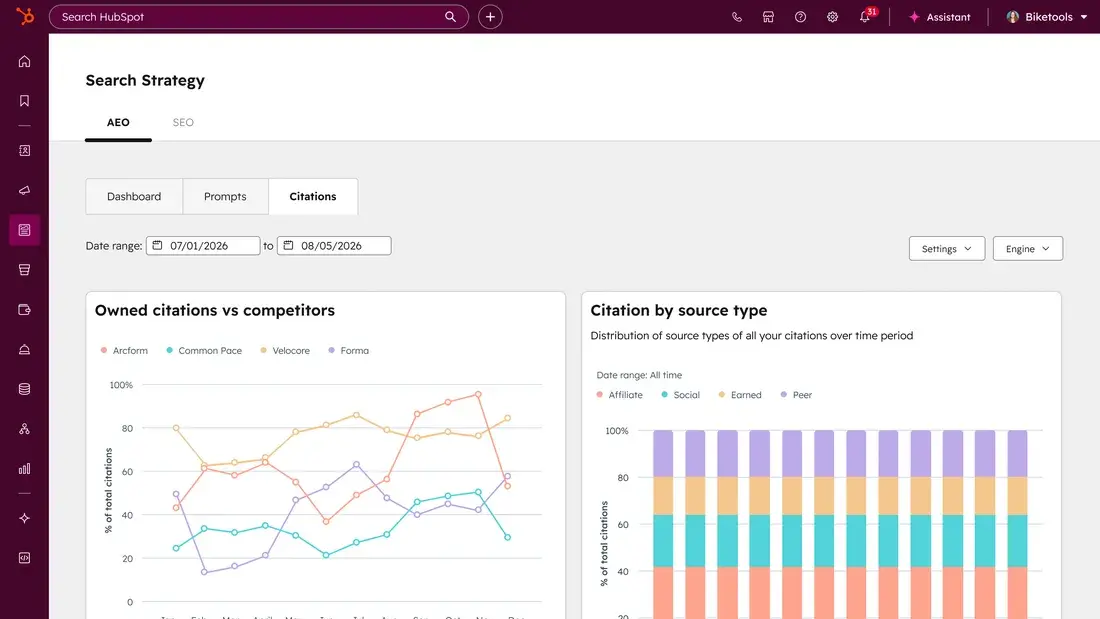
HubSpot AEO is a visibility and analytics platform that helps marketers track and understand how their brand appears in AI-generated responses, including platforms such as ChatGPT, Perplexity and Gemini. HubSpot AEO enables marketing teams to:
- Monitor where your content is cited or referenced in AI responses
- Measure share of voice in AI-generated responses
- Identify content gaps that competitors are filling in AI responses
This level of visibility is important because traditional rank tracking doesn’t tell you where your brand actually appears in the AI-generated responses.
Frequently asked questions about ranking in AI overviews
How long does it take for changes to be visible in the AI overviews?
Schedules vary depending on query type, competition, and how frequently Google updates its AI systems. For established websites that make significant content changes (e.g. restructuring into reply-first formats), the first signals can appear within a few weeks.
For newer websites, it can take several months to build current authority from the ground up. Your best leading indicator is SERP impressions in Google Search Console.
Can I disable AI overviews without affecting organic results?
Yes. Google offers mechanisms like nosnippet And Max snippet Tags to control how your content is used in summaries. While opting out will reduce your chances of being featured in AI reviews, it’s a real trade-off. While opting out protects your content from misinterpretation and sharing, it does lose visibility in AI-driven search.
Do FAQs and HowTo Schemas increase my chances of being cited?
Frequently Asked Questions (FAQs) and How-To Schemas can significantly increase your chances of being cited if implemented correctly.
According to research by SnezziPages with FAQ schema are 60% more likely to appear in AI overviews than pages without structured data. The crucial requirement: Structured data must fit perfectly with the visible on-page content. A mismatched schema can do more harm than good.
What happens if AI Overviews summarizes my content without linking to me?
Lack of attribution is a real problem with AI overviews, especially for publishers whose revenue depends on traffic. However, there is still measurable value in appearing in the response, even without a click.
More interactive found that a brand’s organic click-through rate (CTR) is 35% higher when cited in an AI overview. Being part of the answer creates familiarity and over time, familiarity can turn into trust.
Beyond AI Overviews: Increasing Visibility in Response Engines
Search is becoming increasingly answer-driven across all platforms, not just Google, and AI overviews are just one sign of this shift.
Whether you want to be found in AI Overviews, ChatGPT, Perplexity, Gemini, or other AI systems, Answer Engine Optimization (AEO) is the answer.
HubSpot AEO was built specifically for this emerging landscape. It helps marketing teams track and improve their presence in AI-generated responses by providing insights into where their brand appears, how it is represented, and where there are gaps compared to competitors. HubSpot AEO supports visibility measurement via ChatGPT, Perplexity and Gemini.
If AI overviews are where change in Google Search is most clearly visible, AEO is how marketers begin to respond to the bigger picture. In 2026, search is no longer just about ranking pages; It’s about being part of the answer.