

A blog can grow your audience and build trust, but only if you do it right. AI search now answers questions before users click. Therefore, your posts need to stand out and not just appear in the rankings. Where do you start? What should you write? How do you keep readers coming back? This guide covers everything from finding inspiration and writing great posts to optimizing for search, building an audience, and even making money.
Key insights
- Blogging promotes search engine optimization (SEO) and serves as a powerful marketing tool that increases brand visibility and reader engagement.
- Regular content creation helps improve Google rankings and enables targeting of new keywords.
- Effective blogging requires careful planning, keyword research, and understanding search intent to attract an audience.
- Original and readable articles attract readers; Tools like Yoast SEO help optimize content for search engines.
- Engagement through comments and social media is crucial to maintaining a blog’s visibility and attracting traffic.
Why blog?
If you have a website of any kind, you will need to blog occasionally. It doesn’t matter whether you have an online store, a personal website or a portfolio. Blogging is not only great fun, but it is also one of the best things you can do for SEO. Additionally, you can turn your website into a powerful marketing tool thanks to a high-quality, unique blog.
Google’s AI Overviews/AI Mode and other AI search platforms favor blogs that answer questions clearly and in detail. If you’re not blogging, you’re missing out on a great opportunity to get seen in search and engage with your audience.
Blogging for SEO
Adding content regularly should be part of any sustainable SEO strategy. If you write regularly, Google will recognize your website as active, lively and relevant. These signals help your pages rank better in both traditional and AI-powered searches. This also gives you more chances to appear in AI-generated snapshots where Google summarizes answers for users.
Additionally, blogging allows you to rank for new keywords and maintain ranking for the ones you are already found for. Since AI search favors fresh, well-structured content, regular updates ensure your website stays competitive. Your blog also gives you another opportunity to target search intent, whether users are looking for answers, comparisons, or solutions. We will discuss this in more detail later.
Blogging as a marketing tool
A blog is one of the best marketing tools for any website. It helps readers get to know your brand and products beyond just sales pitches. People remember stories, not advertisements. So share behind-the-scenes details or real customer experiences to build trust. Not everyone who visits your website is already convinced of you or your products. In such cases, a high-quality website is beneficial: if you can provide people with useful information in a post, they are more likely to remember it and convert in the future. Today, this type of authentic engagement is more important than ever as AI search prioritizes brands that users already know and trust.
Read more: To blog or not to blog »
A blog is valuable not just because it exists. It becomes valuable when it helps your audience solve problems, understand something better, or see your expertise in action. In today’s search landscape, the goal is not simply to publish or even publish more. It’s about creating content worth finding, quoting and remembering.
Carolyn Shelby – Lead SEO at Yoast
Set up a new blog
When starting a new blog, prior preparation is important. A little planning now will prevent headaches later, especially since AI search favors well-organized, intent-driven content. Take some time to think about your niche and do thorough keyword research. Remember not to just chase search volume. Focus on topics your audience really cares about, such as questions they’re asking or problems that need solving.
Please don’t forget to set up a clear and manageable structure for your blog. A logical layout helps both readers and search engines navigate your content, which improves engagement and rankings. Thinking about how you want to set up your blog before you start writing will save you a lot of work later. This includes tasks such as assigning categories, setting up cornerstones, and developing an internal linking strategy. A solid foundation makes it easier to adapt as AI search evolves.
Read more: How to start a blog »
What should you blog about?
You can only blog with ideas, so you need many to keep a successful blog running. Whether blogging is the primary purpose of your website or you are using your blog as a marketing tool, you need to consider what topics you want to cover. Don’t forget to think about what your audience needs to read. Where do you look for inspiration?
Keyword research
You need to decide which terms you want to be found for before you start writing your content. To decide this, you need to get into people’s minds and find out what words they use when searching for your type of business. Think beyond individual keywords. Consider phrases, questions, and even conversational queries that people might ask AI search tools. When writing, use these exact terms in your content to signal relevance to both search engines and AI-powered results. Keyword research is the first step in SEO copywriting and an essential part of any successful SEO strategy, even as search itself evolves.
Achieve the right search intent with your blog
When doing keyword research, it’s important to know not only what keywords your target audience is using, but also what they’re searching for. People use search engines with a specific goal in mind, so they have a specific intent for each search query. Results pages provide insight into the intent of a query. AI search tools like Google’s AI Overviews and AI Mode now prioritize content that directly matches what users are looking for, whether they want to learn, compare, or buy.
In many cases, people are looking for information, so search engines prefer informational sites. This is where your blog shines. For example, if you run an online store, your product pages will be aimed at commercial or transactional purposes, but informative blog posts can attract a much larger audience. Write relevant, helpful articles to attract people to your website early in the research phase.
The intent you want to target depends on your niche and goals. Are you trying to educate, entertain, or convert? In any case, aligning your content with intent is now non-negotiable.
Read more: Keyword research: the ultimate guide »
Where do you get inspiration for your posts?
If you have done your keyword research properly, you will end up with a long list of keywords and key phrases to write content about and you will know what intent you want to target. However, a key phrase is not yet an issue. To write a decent blog post, you need an angle or a specific story around a keyword as well as a keyword.
Current events, your own work, and comments from your readers are just a few things that might inspire new posts. For example, if customers ask the same question over and over again, that’s a sign you should write about it. Reading a lot is also a good way to find inspiration for your articles. Read magazines, newspapers and other articles.
Of course, AI platforms and LLMs like OpenAI’s ChatGPT, Gemini, Google’s Perplexity or Anthropic’s Claude can help, while Yoast AI Brand Insights can help you figure out how to show up in chatbots.
Looking at your website statistics or surfing the Internet can also lead to inspiration. Which posts get the most traffic? Which ones keep readers on the page the longest? Double down on what works. Pay attention to trending topics in your industry, but don’t just copy what’s already out there. Always ask yourself: How can you make this better or more engaging?
Be sure to keep a list of new post ideas handy on your phone. Inspiration comes when you least expect it.
Read Next: How to Get Blog Post Ideas: 11 Tips to Find Inspiration »
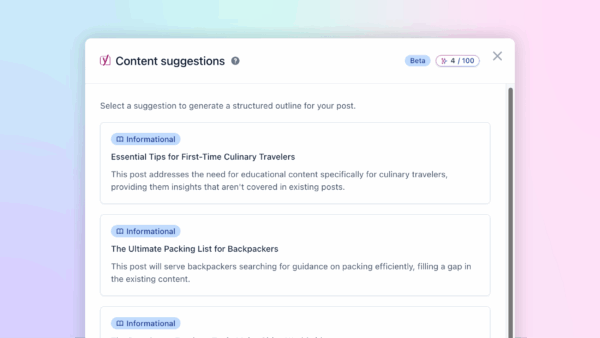
Overcome writer’s block with the Yoast AI Content Planner
How do I write a high-quality blog post?
Writing requires some skills and is more difficult for some people than others. We will give you some tips that will make your writing easier later. But first, let’s discuss two important aspects of quality posts: originality and readability.
Original content
Your posts should always be fresh, new and original. Each should stand out from other articles on the same topic. This is more important today than ever. Google’s AI search tools now filter out generic, repetitive content, so your posts must offer something unique. Focus on what makes you different, even in a crowded niche. Your content should also be something people want to read. With competition fiercer than ever, good isn’t enough, so you have to go further.
Avoid raw material content. These types of posts rehash what’s already out there without adding any value. Google recently issued a warning that AI-generated summaries and search results prioritize content that stands out, rather than just repeating the same ideas. If your contribution does not offer a new perspective or a new point of view, it risks being ignored. Don’t forget to ask yourself if this post teaches or solves a problem in a way that others don’t.
As AI-generated content floods search results, Google values human expertise and unique insights. These are the things AI can’t fake. Your blog can provide these if you do it well.
Read more: The importance of original content for SEO »
Readable content
After writing a post with original content, you should make sure your article is easy to read. Readability is crucial for your audience. If your text is well structured and clearly written, people will understand your message. Readability also impacts SEO, as Google’s AI tools favor content that is easy to scan and process. If your post is easy to read and has a clear structure with subheadings and logical paragraphs, it is more likely to rank higher in search engines.
Read more: Does readability matter? »
Practical tips for writing high-quality blog posts
Plan before you write
Before you begin, take some time to think about what you want to write. Who is your audience and what do you want to say to them? What should they know, understand, or do after reading your post? What topics will you cover and in what order? Answering these questions in advance will save time and ensure you can concentrate on your writing.
Read more: How to write a blog post »
Write clear paragraphs
Begin each paragraph with the most important sentence and then explain or expand on it. In this way, readers and AI systems can grasp your main message by skimming the first few sentences. Keep paragraphs short; seven or eight sentences are sufficient. Think about the order of your paragraphs and make sure they flow logically. Avoid complex words when simpler ones work. Your goal is to be clear and not confuse readers with jargon.
Continue reading: Practical tips for building a clear text structure »
Get help and ask for feedback
Our Yoast SEO plugin helps you write readable posts. For example, readability analysis checks for long sentences and suggests transition words. This is particularly useful today as AI search tools prioritize well-structured, easy-to-read content. When you use Yoast SEO Premium, you also get AI features like Yoast AI Optimize to refine your copy.
However, tools are not everything. Always have someone proofread your post. A fresh look will catch typos and ensure your message is clear. If your proofreader has difficulty understanding your post, your audience will too.
Need more guidance? Here’s a step-by-step guide to creating the perfect blog post!
Read more: 5 tips for writing readable blog posts »
Optimize posts for search engines
After you’ve written a blog post that’s both original and readable, you’ll want to make sure your content is optimized for search engines. You want to maximize the chances of Google picking up your content. Don’t try to game the system, just make sure your article is really good for both search engines and readers. You must take this final step after But you wrote your post. SEO should never compromise the originality of your idea or the readability of your text.
How Yoast SEO helps
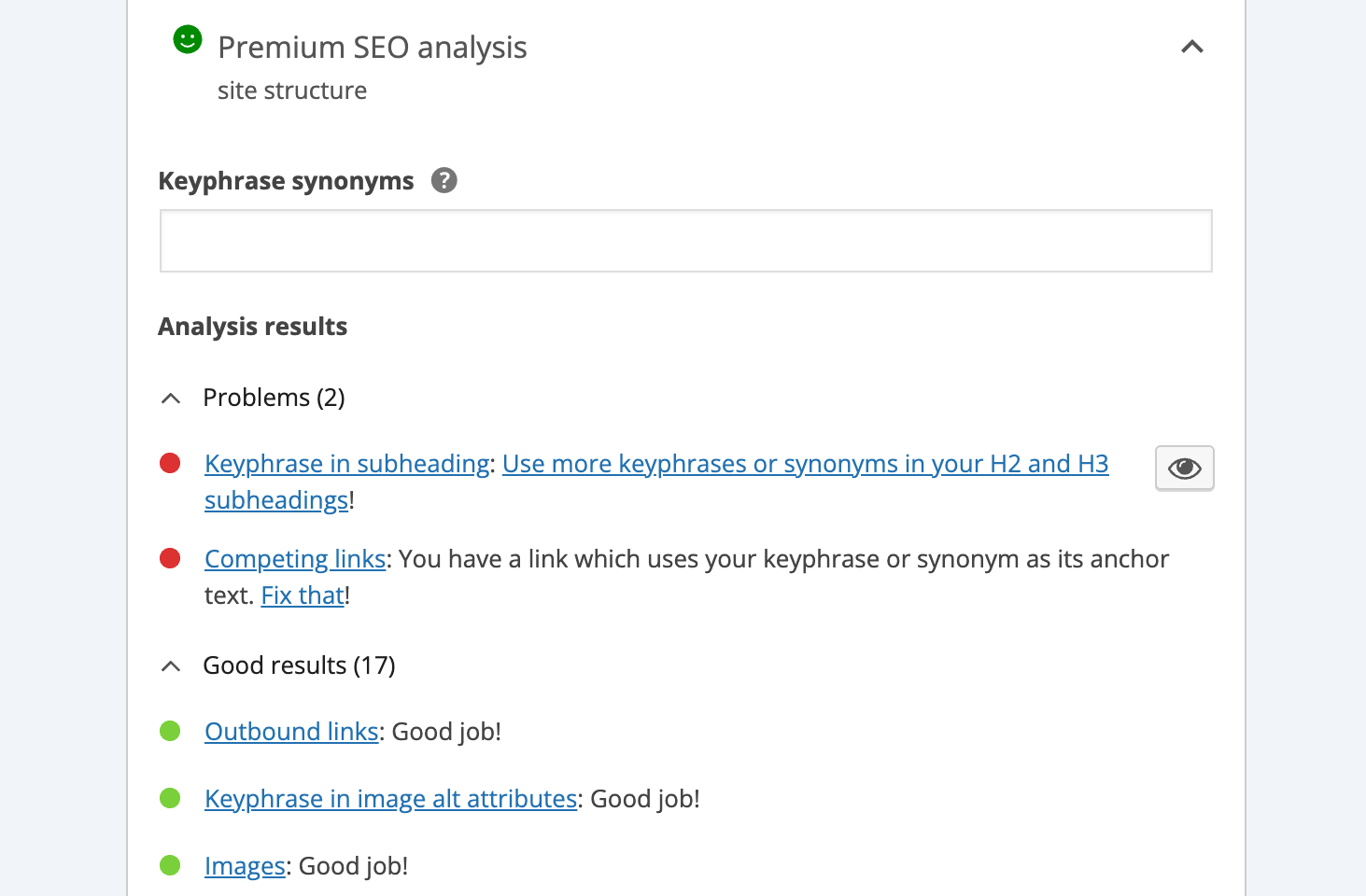
Yoast SEO gives you the tools to optimize your post without the guesswork. We call this process “Yoast your post”. It’s about making small, smart adjustments to improve visibility.
- The red and orange traffic lights highlight areas that require attention, such as: B. the placement of keywords or readability.
- The plugin may suggest adding your focus keyword in the first paragraph or a heading to signal relevance.
- It also helps you create a compelling Google preview that includes the titles and descriptions that users see in search results.
Don’t just set it and forget it. Use Yoast SEO to identify opportunities, make improvements, and give your post the greatest possible chance of being discovered.
Read more: Use Yoast SEO to make your content discoverable »
Blog engagement
Blog engagement is an important SEO factor. When your audience leaves comments on your posts and you respond, Google recognizes that your blog is very lively and active. If people share your post on social media or talk about it online, it will definitely generate more traffic. Engagement goes beyond just commenting and sharing. Citations, when others refer to your content, and mentions, even without links, also signal authority and trust.
Responding to comments is important for building engagement, but it takes effort. By answering questions and participating in discussions, you show your audience that you value them, which leads to more interaction. Positive feedback is easy to handle, but negative comments require care. Please just remain professional and keep the conversation constructive.
For more tips, see our guide to handling comments.
Marketing your blog
When you write posts, you need an audience. Nobody wants to perform in an empty room! A good ranking in search engines through flawless SEO obviously helps. But you can always do more.
Read more: Marketing your blog »
Social media and newsletters
Social media is a powerful way to engage with your audience and drive traffic. Start with a Facebook page and an X or Reddit account, but don’t stop there. If your audience is younger, Instagram and TikTok are essential for engagement. Short video content like Instagram Reels or TikTok videos can help your posts reach a wider audience.
A newsletter is another great way to keep readers coming back. Collect email subscribers and send regular updates with your latest posts, exclusive insights, special discounts or gifts, or behind-the-scenes content. This creates a direct line with your audience, regardless of algorithm changes.
Read more: Does social media affect SEO? »
Monetizing your blog
Increasing your audience does not automatically mean increasing your income. Many bloggers focus on goals beyond money, like building a community or sharing expertise. However, if you want to make money, here are the most effective strategies:
- Advertising: Display ads like Google AdSense can generate revenue, but work best when traffic is high.
- Affiliate marketing: Promote products you trust and earn commissions on sales made through your links.
- Sponsored Posts: Brands can pay you to write about their products or services.
- Sell your own products or services: Use your blog to drive traffic to your online store, courses or consulting services
If you have an online store, your blog can improve its rankings by attracting organic traffic and linking to your products.
Read more: Monetizing your blog »
Maintain a blog
Starting a blog is easier than maintaining one. Writing blog posts regularly can be a lot of work. You don’t have to blog daily, but you should decide on a frequency and stick to it so your audience knows what to expect. Consistency builds trust, and trust keeps readers coming back. Blogging requires a certain discipline.
As your blog grows, you will likely face new SEO issues. How do you manage to continually develop new content and keep your old content up to date? How do you manage different authors? What do you do when traffic to your blog decreases? And how do you keep the structure of your blog in shape?
Some challenges and how to solve them
As your blog grows, new problems arise. Here’s how you can tackle them:
- I’m running out of ideas. Repurpose old content and update outdated posts with new data or insights. Use the Yoast AI Content Planner to generate new topic ideas from your existing content. Don’t forget to listen to your audience, as their comments, emails, and social media threads may contain questions that need to be answered.
- Keep old content up to date. Please review your blog every six months, fix broken links and update outdated advice. You may want to add “last updated” dates to show readers and Google that your content is up to date. AI search tools prioritize new content, which can revitalize traffic to old posts. If you have a lot of similar content, you can merge posts and combine thin or overlapping articles into a single comprehensive guide.
- Declining traffic. Please check Google Search Console regularly to see which posts have lost rankings and why. You can then improve this underperforming content by adding depth, updating keywords, or merging it with stronger posts. Advertise strategically and share old but valuable posts on social media or in newsletters.
Site structure
As your blog grows, it is important to regularly analyze its structure. Organize your categories, subcategories and tags well. As your blog grows, its structure will change and evolve. To keep the structure of your website clear, you can organize it by topic clusters. Group related posts under pillar pages, e.g. E.g., “SEO Basics,” which references “Keyword Research,” “On-Page SEO,” etc. Don’t forget to update internal links. When you publish new posts, link to 2-3 relevant older ones. If your website becomes unwieldy, remove low-quality content. Delete or redirect posts that no longer serve your audience. As long as you stay on top of things, your structure will remain SEO friendly!
Read more: Why you should add links to a new post as soon as possible »
Content planning
As your blog grows, writing shifts from spontaneous posts to strategic planning. Without a system, teams risk duplicate topics, inconsistent tones, or missed opportunities. A clear plan will ensure your content is organized and aligned with your goals, whether it’s increasing traffic or conversions. Use tools like editorial calendars, topic clusters, and the Yoast AI Content Planner to streamline the process. Assign roles and document voice, style, and formatting guidelines to ensure consistency.
Planning saves time and reduces last minute stress. An editorial calendar sets topics, deadlines, and authors in advance, while topic clusters group related posts to improve SEO and reader navigation. Regular audits help you identify gaps and adapt to trends so your blog stays relevant and valuable.
Read more: Content planning for a (growing) blog: 6 easy-to-use tips »
Avoiding content cannibalization
If you’ve been blogging in a particular niche for a long time, you’re bound to touch on the same topic more than once in your blog posts. This isn’t necessarily a problem, but make sure you don’t jeopardize your own ranking chances. Keyword cannibalization occurs when you have several different articles that could rank for the same and similar keywords. If a search engine cannot identify which article should rank highest for a given search query, both articles will likely rank lower. The Solution: Stay on top of things by regularly conducting an SEO audit of your blog posts to identify and address keyword cannibalization.
Diploma
Blogging is great. It is one of the most powerful tools for growing your website, whether it is an online store or a personal blog. It increases your search visibility and converts visitors into followers. But to get the best results, you need more than just good writing.
Start with a good keyword strategy to target exactly what your target audience is looking for. Keep your AI search content original and structured. Google’s algorithms and your readers reward clarity and depth. As your blog grows, stay organized with scheduling tools and engage with your audience to stay in flow. Use our tips to create a blog that ranks and offers real value. Now write something great!
Read more: WordPress SEO: The Definitive Guide to Higher Rankings for WordPress Sites »
