
Schema markup for AEO helps response engines understand a website. The schema is readable by AI crawlers because it is added to a website’s HTML. It allows SEO professionals to add additional context and map elements without overwhelming the frontend or website users. This additional context provided by the schema reduces ambiguity and increases the likelihood that the web content can be correctly cited in AI-generated answers.
For SEOs and technical marketers new to schema markup, it can be overwhelming, but for those who want to follow AEO best practices, schema is non-negotiable. Adding schema is a low-risk, high-reward tactic because it undeniably strengthens SEO and, in theory, directly supports how an Answer Engine Optimization (AEO) crawler understands websites.
This comprehensive guide covers what schema markup is, how it supports AEO, which schema types are most important for AI visibility, and how to properly implement structured data. Teams also learn how to avoid common schema pitfalls so they can get it right the first time.
Table of contents
What is schema markup for AEO?
Response engine optimization schema markup is an AEO strategy in which AEO specialists add additional information to content to help search engines better understand, extract, and safely reuse information from a website when generating responses. This additional information is displayed using structured data and schemas. Schema markup and structured data are terms that are often used interchangeably, but they are not the same thing.
Structured data is data that has been structured for a specific purpose. Search engines and websites use schemas in JSON or microdata, but many technologies use structured data. Formatting data in databases or spreadsheets is based on structuring data.
Schema markup is used on the web. There are defined Types And Characteristics understand the search engines (see below).
Schema Markup: AEO vs. Traditional SEO Schema
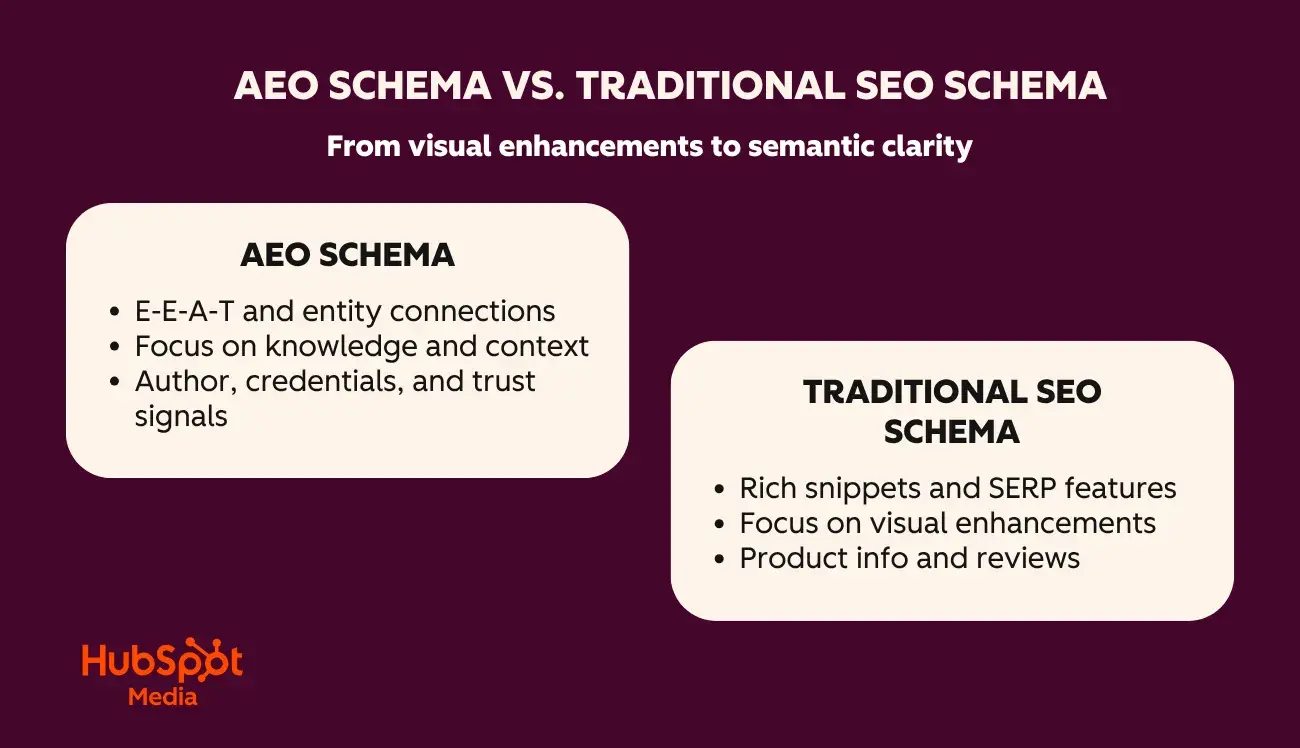
Traditional SEO schemes are primarily used to help search engines generate rich results and enhanced SERP features such as product snippets, ratings, and review snippets.
The role of the schema expanded as the value of experience, expertise, authority and trust (EEAT) increased. EEAT is a concept used by Google’s human search quality raters. Therefore, EEAT components of algorithms can be used to assess the credibility and reliability of content. As a result, publishers began using schemas to describe authors, including references that suggested expertise. In addition, the authors were linked to verifiable instances that suggested experience, such as social media profiles or certifications. Trust signals became clearer and more machine-readable.
As SEO specialists take on the AEO role, schema markup becomes even more important. Entities, attributes, and relationships are critical today because they help websites function as structured knowledge bases rather than isolated pages. This improves the clarity with which AI systems can understand and contextualize content. The role of schema has shifted from visual SERP improvements to semantic clarity and further context.
Why schema markup is important for AI visibility
Current tests has shown that pages with a well-implemented schema appear in the AI overview and rank highest in traditional SEO. Pages with poorly implemented schema or no schema were not displayed in the AI overviews. This shows us that it’s not just the existence of a schema that matters, but also the implementation.
In some cases, the value of schema markup for AI visibility is obvious. Rich snippets or knowledge panels can appear within hours of implementation. However, when schemas are used for entity mapping or EEAT reinforcement, the benefits are more subtle and long-term, without the immediate feedback that rich results provide. SEO platforms like HubSpot’s SEO marketing tools can help bridge this gap by displaying technical recommendations, tracking performance trends, and identifying opportunities to strengthen content for both search engines and response engines.
As AI-driven discovery continues to evolve, platforms like XFunnel (recently acquired by HubSpot) are emerging to help teams understand how content works across the entire AI search journey, from rankings to visibility in answer engines, copilots and generative interfaces.
Recommended Resource: How to breathe new life into your Google search results with rich snippets.
Which schema types are most important for AEO?
organization
Organizational scheme is structured data used to describe a company or brand as a first-class entity. For most websites, it acts as an anchor entity to which other schema types (Article, Person, Product, Service) connect. An organizational schema plays a fundamental role in EEAT by helping crawlers clearly identify the source of the content. It strengthens authority, ownership and attribution signals that can help response machines “decide” which brand to trust and which to quote. It defines things like:
- Who is the brand?
- What it does
- Where it operates
- How to check it across the web (e.g. social media)
- Further business details such as founder names, founding dates and much more
For AEO, the organizational schema helps ensure that content is consistently linked to the same entity across pages, datasets, and AI interpretations. Here is one Example a simple organizational scheme AEO:
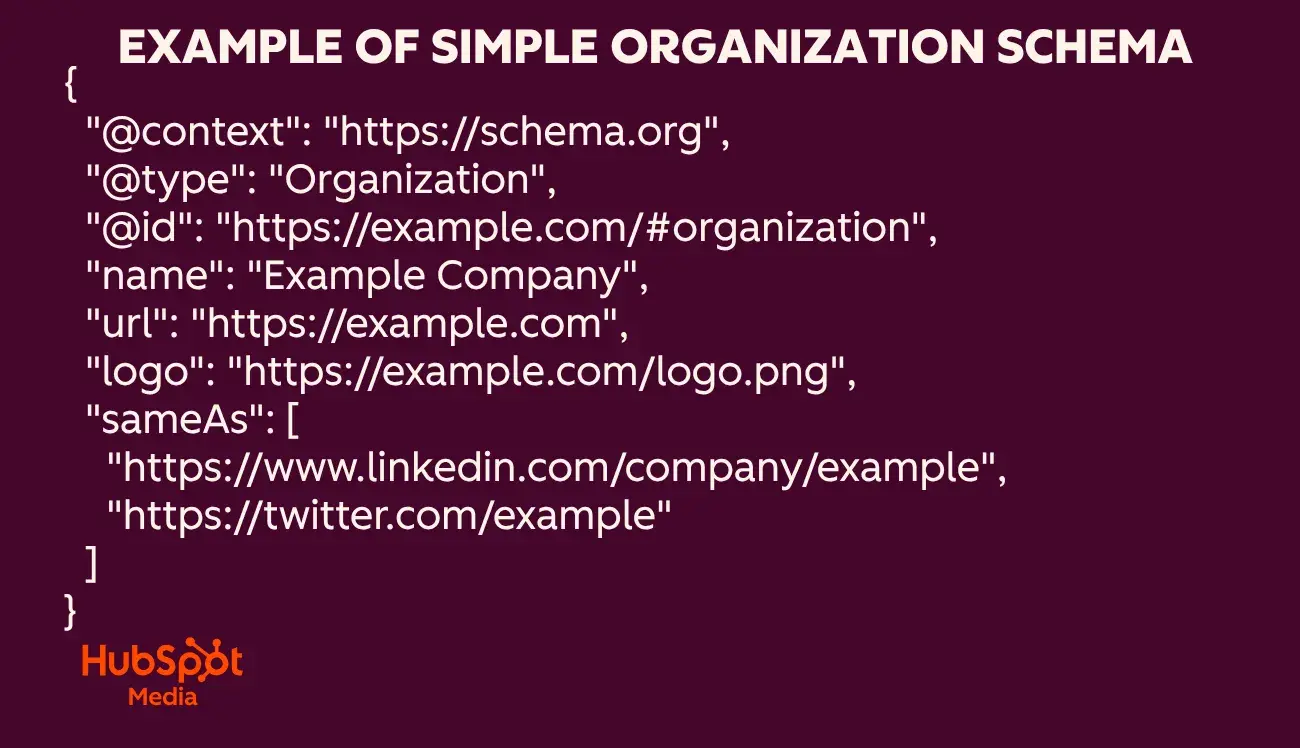
For an organizational schema to be valid, it needs at least the following:
- @Context
- @Type
- @ID
- name
- URL
It’s also good to include things like:
- logo
- even
- Description
- Founding date
- founder
- contactPoint
- address
- Keywords
- knowsAbout
- Employees
Why I like organizational schema: I view organizational schemes as non-negotiable. It makes sense for websites to provide crawlers with context about who they are, what they do, and how their site performs.
Pro tip: It can be difficult to see the benefits of an organizational scheme, but it can help companies secure a knowledge panel. Brands can also compare brand perception before and after adding using AI tools and see how it changes. To do this, use HubSpot’s AEO Gradera tool that allows AEO specialists to test their website’s AEO.
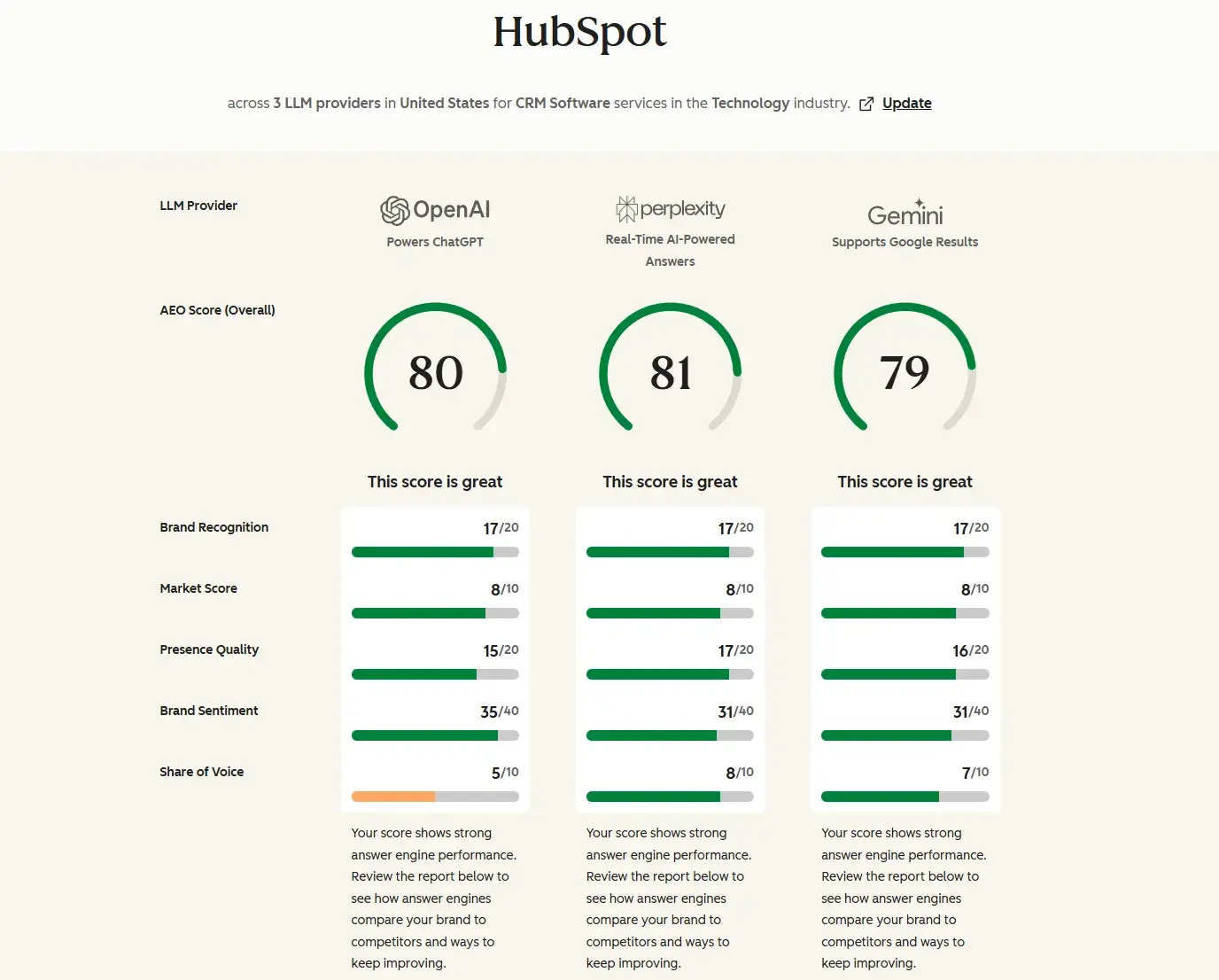
HubSpot’s AEO Grader evaluates entity clarity, content structure, and the likelihood of a page being reused in AI-generated responses. This is a practical way to evaluate the real impact of adding an organizational schema.
person
Person scheme is used to describe an individual as a whole. It is most commonly used to represent authors, founders, subject matter experts, and speakers, and is often linked directly to the organization and article schema to demonstrate authorship and expertise. In response engines, the persona schema helps determine who is responsible for the information on a page and whether that person can be trusted to speak on the topic. It may contain information such as:
- name
- role
- Experience
- Credentials
- Presence across the web
Here is one Example a simple person schema:
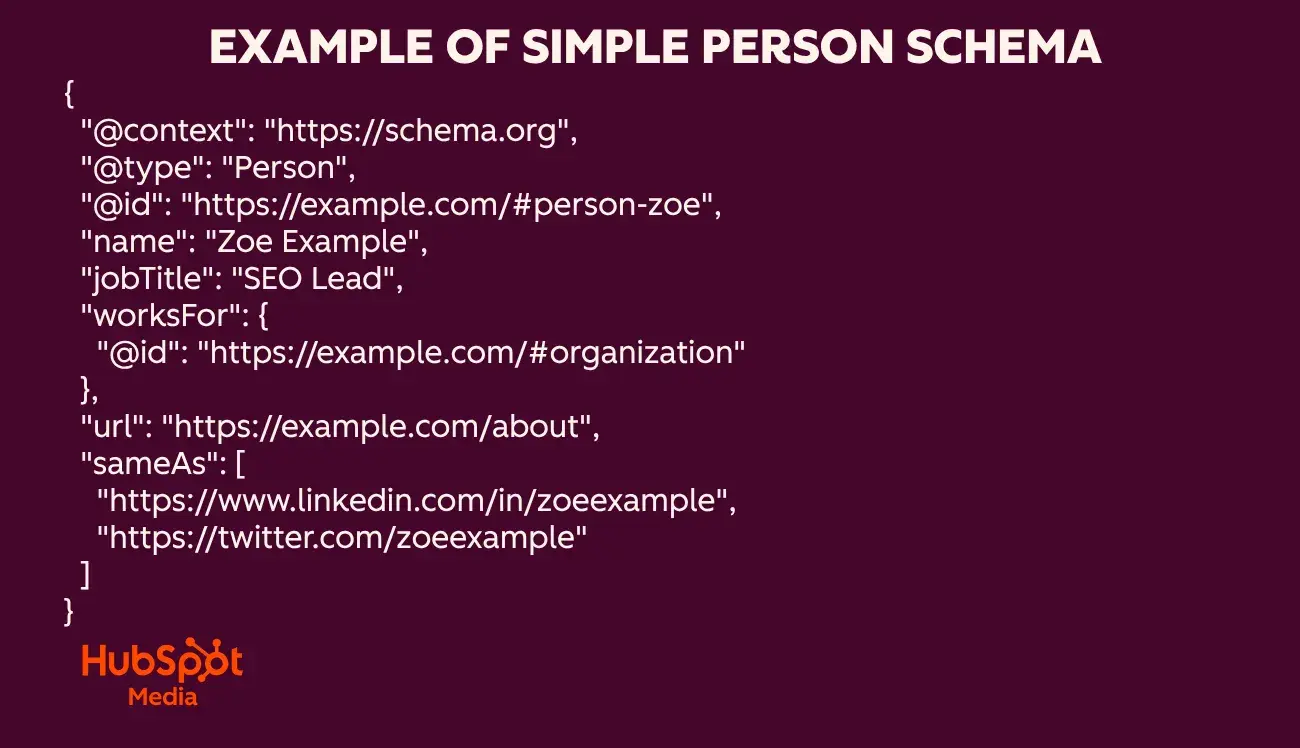
For a person schema to be valid, it needs at least the following:
Other things you should include:
- Job title
- works for
- URL
- even
- knowsAbout
- alumniOf
Why I like People Schema: I have found that the people schema is really effective. I added it to my schema on my About page and linked my social profiles to it sameAs propertyand highlighted my experiences in the knows about real estate. Days later I received a knowledge panel for my name. There is no doubt that the person schema contributed to the appearance of my knowledge window. I was able to repeat this success in a few customer projects, so it wasn’t an isolated case.
Article
Item schema describes written content as an independent unit. It is most commonly used for blog posts, guides, news articles, and editorial content, and is typically linked to both the people and organizational schema to clearly define authorship and ownership.
The article schema helps to find out what the article is about. It highlights parts of the article and tells who wrote the content, who published it, and when it was created or updated. An article schema also helps AI systems understand the scope and intent of a page, reducing the risk of content being misattributed or ignored due to unclear ownership. It contains information such as:
- headline
- author
- Release date
- editor
- Main topic or entity focus
Here is one Example a simple article schema:
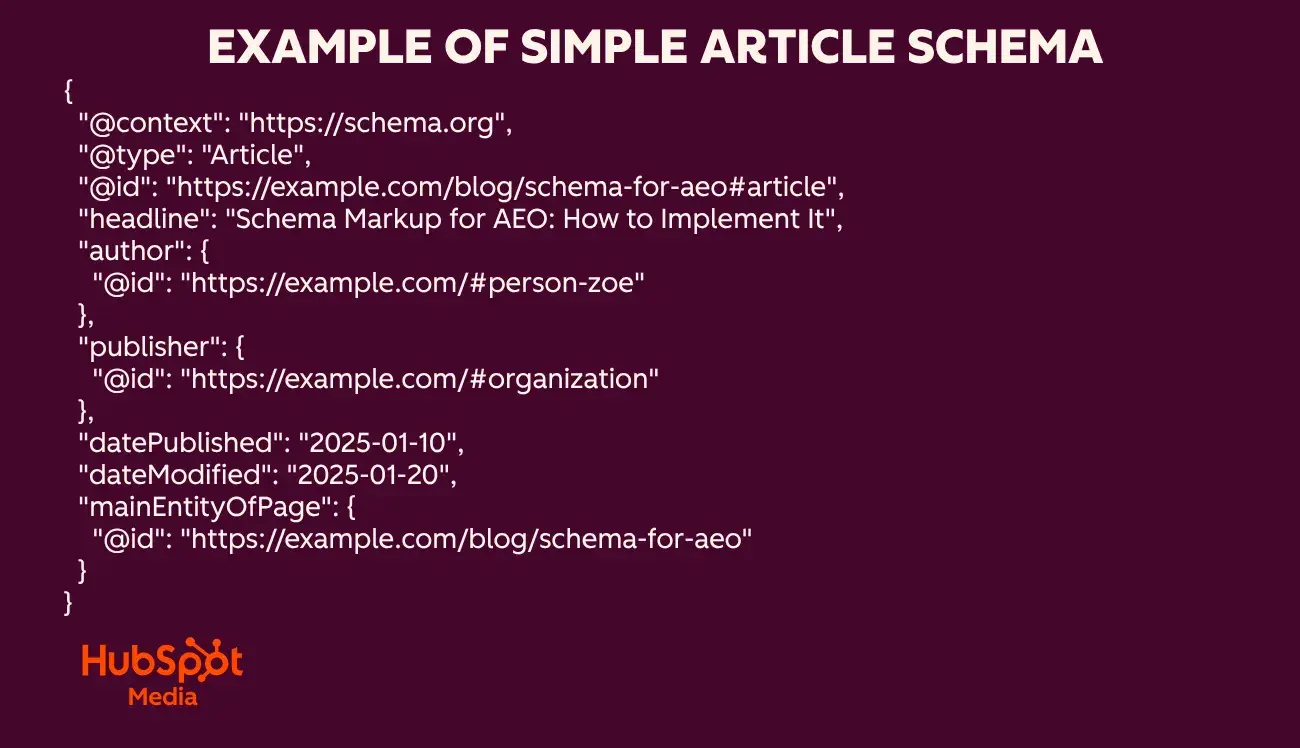
For an item schema to be valid, it needs at least the following:
- @Context
- @Type
- @ID
- headline
- author
It can also include things like:
- editor
- Date of publication
- Date changed
- mainEntityOfPage
- about or mentions
Why I like the article schema: When the article schema is associated with person and organizational entities, ambiguity regarding authorship and ownership is eliminated. As the study mentioned above shows, a well-implemented scheme improves ranking and visibility in the AEO.
FAQ page
FAQ page schema is used to mark a list of questions and answers that are fully visible on a page. It may contain information such as:
- Questions users frequently ask
- Clear, concise answers
Here is one Example a simple FAQPage schema:
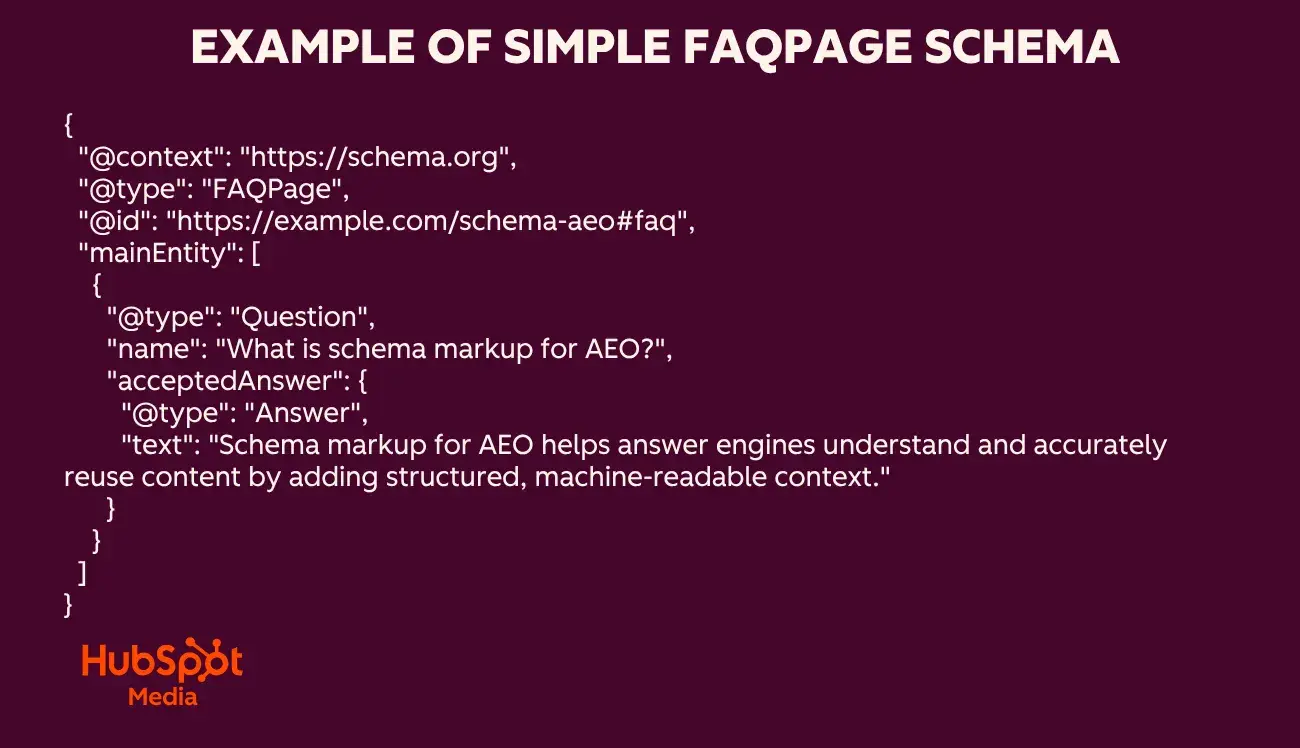
For an FAQPage schema to be valid, it needs at least the following:
- @Context
- @Type
- mainEntity
- Question with name
- accepts answers with text
Working with the FAQ schema is pretty easy. There isn’t much to add, but it may include:
- Narrow, intent-oriented questions
- Concise answers that reflect how users ask questions
- Alignment between on-page copy and structured data
Why I like the FAQPage schema: Many SEO specialists have abandoned the FAQPage schema as Google has confirmed that FAQ rich search results are now largely reserved for reputable government and health websites and are not influenced by the FAQ scheme. The FAQPage schema can still play a role in making it easier for crawlers to understand the content. Automation is relatively easy if SEO specialists work with good developers who can apply the scheme automatically. We know that AEO crawlers can read HTML, and defining questions and answers can certainly help answer engines.
product
Product scheme is used to describe a product as a whole, including what it is, who it is intended for, and how it can be purchased. It may contain information such as:
- Product name and description
- Brand or manufacturer
- Prices and availability
- Reviews and Ratings
- Key attributes and identifiers
Here is one Example a simple product schema:
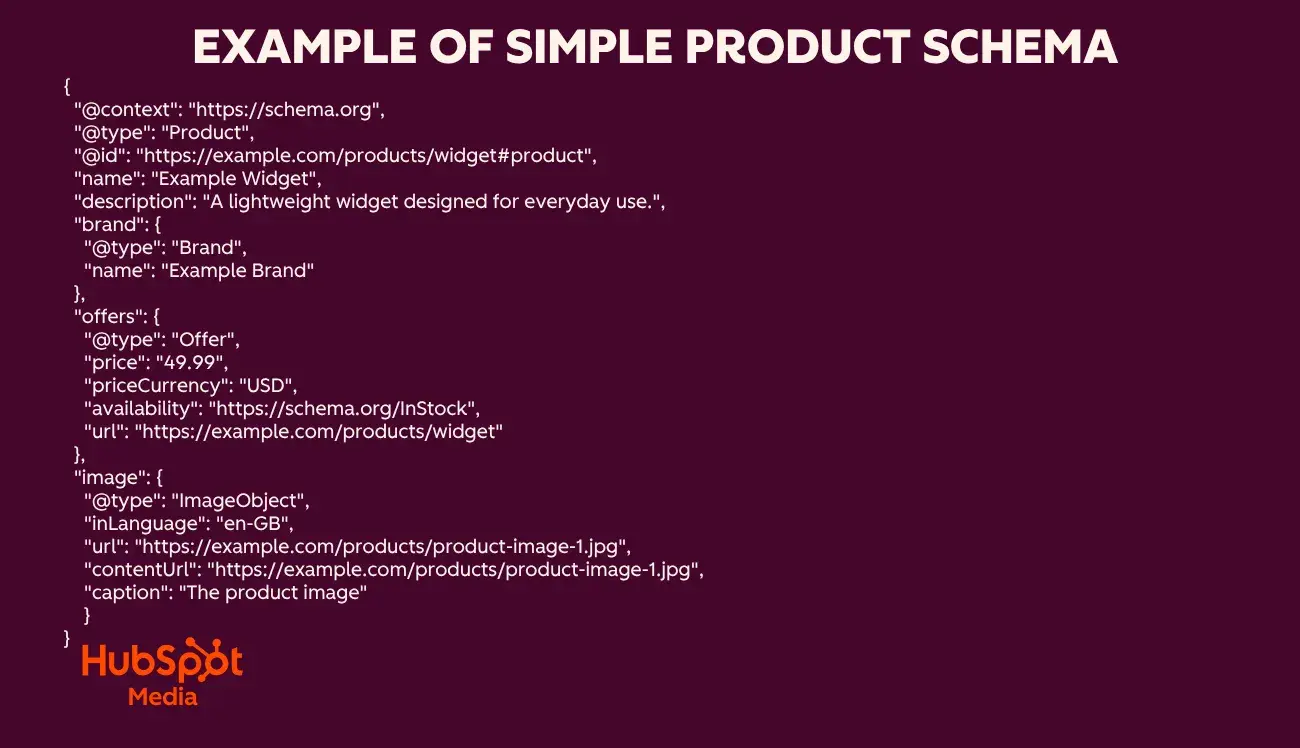
For a product schema to be valid, it requires at least the following:
- @Context
- @Type
- @ID
- name
- Offers
- Picture
It can also include things like:
- Description
- brand
- Overall rating
- review
Why I like the product scheme: Product Schema is one of these implementations generally proves its worth within a few days. After adding a product schema, including product attributes such as reviews, the organic listing began to show five stars. From an AEO perspective, it provides AI systems with structured, factual data to work with. The information is easy to analyze and aggregating and controlling the facts about a product gives companies the best chance of appearing accurately in AI searches.
service
Service scheme describes a service offering as a whole, including what is provided, who is providing it, and for whom it is intended. It may contain information such as:
- Service name and description
- The provider (organization or person)
- Service area
- Target group or industry focus
- Related offers or prices
Here is an example of a simple service schema:
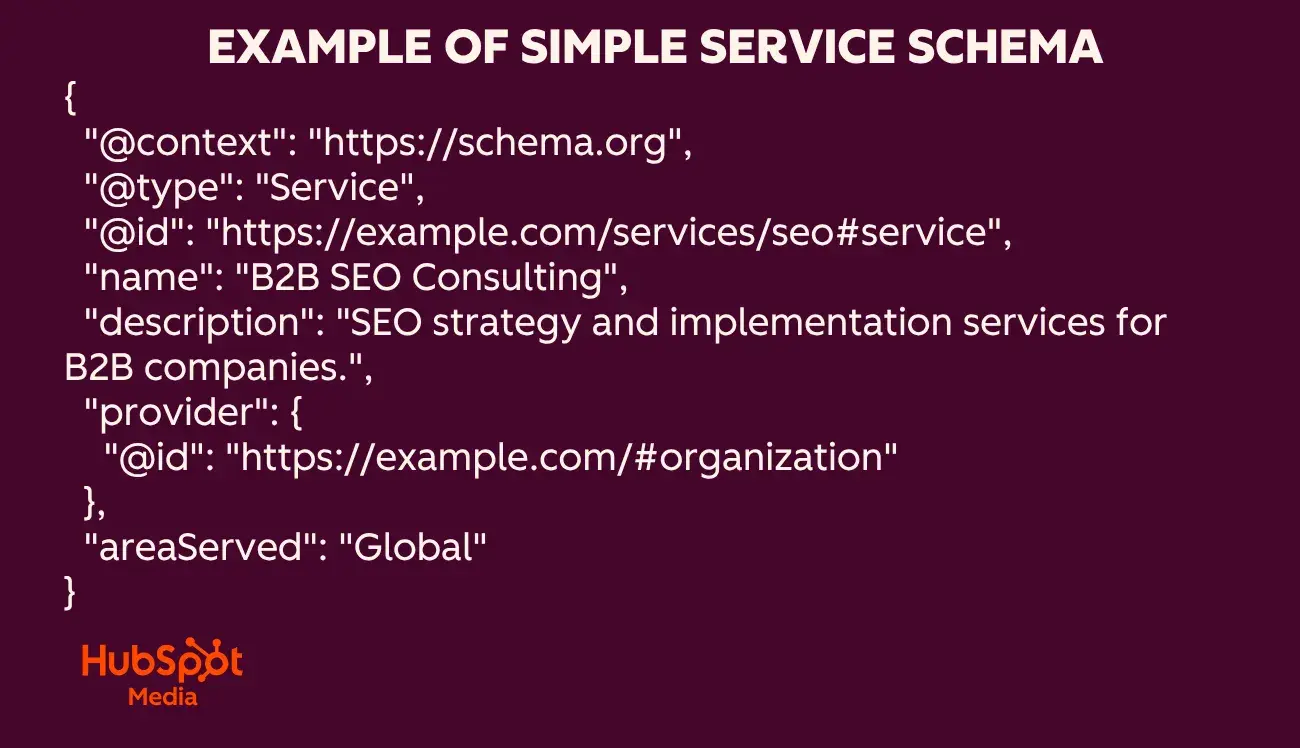
For a service schema to be valid, it requires at least the following:
It can also include things like:
- Description
- Provider
- AreaServed
- audience
- serviceType
Why I like the service scheme: As with product schema, sharing more about a service with AEO crawlers may not be helpful. Adding structured service information via a schema simply improves clarity. Service schema is well understood in traditional SEO and can support improved search results and clearer service classification.
BreadcrumbList
BreadcrumbList schema is used to describe a page’s position within a site’s hierarchy. It may contain information such as:
- The parent categories of the page
- The order of pages in the site structure
- Canonical URLs for each level
Here is one Example of a simple breadcrumb schema:
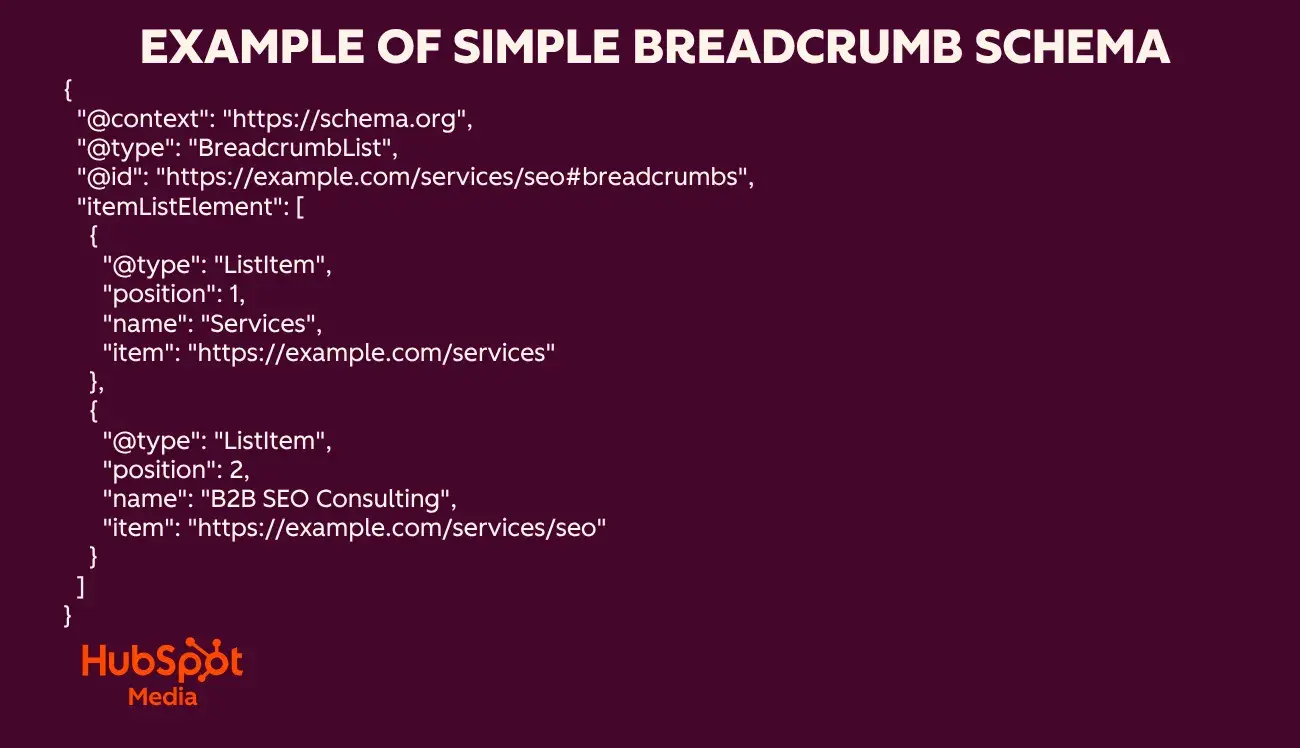
For a BreadcrumbList schema to be valid, it requires at least the following:
- @Context
- @Type
- itemListElement
- position
- name
- Article
Why I like the breadcrumb list schema: Breadcrumbs make a silent contribution to search engine optimization. It rarely receives recognition, but continually strengthens the site’s structure for both search engines and AEO. I found it particularly useful on large or complex websites.
Pro tip: HubSpot’s Content Hub gives users Schema-ready content out of the box. It automatically applies structured data where appropriate and displays SEO suggestions directly in the editor, allowing teams to align content structure, metadata, and markup as they write. In combination with his AI content generatorTeams can also create well-structured, entity-rich designs that already follow AEO best practices, reducing the need for extensive manual optimization later. Content Hub is a convenient option for teams that want to implement schemas consistently without relying on manual JSON-LD injections on every page.
How to structure your entity diagram for AEO
A schema diagram is like a coherent map of a website’s information. It links related things together, such as the company, services, items, people and locations, so that search engines and AI search engines can clearly see how everything is related.
If a website doesn’t use an entity diagram, you’re left with separate schema blocks that are more like individual sticky notes. Each describes something (an item, a product, an organization), but search engines have to do more work to put it all together.
Both methods can reference and link elements using the @id property, but the schema diagrams hold everything together, making these references much easier to process. It is important to note that an entity diagram is not strictly necessary. Separate schema blocks are still effective, but using entity diagrams is a best practice.
What does a schema entity diagram look like?
The following table shows two schema code examples:
- Separate schema block: Each schema (breadcrumb, article, person and organization) is included in one
- Schema diagram: The entire schematic diagram is included in one
Separate schema blocks{ “@context”: “https://schema.org”, “@type”: “BreadcrumbList”, “@id”: “https://example.com/services/seo#breadcrumbs”, “itemListElement”: ( { “@type”: “ListItem”, “Position”: 1, “name”: “Services”, “item”: “https://example.com/” } ) } { “@context”: “https://schema.org”, “@type”: “Article”, “name”: “Example article 1”, “url”: “https://example.com/article-1/”, “Publisher”: { “@id”: “https://example.com/#organization1” }, “Author” : { “@id”: “https://example.com/#john-smith” } } { “@context”: “https://schema.org”, “@type”: “Person”, “@id”: “https://example.com/#john-smith”, “Name”: “John Smith”, “url”: “https://johnsmith.com”, “sameAs”: ( “https://linkedin.com/john-smith” ), “worksFor”: { “@id”: “https://example.com/#organization1” } } { “@context”: “https://schema.org”, “@type”: “Organization”, “@id”: “https://example.com/#organization1”, “name”: “Example organization”, “url”: “https://exampleorg.com”, “foundingDate”: “01/01/2020”, “email”: “contact@exampleorg.com” } |
Schema diagram{ “@context”: “https://schema.org”, “@graph”: ( { “@context”: “https://schema.org”, “@type”: “BreadcrumbList”, “@id”: “https://example.com/#breadcrumbs”, “itemListElement”: ( { “@type”: “ListItem”, “Position”: 1, “name”: “Services”, “item”: “https://example.com/” } ) }, { “@context”: “https://schema.org”, “@type”: “Article”, “name”: “Example article 2”, “url”: “https://example.com/article-2/”, “Publisher”: { “@id”: “https://example.com/#organization2” }, “Author” : { “@id”: “https://example.com/#john-doe” } }, { “@type”: “Organization”, “@id”: “https://example.com/#organization2”, “name”: “Example organization 2”, “url”: “https://exampleorgtwo.com”, “foundingDate”: “01/01/2022”, “email”: “contact@exampleorgtwo.com” }, { “@context”: “https://schema.org”, “@id”: “https://example.com/#john-doe”, “@type”: “Person”, “Name”: “John Doe”, “url”: “https://johndoe.com”, “sameAs”: ( “https://linkedin.com/john-doe” ), “worksFor”: { “@id”: “https://example.com/#organization2” } } ) } |
Here’s how the schema diagram improves crawling and context understanding for AEO:
- Within each block, the entire page must be interpreted before the ID references can be understood.
- In the diagram, only the diagram block needs to be read; then the crawlers have access to all ID references.
@id: How to link schemas together
Schema entities should be linked together using the @id property. The @id property is a unique, persistent identifier for an entity that allows developers to reference existing data without duplicating it. @id ensures order and order in the schema. It prevents developers and SEOs from having to create multiple schemas for the same entity, which could lead to confusion or errors.
For example, if a developer uses the Grab schema (see table above), they may have a person associated with the organization as an employee. This person could also write articles on the site as a subject matter expert. By using the @id property, you can mark that person as both an author and a collaborator without repeating that person.
AEO schema best practices
sameAs: How to showcase your experience and expertise to crawlers
The sameAs property links an entity on the website to authoritative external references such as social profiles, Wikipedia, or relevant articles or pages on the Internet. Objectively speaking, it serves as a confirmation mechanism, indicating to crawlers that two profiles describe the same entity.
Pro tip: I love the SameAs scheme because it is almost always helpful. Most of the time I personally use it to link article authors to their social media accounts or other author pages, especially when it could help build EEAT signals.
Entity anchoring with organization
In most cases, the organizational entity should act as an anchor for the entire schema implementation. People, items, products and services should all refer to the same organizational unit and not exist independently.
Description of the entity graph diagram
A clean entity graph usually looks like this: The organization is in the middle and is connected to one or more person entities. These person entities are linked to article entities as authors, while articles refer to products, services, or topics. BreadcrumbList and internal linking strengthen the hierarchy, while sameAs connects core units to external sources.
JSON-LD organization pattern
A stable, reusable JSON-LD organizational pattern should be implemented once and referenced everywhere. This pattern typically includes a fixed @id, core business details, and SameAs links to authoritative profiles.
Using a consistent organizational schema pattern is important because it serves as the foundation for the entity graph. In my experience, once this pattern is established and reused correctly, it is much easier to scale the schema across the site without introducing inconsistencies that impact AEO performance.
How to structure a page for AEO
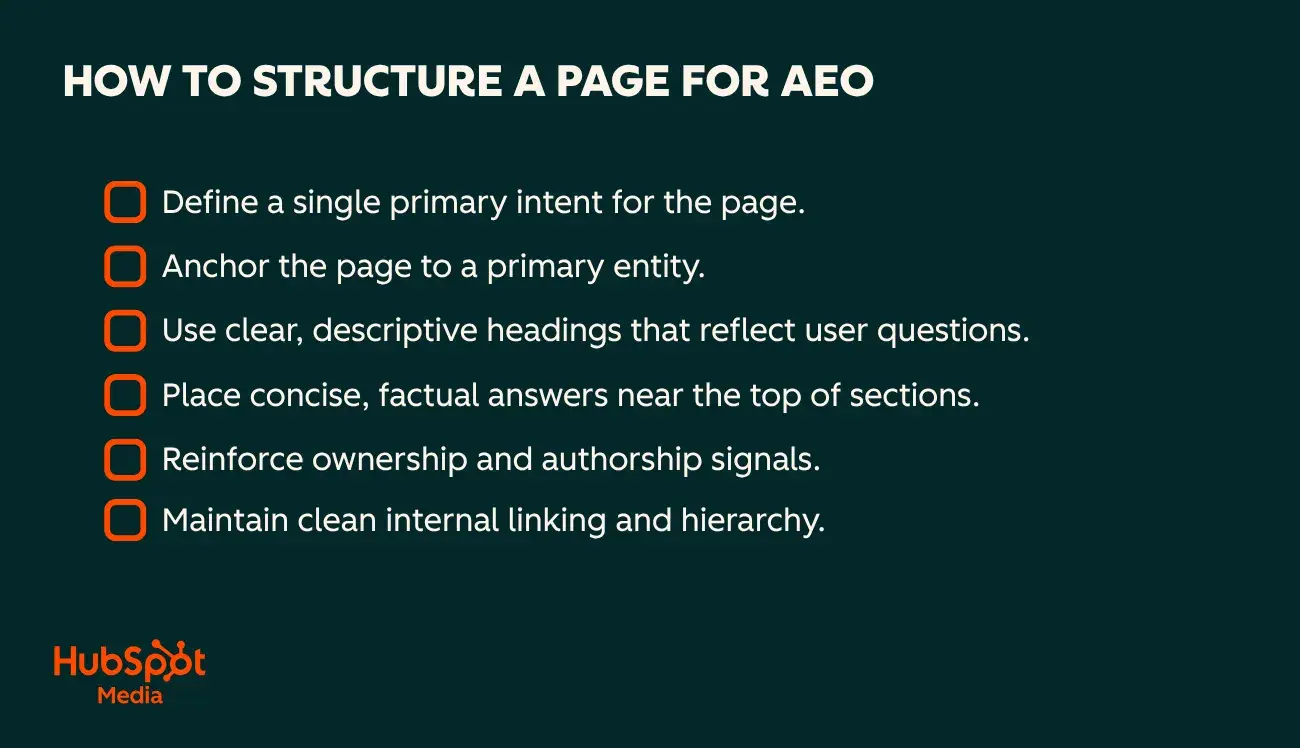
Structuring a page for AEO is about making intent, ownership and meaning clear. SEO specialists and content marketers need to clearly structure content, defining what the page is about, who it is intended for, and how it connects to known entities. The following steps describe a practical, repeatable way to structure pages to make them easier for AI systems to understand and reuse.
1. Define a single primary intent for the page.
Each page should serve a clear purpose, whether it’s answering a question, explaining a concept, or describing a product or service. This intent should be evident in the title, headings, and introductory content. This is important because response engines are far more likely to reuse content when the page has a narrow, well-defined scope.
In my experience, pages that serve multiple intents perform worse because they are less relevant, which doesn’t help AI and isn’t the best for SEO. Additionally, pages that serve multiple intents don’t convert as well because the focus is divided. Single intent pages also help with schema. It is either an article OR a service page, and this type of schema only exists on the relevant page.
2. Anchor the page to a primary entity.
Each page should be uniquely associated with a primary entity, such as an article, service, product, or person. Explicitly anchoring pages in a single entity reduces ambiguity and improves consistency when summarizing or citing content.
3. Use clear, descriptive headings that reflect user questions.
Headings should reflect how users naturally ask questions or search for information, especially at the H2 and H3 levels. This is important because response engines often rely on headings to understand content structure and extract relevant sections.
Don’t fall into the trap of using headings only as stylistic elements; they are so much more! Headings help AI crawlers contextualize content. Tools like here HubSpot’s Content Hub can be particularly useful. It is AI content generator helps structure content around clear questions, concise answers, and a logical hierarchy, all of which closely align with the way answer engines extract and reuse information.
4. Place concise, factual answers at the top of the sections.
Important answers should appear at the beginning of each section, followed by supporting explanations or details. Answer engines prefer content that provides direct answers without the need for interpretation.
I’ve consistently seen better AI reuse when pages start clearly and are then fleshed out in more detail, rather than slowly coming to a conclusion.
Pro tip: If a web designer hides content in elements like accordions or behind tabs, make sure it is available in the HTML. If it is not in the HTML, AI crawlers cannot access it.
5. Strengthen ownership and authorship signals.
Pages should clearly indicate who wrote and published the content, both on the page and through schema markup. This is important because attribution and trust are central to AEO. When authorship is unclear, response engines are less likely to reuse content even if it is accurate.
Pro tip: The data contained in the schema (e.g. authorship and publication date) is not available to readers unless it is also added to the page itself.
6. Ensure clean internal linking and hierarchy.
Pages should be logically connected through internal links and breadcrumb navigation that reflect thematic relationships to help response engines understand how content fits into a broader knowledge framework.
In my experience, websites with a variety of content on a topic tend to perform better in SEO and AEO.
How to implement a schema for AEO in Content Hub
SEO and AEO specialists may need to work with developers to implement a schema on a page. While website administrators or AEO specialists can add schemas manually by adding code to the HTML, automated schema injection is much more efficient and reduces inaccuracies.
Platforms like HubSpot’s Content Hub Simplify this process by combining schema implementation with content creation. Instead of treating structured data as a separate task, teams can use built-in AI writing tools to create content already aligned with schema types, entity relationships, and AEO-friendly formatting.
Here are some tips on how to implement the scheme for AEO, as well as bonus tips on how to use it HubSpot’s Content Hub.
- Focus on a scheme that is consistent with AEO objectives (Organization, Person, Article, FAQ Page, Product, Service).
- Don’t try to implement everything. Clarity and consistency are more important than volume. Once you’ve mastered the basics, you’re ready to scale.
- Choose an implementation method. One template-able schema per page type is best when all pages use the same schema (e.g. all blog posts use article schema and all product pages use product schema). A module-based scheme is better when content varies (e.g. mixing articles, events, or job postings) and editors need flexibility.
- When using HubSpot’s Content Hubuse HubSpot’s require_head HubL tag to ensure JSON-LD is included in Google recommended placement.
- Use HubSpot variables to dynamically populate the schema. Retrieve data from the content object (e.g. title, published date, author) so that the schema automatically updates when the content changes. This reduces human error and ensures that the schema matches the content on the page, which is crucial for AEO trust.
- Apply conditional logic when necessary. Use HubL logic to include optional fields (like images) only when they exist. This prevents invalid or misleading structured data.
- Validate the schema Using the schema validator and test pages with Google’s rich results tester. If you’re not sure what Google needs, Google Rich Results Tester is the best tool for testing structured data because it provides more information about what’s missing.
In addition to external validators, there are also tools like HubSpot SEO recommendations And Performance analysis can help identify missing schema opportunities, highlight technical issues, and monitor how optimizations impact organic visibility over time.
Common schema pitfalls that block AEO
Adding an AEO schema is probably easier than you think, but it’s also easy to add a schema that doesn’t meet the criteria to validate or support AEO. Below are some of the most common pitfalls that block AEO performance.
Valid but meaningless markup
Valid but meaningless markup is when the schema is technically valid but adds little or no semantic value. Examples include generic schemas with missing relationships, placeholder values, or properties that do not reflect the actual content of the page.
For example, if a product schema is added that contains the product name and type but no price, availability, brand, or offer information, the schema markup is valid and displayed in the Schema validatorbut that doesn’t make it useful. It doesn’t provide the response engine with enough factual detail to understand what the product is, how it’s sold, or how it compares to alternatives. In practice, such a schema confirms that a product exists, but does not provide actionable information that AI systems could reference in responses.
This is where ongoing testing is crucial. SEO tools that provide structured recommendations – how HubSpot’s SEO tools – can flag incomplete markup, missing relationships, or weak content signals before they impact AEO performance.
Pro tip: Use Google’s rich results test as a validation method. Unlike the schema validator, the rich results test shows which fields Google requires.
@id and sameAs are missing
Without consistent @id values, entities cannot be reliably identified across pages. Likewise, missing SameAs links prevent entities from connecting to authoritative external sources.
Orphaned person or item entities
Orphaned entities occur when a person or item schema exists without being associated with an organizational entity. This often happens when the schema is added page by page without a centralized entity strategy.
Misaligned or incorrectly formatted dates
Inconsistent or incorrect publication and modification dates in the article schema are a common problem. For example, a page may show users a clear “last updated date,” but the schema omits “dateModified,” includes a stale value, or uses an invalid format.
In schema markup, dates should be formatted using ISO 8601. The standard format looks like this:
- Date only: YYYY-MM-DD (Example: January 20, 2025)
- Date and time: YYYY-MM-DDThh:mm:ss (Example: 2025-01-20T14:30:00)
- With time zone (recommended): Example: 2025-01-20T14:30:00+00:00
Frequently asked questions about Schema Markup AEO
Do I need unique @id values for each entity on a page?
Yes, every entity (organization, person, item, product, service) should have a unique, stable @id. Reusing the same @id for different entities or changing IDs on different pages fragments the entity graph and makes it harder for response engines to recognize relationships.
Can I include both FAQPage and HowTo on the same page?
Yes, but only if both are actually present in the visible content and serve different purposes. From an AEO perspective, it is usually better to focus on one primary schema type per page to avoid diluting intent and confusing extraction systems.
How often should I check my schema sitewide?
Once it’s set up, the scheme shouldn’t really break. Review the schema quarterly or even twice a year or after major site changes.
Can I implement a schema without a developer?
Yes, SEO specialists often implement schemes without developers. Many CMS platforms and marketing tools, such as Some platforms, such as HubSpot Content Hub, allow website administrators to implement schemas at the template or module level.
What breaks AEO even if my JSON-LD is validated?
For a valid schema, AEO can still fail if it is meaningless, inconsistent, or disconnected. Common problems include orphaned entities, missing ownership signals, mismatched content, reused IDs, and incorrect freshness signals. Syntax Validation Checks – AEO depends on semantic clarity and confidence.
Implement schema markup for AEO
When implemented with clear entities, consistent relationships, and accurate data, the AEO schema helps response engines understand who a company is, what its content represents, and why it can be trusted. This also strengthens traditional SEO.
In my experience, the easiest way to get this right is to treat the schema as part of your workflow rather than a one-off task. Tools like HubSpot’s Content Hub make it easy to create schema-ready content at scale, so you can avoid common mistakes and future-proof your site for AI-driven search.
As AEO matures, measurement becomes just as important as implementation. By using tools like HubSpot’s AEO Grader in conjunction with traditional analytics, teams can understand not only ranking, but also how often their content is selected and reused by AI systems.