
AI is changing search and rewriting the rules. If your brand isn’t visible in AI-generated responses, you have a bigger problem than just traffic. You’re missing out on trust, credibility, and customers who now expect AI to recommend the best options everywhere.
We see that traditional SEO is no longer enough. These days, it’s possible to rank #1 on Google and still remain invisible in the AI responses that humans often use for recommendations these days.
Yoast AI Brand Insights is a great tool that shows you exactly how your brand appears in AI-generated responses from ChatGPT, Perplexity or Google Gemini. It tracks sentiment and benchmarks compared to competitors. Additionally, it not only helps build your AI visibility but also helps guide your brand’s narrative.
Key insights
- AI visibility is important; Brands missing AI answers lose trust and customers.
- Yoast AI Brand Insights helps track brand mentions, sentiment and credibility across all AI platforms.
- Modern SEO now focuses on AI visibility and goes beyond traditional search engines.
- To improve AI brand visibility, brands should publish authoritative content and optimize it for AI citations.
- Active participation in online communities increases brand visibility on AI platforms.
Why modern SEO is about AI visibility
People don’t just search on Google anymore. Every day more people ask for recommendations for AI tools and Large Language Models (LLMs) like ChatGPT, Gemini and Perplexity. In contrast to classic search engines, these tools don’t just list links; They curate answers by combining trained knowledge with information learned from the internet.
AI platforms combine information from multiple sources to provide a single, contextual and personalized response. People are even starting to view these AI answers as personal advice and not just general search results. This will become more common as search engines like Google increasingly integrate AI into their search results. This blurs the lines between traditional search and AI-generated answers.
AI search is a blind spot for most
Classic SEO tools track rankings, but not how your brand appears in AI responses. This creates blind spots where your competitors may be tracking all the AI recommendations in your market without you realizing it.
Additionally, you may rank well on Google, but could be invisible to a growing audience if AI systems ignore your brand. Your competitors may appear more frequently or more positively in AI recommendations. Or there is a negative sentiment in the AI responses that can damage your reputation without you even realizing it.
Control your brand’s narrative
AI platforms like ChatGPT, Perplexity, and Gemini compile your brand’s story from scattered sources like reviews, news articles, social media, and your own content. If these send mixed signals, so will the answers from an AI. That’s why you need to send a unified, consistent message. This is one of the most effective ways to strengthen your narrative across all platforms.
Repeat your core message, whether “affordable luxury” or “sustainable innovation,” everywhere, from your website content to press releases and from social media to external interviews.
Quickly resolve misinformation and respond to inaccurate reviews by posting clarifications online. This prevents the AI from reinforcing outdated or incorrect information.
Support your brand’s most important attributes with structured data. Add the awards your brand has won or its unique selling points to give the AI platform an all-encompassing frame of reference.
Remember, consistency is about repeating your key brand aspects throughout. Design the narrative so that the AI has no choice but to reflect the brand the way you want to portray it.
Yoast AI Brand Insights is here to help
Yoast AI Brand Insights is a helpful tool that tracks how your brand appears in AI responses. It provides a clear, actionable overview of your brand’s visibility, sentiment and credibility on major AI platforms.
Yoast AI Brand Insights helps you:
- Understand if and how your brand is mentioned in AI responses
- Track sentiment and see whether AI platforms describe your brand positively or negatively
- Identify the sources to see what the AI is referring to when mentioning your brand
- Compare yourself to the competition to see how you stack up
We built this not to give you data, but to turn this AI black box into actionable insights.
Understanding AI visibility metrics
Yoast AI Brand Insights metrics help you measure and improve your brand visibility on AI platforms. To get the most out of it, you need to understand what metrics mean and why they are important.
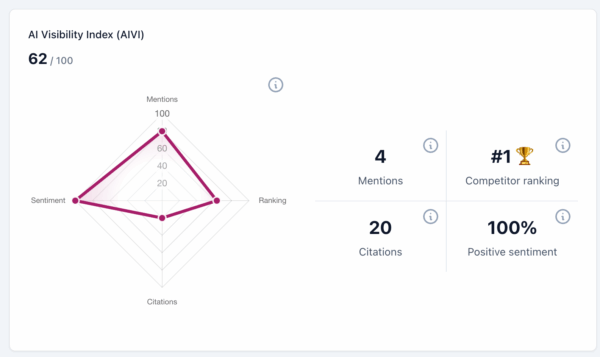
AI Visibility Index (AIVI)
The AI Visibility Index (AIVI) rates (on a scale of 100) how visible your brand is on AI platforms like ChatGPT, Perplexity and Gemini. It consists of the following metrics:
- Mentionsor how often your brand is cited in AI answers
- Quotesor the number of authoritative sources that reference your brand
- Feelingor the rate of positive vs. negative keywords associated with your brand
- Rankingsor the relative position of your brand mentions compared to your competitors
The higher the AIVI score (on a scale of 0-100), the more visible your brand is in AI search results for the terms you track. If you find that your score is low, you should focus on getting more mentions and citations. You should also work on creating a positive vibe around your company.
You increase your relevance by publishing authoritative content. Try to get featured on relevant websites and monitor and improve the negative sentiment around your brand. Learn more about how AI influences brand perception.
Mentions
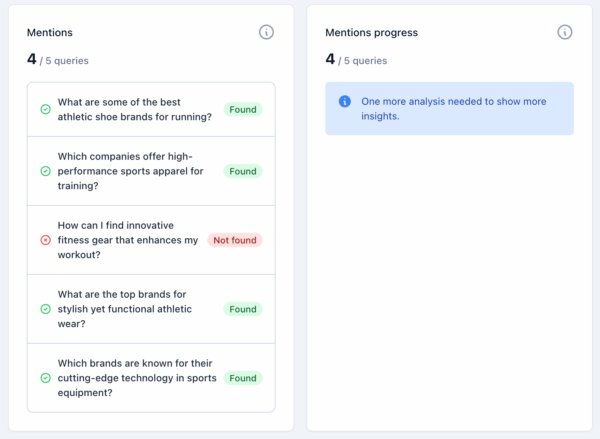
The Mentions section tracks the specific searches for which your brand appears in AI responses. So when someone asks, “What is the best low-cost CRM system for small businesses?” and your brand is in the results, that’s a mention.
It’s not hard to see why this is important. More mentions generally lead to greater visibility. If you’re not showing up for terms and searches relevant to your brand, you need to start improving your content.
Use the built-in AI-generated branded queries to find high-intent questions and write content that comprehensively answers those questions. These can be blog posts or FAQ pages or whatever makes sense. Also optimize for conversational questions like “Is brand X good for startups?”
Feeling
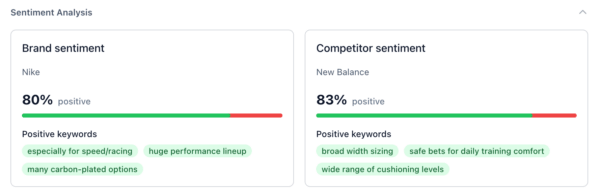
Sentiment measures the percentage of negative versus positive words in query results associated with your brand. So if the AI describes your brand as “innovative” or “reliable,” that’s considered positive sentiment. However, when they use terms like “overpriced” or “unreliable,” that’s a negative sentiment.
A positive mood helps build trust, while a negative mood can turn off potential customers. That’s why you should always actively address negative feelings online. Don’t leave those bad online reviews unanswered. You can also post testimonials on your website to amplify positive voices, and you can do the same in your marketing messages by talking about “a brand loved by thousands” or “award-winning” products.
Keep an eye on trends in your online sentiment and identify and resolve problems early.
Quotes
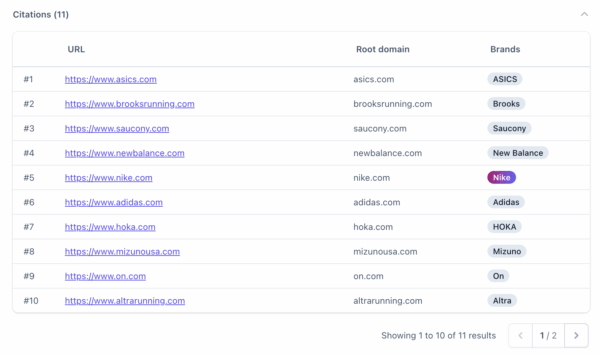
Citations refer to the sources that AI platforms specifically reference when generating an answer, not to the brands mentioned in those sources. For example, if Gemini answers a question about “best credit cards” and cites a New York Times article about the best credit cards, that New York Times page is cited. Even if brands such as American Express or Chase appear in the article, the citation should be attributed to the publisher and not to the individual brands.
However, it is still of great importance to appear in the sources cited. Having your brand regularly featured in relevant, highly respected publications like The New York Times increases the likelihood that AI systems will highlight your brand in their responses over time. In other words, you may not receive a direct mention, but you will benefit from being part of the content that AI platforms trust and rely on.
Over time, the likelihood that your brand (e.g. American Express or Chase) will be included in AI responses to queries like “best credit cards” increases, especially if it appears regularly in trusted sources.
AI platforms use quotes to validate their answers. Quotes from top sources such as industry publications increase credibility. Find out where there is a natural fit between your customers and their audience and post the type of content that people want to link to.
5 Ways to Improve Your AI Brand Visibility
Now that you understand the metrics, here’s how you can use Yoast AI Brand Insights insights to improve your AI visibility.
Optimize for AI citations
AI platforms like Gemini, Perplexity, and ChatGPT use quotes to validate their answers. So citations increase the likelihood that your brand will be included and trusted in AI-generated responses
Try to get featured on relevant, authoritative websites and guest post on industry, news, or educational sites. Are you mentioned in summary articles, e.g. E.g. “Top 10 Tools for X”. Ask customers to write reviews on platforms like Capterra, G2 and Trustpilot. All of these tactics can serve as evidence that your brand is a trustworthy source. Remember that these must be relevant quotes.
Make sure your content is structured so that the AI can read it easily. Use clear, hierarchical headings and bullet points to make the content easy to read. Add FAQs and post direct answers to frequently asked questions. It’s also a good idea to add schema markup to make it easier for AI crawlers to understand your content.
Don’t forget to update old content regularly. The AI platforms prioritize fresh, up-to-date information when retrieving sources. So, update your content regularly to stay relevant.
Monitor and improve brand sentiment
By mentioning your brand, the AI platforms also shape how people view your brand. If these sentiments are negative in the AI’s responses, it can harm your trustworthiness and reduce the cost of conversions. This could signal the need for a broader reconsideration of business strategy priorities.
If you notice that AI platforms are associating your brand with negative terms (e.g. “slow customer service”), respond publicly to this issue. For example, you could contact customers on review sites to resolve complaints. You can also publish case studies and testimonials to steer AI toward positive perceptions.
In your monitoring you will also find the positive terms that associate AI platforms with your brand, such as “trustworthy” or “innovative”. Use these terms in your marketing, website content, and social media.
Weekly scans in Yoast AI Brand Insights track changes in sentiment for your searches over time. If mood drops, investigate the cause, such as a recent PR issue or product recall.
Benchmark with competitors
AI visibility also depends on how you compare to the competition. If they are mentioned more often or in a better light than you, they will appear more often in recommendations from AI platforms.
See how your brand compares to the competition. Use Yoast’s Competitor Ranking tab to see which brands appear frequently in the AI responses. Analyze your content strategy. Do they publish more case studies? Are they active on review sites?
This tool shows how AI describes your brand compared to others in your market. For example, if you’re a Harrogate-based coffee company like Taylor’s, you may find Lavazza regularly referred to as ‘the Italian espresso expert’. Now you know exactly what to emphasize – be it your heritage, your roasting process or your sustainability – to stand out. Use these insights to sharpen your messages and compete more effectively.
Don’t forget to check your weekly competitor analysis to see if your AI visibility is improving. Double down on the strategy that works for you. The tool also includes a historical view. This allows you to look back at previous analysis by selecting a past date, allowing you to compare visibility and sentiment across different points in time.
Answer brand-specific questions
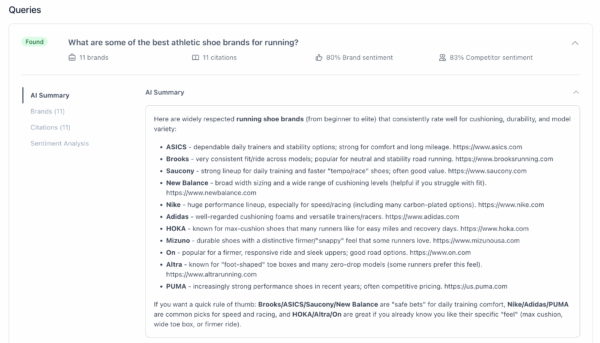
AI platforms are very good at answering specific questions such as “Is brand X reliable?” or “What is the best tool to do Y?” If your brand doesn’t appear in these answers, you’re missing out on a lot of potential customers.
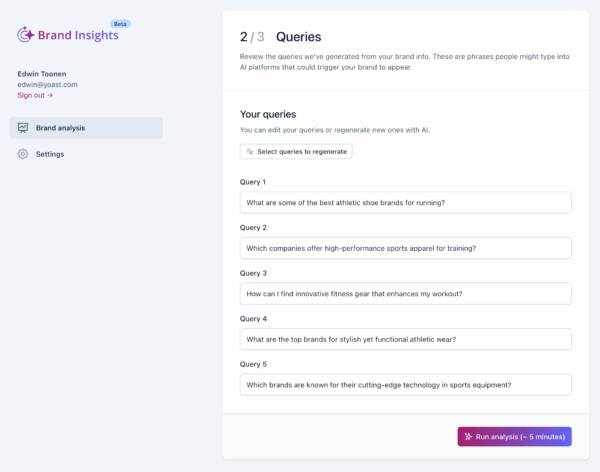
Yoast AI Brand Insights suggests questions to monitor based on your input, such as: B. “Is (your brand) good for small businesses?” Additionally, do in-depth research on frequently asked questions in your industry using tools like AnswerThePublic, AlsoAsked, or simply searching Google’s People Also Ask section.
Publish blog posts, FAQs or landing pages with the insights you have collected and directly answer these brand-related questions. Support content with properly structured data such as FAQs and how-to schemas to give AI platforms more tools to understand your content.
Track which questions are mentioned most frequently across AI platforms in Yoast AI Brand Insights. Don’t forget to keep your content updated to keep it accurate and relevant.
Track progress with the AI Visibility Index
Improving your brand’s AI visibility is not a one-time task but a recurring effort. Luckily, Yoast’s AI Visibility Index gives you an easy-to-understand metric to track your progress over time.
Run your first scan to set the starting point for your AI Visibility Index. Notice which areas, such as quotes or sentiment, are strongest and weakest.
Yoast AI Brand Insights runs weekly scans. Please review them to track progress. Check the historical view, but remember that these cannot be viewed together. Select the week before and then select this week again to see changes. Look for trends such as: B. Mood improvements or a sudden increase in citations.
If your score doesn’t improve, reconsider the strategies above, such as: B. Optimizing for quotes and improving mood. Be sure to experiment with new tactics and publish original research to attract more earned media.
How to get LLMs to mention your brand
Imagine this: A potential customer asks ChatGPT, “What is the best CRM for small businesses?” If your brand isn’t mentioned in the response, you’ve lost a customer before they even knew you existed.
LLMs like ChatGPT, Gemini, and Perplexity don’t just pull answers out of thin air. They rely on data, quotes, and patterns to generate answers. If your brand isn’t part of these patterns, it’s far less likely to be mentioned, no matter how well you rank on Google.
Publish authoritative content
LLMs look for well-structured, factually correct content. These AI platforms love sources that provide unique insights or expert opinions, so be sure to focus on those.
Start with original research. Publish surveys, case studies or industry reports with unique data. For example, “2026 State of (Your Industry) Report: Key Trends and Insights” positions your brand as an authority and gives AI platforms a reason to cite you.
Use the proven inverted pyramid structure in your content. Start with the most important information, such as key findings and conclusions, follow with supporting details, and end with background information. This makes it easier for AI to extract, digest, and use your content.
Don’t forget to optimize based on facts. Add statistics, expert quotes, and actionable insights. For example, instead of “Our tool is great for marketers,” you say, “According to our most recent case study, our tool increased conversion rates by 30% for over 500 marketers in 2025.”
For example, HubSpot built its authority by publishing ultimate guides like “The Ultimate Guide to Inbound Marketing.” These guides became go-to resources for marketers and gained backlinks from industry blogs, news sites, and even competitors. As a result, HubSpot is now frequently cited in AI answers about marketing tools.
Get featured on relevant, high-authority websites
LLMs trust reputable sources such as industry publications, news sites and review platforms. The more your brand is mentioned on these sites, the more likely it is to appear in AI responses. Please remember that relevance is crucial here. For example, if Yoast is mentioned in Gardeners’ World or Home and Garden, it will do little to nothing for our brand. Find the most important and relevant sources and focus on those.
Pitch stories to journalists or industry blogs. For example, try to get featured in “Top 10 (your industry) tools in 2026” lists.
Encourage customers to leave reviews on G2, Capterra, Trustpilot or Google Reviews. Don’t forget to respond to (negative) reviews to show commitment and transparency.
If possible, try reaching out to sites like HubSpot, Search Engine Journal, or industry-specific blogs and asking to write for them. Be sure to include a bio with your brand name to increase recognition.
Optimize for conversational requests
LLMs are designed to answer questions in natural language. This means you need to optimize your content for conversational queries. Conversational queries are things like “What is the best CRM for startups?” instead of “best CRM”.
You should use question-oriented headings in your content. For example, answer the question “Is (your brand) good for small businesses?” right in the first paragraph to make it clear and easy to understand.
LLMs often answer long-tail questions, so you should target long-tail keywords. For example, instead of “Project management tool,” you should choose “Best project management tool for remote teams in 2026.”
To support all of this, create FAQ pages with schema markup to help the AI understand your content better.
Create quotes
Build a network of high-quality mentions that build your brand’s authority. The more high-quality, relevant citations you have, the more likely LLMs are to mention your brand.
Publish assets like ultimate guides, templates, or tools that people want to reference and link to. For example, “The Ultimate Guide to (Your Industry) in 2026.”
Reach out to bloggers, journalists, and influencers to reference your content. For example: “We noticed that you mentioned (competitor) in your article. Because of this, (your brand) might be a better fit.”
Get featured in press releases, podcasts or webinars. Example: “(Your brand) announces groundbreaking feature for (industry).”
Make sure AI crawlers can reach your website
It’s important to ensure that AI crawlers can discover and index your content. If your website is invisible to them for some reason, your brand will not appear in the AI responses.
Your website should be technically sound, but you can also support LLMs in other ways. Make sure your website loads quickly and is mobile friendly. Use clean URLs, good meta tags and descriptions, and alt text for images. Additionally, use schema on your website to help AI crawlers understand what your website is about and how it all fits together.
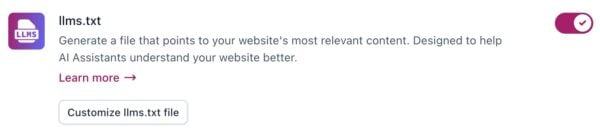
In Yoast SEO you can activate an llms.txt file. This proposed standard helps AI crawlers find your most important content. Also, check if your robots.txt file is accidentally blocking AI crawlers from accessing your content.
Be active in online communities
LLMs are trained and able to obtain information from forums, social media and community platforms such as Reddit, Quora and LinkedIn. It can improve your brand visibility on AI platforms if you participate there.
Answer questions on Quora and Reddit. Provide valuable, non-promotional answers that naturally mention your brand. For example: “As (your industry) expert, I recommend (your brand) because…”
Join discussions on Slack, Discord, or niche forums. Share insights and link to your content when necessary. Post thought leadership content on LinkedIn, Twitter or Facebook. For example: “Here’s why (your industry) is changing in 2026 and how (your brand) is leading the way.”
The future of brand visibility is AI-driven
We’ve seen AI transform the way people discover brands. There’s a simple rule: if your brand isn’t visible in AI responses, you’re missing out on an ever-growing audience.
Luckily, Yoast AI Brand Insights gives you the tools to:
- Track mentions, sentiments and quotes across all AI platforms
- Compare with competitors to identify gaps
- Optimize for high-intent searches to attract more attention
- Monitor progress with the AI Visibility Index
Additionally, we have other tips to help you optimize your content using Yoast’s AI LLM understanding tools.
Are you ready to take control of your AI brand visibility?
AI is the future of search, and brands that adapt early will win the AI visibility race. Don’t wait for your competitors to take the lead.
First, run your first scan in Yoast AI Brand Insights. Identify your pain points, implement these strategies, and watch your AI visibility grow.
Now is the time to act. So get started on your brand’s AI future today.
